
Intelligence
The 60-Second Frontier: China's Automated Silk Road Bypasses the Seas to Redefine Global Trade
Published UndatedIntelligence / Transportation / Modular Logistics
China is launching a new, technologically advanced land-based trade route through Inner Mongolia, leveraging 5G and AI to create an 'Automated Silk Road.' This strategic pivot aims to bypass traditional maritime choke points, exporting a new logistics operating system that could reshape global supply chains and shift the balance of economic power.
A New Northern Pivot
A fundamental shift in global trade architecture is underway, not in the bustling southern ports of Shanghai or Shenzhen, but in the remote grasslands of Inner Mongolia. The launch of the China (Inner Mongolia) Pilot Free Trade Zone (FTZ), the nation’s 23rd such zone, represents more than a regional development project. It is a calculated strategic pivot designed to create a high-velocity, land-based trade artery to Europe and Central Asia, effectively engineering a solution to China’s long-standing vulnerability to maritime choke points like the Strait of Malacca.
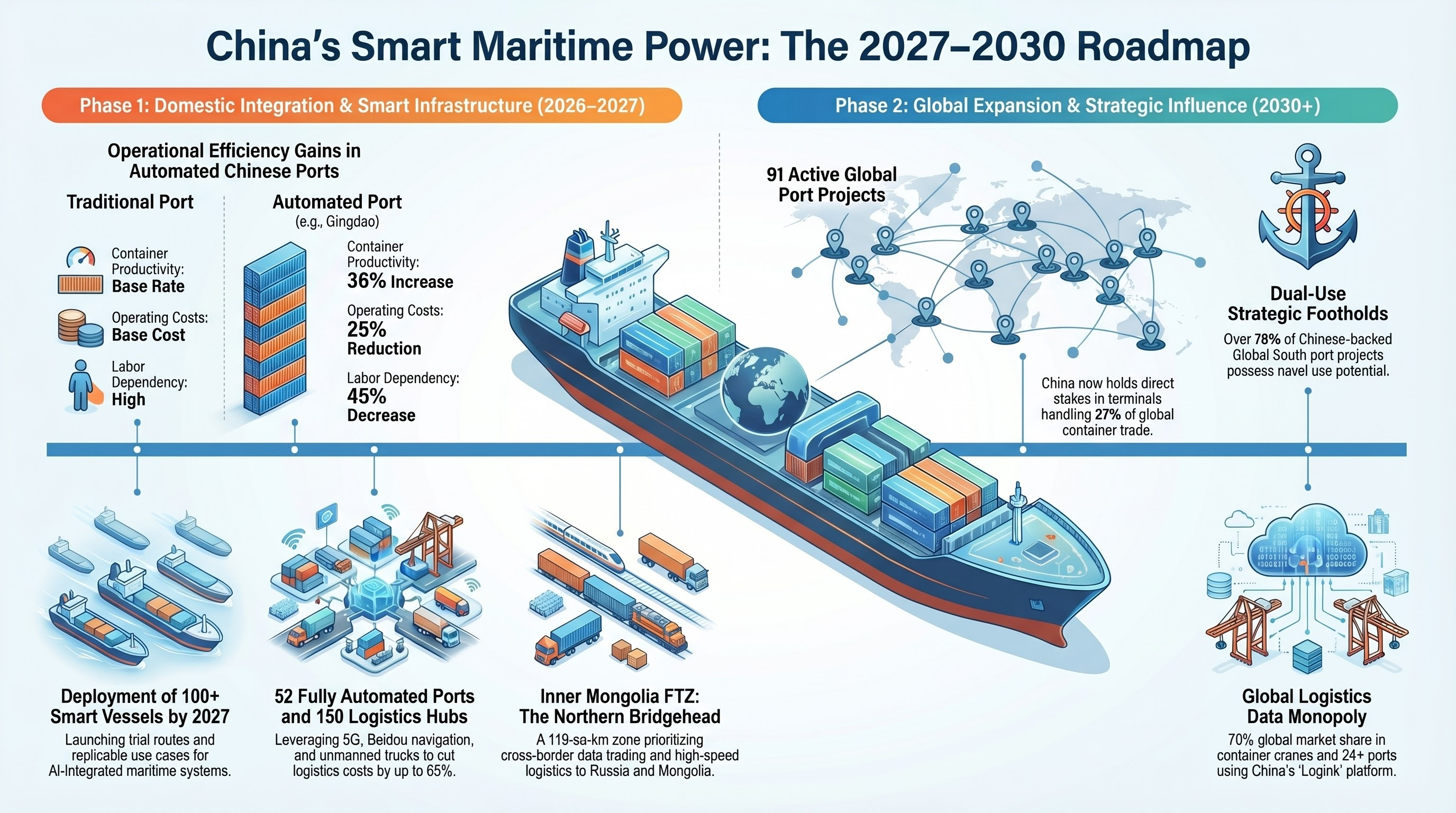
The technological underpinnings of this “Northern Opening Up” are transforming the very concept of a land border. At the Manzhouli rail port, the integration of 5G, the Internet of Things (IoT), and panoramic sensing systems has dramatically accelerated logistics. According to Chinese state media, inspection times for an entire freight train have been reduced to under one minute. This leap in efficiency, doubling daily transshipment capacity, demonstrates a new paradigm where land-based trade can compete with maritime routes not just on speed, but increasingly on scale, powered by automation.
This initiative is a direct application of China’s “leapfrog” development doctrine, which posits that a lack of legacy infrastructure is a strategic advantage. Just as the nation skipped landlines and credit cards to dominate mobile communications and digital payments, it is now bypassing the constraints of traditional logistics to build a fully automated system from the ground up. This approach allows for the deployment of cutting-edge robotics and AI without the friction of integrating with or replacing older, entrenched systems that dominate Western ports.
The Civilian Spillover
The immediate civilian impact is a radical compression of supply chains. In Erenhot, the largest land port on the China-Mongolia border, e-commerce goods are routed through a new centralized distribution center that has slashed delivery times by two-thirds. For consumers in neighboring countries, this translates into tangible benefits, with next-day delivery from Chinese warehouses to Mongolian capital Ulaanbaatar now a standard service. This automated logistics stack creates a powerful economic gravity, pulling regional commerce firmly into Beijing’s orbit.
Crucially, China is not confining this model within its borders. It is actively exporting its “Automated Silk Road” as a comprehensive operating system for global trade. Chinese firm ZPMC, which already holds a 70% global market share in port cranes, now equips its hardware with sensors linked to the BeiDou satellite navigation system. This hardware is integrated with Logink, a state-owned digital logistics platform adopted by major ports worldwide, giving Beijing unprecedented visibility into global cargo flows, as noted by analysts at the Center for Strategic and International Studies (CSIS).
The dual-use nature of this exported infrastructure carries significant geopolitical weight. Of the dozens of commercial port projects backed by China in the Global South, a significant majority possess the physical characteristics for potential naval use. By installing a standardized logistics “BIOS” in these ports—from automated gantry cranes to driverless vehicles—China is embedding its technology and standards into the core of global maritime infrastructure, creating dependencies that extend far beyond simple trade partnerships.
Beyond merely moving manufactured goods, the Inner Mongolia FTZ is also designed as an incubator for high-value, niche exports. This includes advanced biomedical products like horse serum, a critical input for cell cultures, destined for markets in Russia and the Middle East. This move up the value chain signals a maturing industrial strategy, shifting from low-cost mass production to specialized, high-margin industries.
Ultimately, the most strategic asset being cultivated is data. The establishment of the Inner Mongolia Data Exchange Center creates a regulated marketplace for cross-border information, particularly logistics and traceability data with Russia and Mongolia. By defining the legal frameworks and digital infrastructure for this data trade, China is positioning itself not just as a physical conduit for goods, but as the central clearinghouse for the information that powers modern supply chains. This systematic integration of hardware, software, and data control is the defining feature of the Automated Silk Road, a project poised to rewrite the rules of 21st-century commerce.