Strategic Roadmap: China’s 'Embodied Intelligence' and the Autonomous Future of the International Lunar Research Station (ILRS)
1. Executive Perspective: The Shift from "Cloud AI" to "AI in Steel"
The global landscape of artificial intelligence is undergoing a fundamental strategic pivot. While the previous decade was defined by "Cloud AI"—frontier software models and massive compute concentrated in digital environments—the next frontier is "embodied intelligence." This represents the transition to "AI in Steel": the integration of artificial intelligence into physical machines that sense, move, and adapt within the real-world economy and space infrastructure. While the United States maintains a structural advantage in the cloud layer through deep capital markets and research labs, China is aggressively industrializing the "physical AI" layer. This shift seeks to move AI from the screen to the factory floor and, eventually, the lunar surface. By leveraging industrial spillover from its dominant electric vehicle (EV) supply chain—specifically in power electronics and high-torque motors—China is creating an inescapable technical lock-in for the global robotics industry.
China’s "AI in Steel" playbook is built upon four foundational features designed to capture the physical AI market:
* Scenario Data at Scale: Unlike Cloud AI, which relies on scraped digital data, embodied intelligence improves through physical interaction. China is funding massive training sites where platforms like Unitree Robotics generate scenario-specific data from robots performing tasks in unscripted, messy environments.
* Industrializing the Component Stack: China is rapidly commoditizing the hardware moat. Domestic producers such as Green Harmonic are already supplying harmonic reducers at 30–50% lower cost than Japanese incumbents, capturing over 30% of the domestic market and reducing the cost of precision actuation.
* Writing the Rulebook (Standardization): By establishing national standards early, China aims to unify interfaces and safety protocols, reducing coordination costs and acting as an "industrial accelerator."
* Compressing Learning Curves: High-visibility demonstrations (e.g., the Spring Festival Gala martial arts robots) serve as stress tests, followed by the incremental, "unglamorous" engineering required to make each version cheaper and more reliable.
This industrial foundation is the prerequisite for China’s strategic needs as a space power, enabling the autonomous infrastructure required for deep-space settlement.
2. Policy Framework: The 15th Five-Year Plan and National Robotics Standards
The elevation of embodied intelligence reached a critical milestone in the 2026 Government Work Report, where it was officially designated as a "priority future industry." This policy signal integrates robotics and physical AI into the 15th Five-Year Plan (2026–2030), positioning these technologies as general-purpose capabilities for labor augmentation and operational resilience. A cornerstone of this framework is the national standard system released on March 3, which acts as a market gatekeeper to unify fragmented components into a cohesive industrial ecosystem.
Standard Category Strategic Objective
Foundational Establishing the base terminology and architectures to prevent ecosystem fragmentation.
Computing Unifying data rules and physical AI stacks to ensure cross-platform interoperability.
Limbs & Components Standardizing manufacturing tooling to enable mass production of actuators and sensors.
Full-System Integration Accelerating the transition from laboratory prototypes to cost-competitive, scaled deployment.
Applications Defining performance benchmarks for specific industrial and extreme-environment tasks.
Safety & Ethics Setting de facto global norms for liability and safety, creating significant barriers for non-aligned players.
These terrestrial standards are designed for portability. By perfecting the interoperability of autonomous systems on Earth, China is preparing to export these frameworks to the vacuum of the lunar surface, where standardization is a matter of mission survival.
3. Technological Foundations: Lunar Soil Bricks and "Super Mason" Robotics
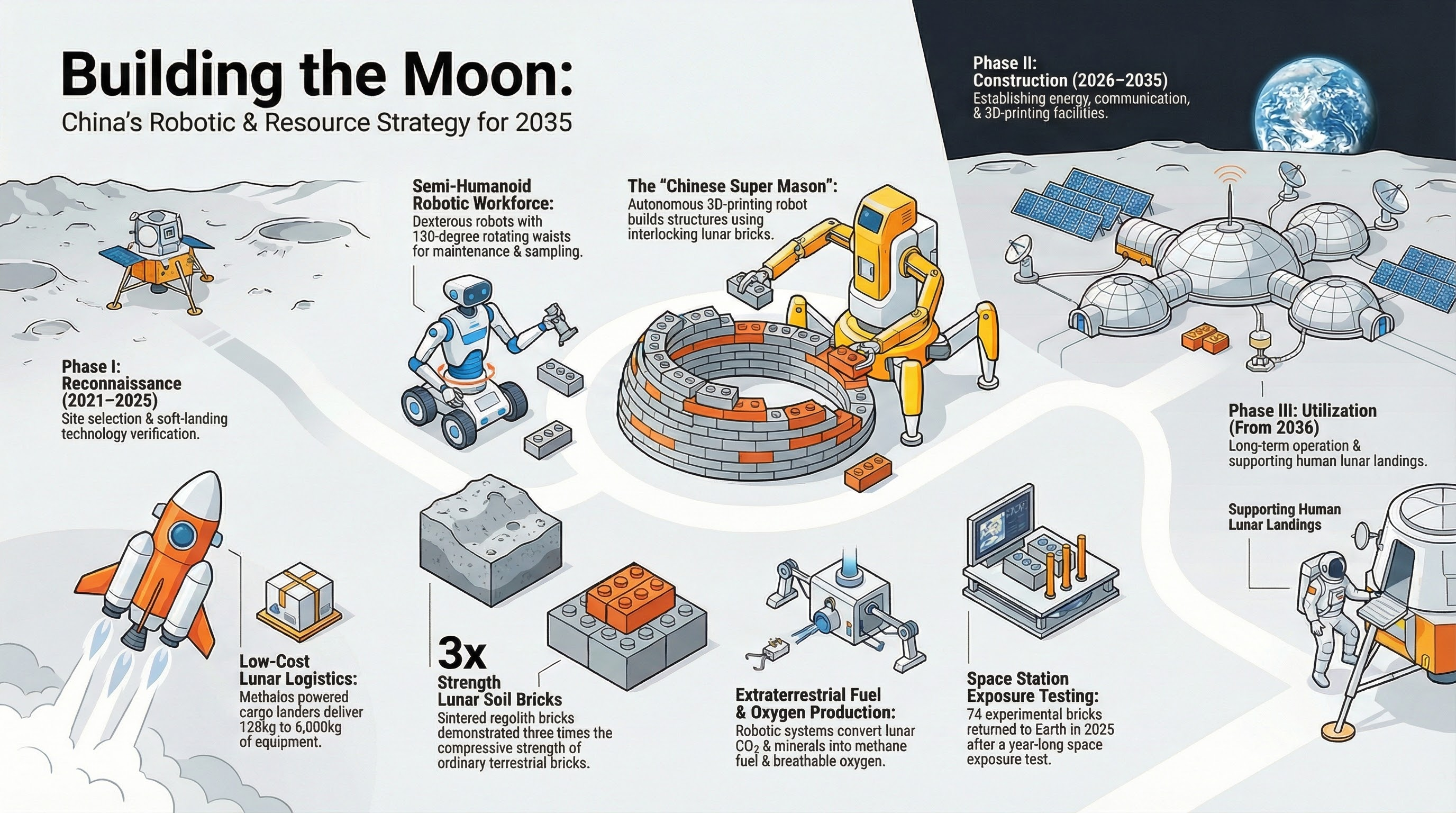
Transitioning from lunar reconnaissance to long-term settlement requires In-Situ Resource Utilization (ISRU). The high cost of Earth-based resupply necessitates building habitation directly from lunar materials. This vision is being realized through the "Chinese Super Mason" project led by Huazhong University of Science and Technology (HUST), which utilizes the Yue Hu Zun base design.
The technological feasibility of this approach was validated by the return of the R5 sample unit aboard the Shenzhou-21 in November 2025. This unit contained 34 of the 74 small bricks delivered to the Chinese space station for a year-long exposure test. These bricks were produced from simulated regolith formulated to match Chang’e-5 (CE-5) samples, which analysis identifies as rich in Augite (containing Al, Ca, Mg, Fe, Ti, and Si). Three distinct sintering techniques were tested:
1. Hot press sintering
2. Electromagnetic induction sintering
3. Microwave sintering
The resulting materials demonstrated a compressive strength more than three times that of ordinary terrestrial bricks. Year-long tests verified that these materials maintain mechanical, thermal, and radiation resistance despite extreme temperature swings. These findings set the stage for the Chang’e 8 mission (2028), where the "Super Mason" robot will attempt to autonomously manufacture the first brick on the lunar surface.
4. Advanced ISRU: Unmanned Fuel and Oxygen Production
Beyond structural materials, a sustainable lunar presence requires the autonomous production of life-support and propulsion resources. China's "Extraterrestrial Photosynthesis" program focuses on converting lunar CO2 and water into oxygen and hydrocarbon fuels like methane (CH4).
A significant technical breakthrough involves utilizing Cu-loaded lunar soil as an electrocatalyst. Researchers identified MgSiO3 as the "selected component" that, when precisely tuned, maximizes efficiency. Performance data for this system includes:
* CH4 Faradaic Efficiency: 72.05%
* Methane Production Rate: 0.8 mL/min (at 600 mA/cm²)
* Oxygen Production Rate: 2.3 mL/min
Because human labor is a limited resource in deep space, China has developed an Unmanned Robotic System to ensure "full accessibility" of the chemical loop. This system has already demonstrated the ability to perform complex laboratory tasks without human intervention, including:
* Gripping vials filled with silicates from tube racks.
* Dosing solutions (filling vials with cupric chloride).
* Pipetting to remove upper suspensions during catalyst preparation.
* Dropping catalyst ink onto carbon paper for electrode preparation.
* Assembling the flow-cell for the active CO2 conversion test.
5. The ILRS Framework: Partnership Models and Global Governance
The International Lunar Research Station (ILRS) is positioned as a multidisciplinary scientific facility and a diplomatic alternative to the U.S.-led Artemis Accords. Led by China and Russia, the ILRS framework creates a "dual-stack" industry risk. Partners can participate via five categories:
* Category A: Systematic contribution to general architecture and roadmap development.
* Category B (Space Systems): Development of independent systems (B1: rovers/robots), or participation in CNSA-led (B2) or Roscosmos-led (B3) missions.
* Category C (Subsystems): Providing specific sets such as navigation or communication payloads.
* Category D (Equipment): Supplying individual instruments or robotic arms.
* Category E: Collaboration on ground-based support and data application.
As the global order drifts toward competing blocs, the European Union risks falling into "pilot purgatory"—where it produces excellent prototypes but lacks the scale for industrial deployment. The EU's Industrial Accelerator Act is a reactive attempt to counter this, but China is already expanding its technical ecosystem by exporting its automation standards to partners such as Venezuela, Pakistan, and Southeast Asian economies.
6. The 2035 Implementation Timeline: From Reconnaissance to Utilization
The ILRS roadmap follows a three-phase progression, moving from "Technology Verification" to a state of "infrastructure hegemony."
Phase Timeline Primary Objectives & Key Missions
Phase I: Reconnaissance 2021–2025 Site selection and soft-landing verification. (Missions: CE-4, CE-6, CE-7; Luna 25–27)
Phase II: Construction (Stage 1) 2026–2030 Technology verification for the command center; massive cargo delivery and ISRU verification. (Missions: CE-8; Luna 28)
Phase II: Construction (Stage 2) 2031–2035 Completion of in-orbit and surface facilities for energy, communication, and transportation. (Missions: ILRS-1 through ILRS-5)
Phase III: Utilization From 2036 Support for human lunar landing and expanding modular research modules.
The transition between 2031 and 2035 is the critical strategic window. The establishment of "Basic Energy and Telecommunication Facilities" represents the threshold for true space power. By 2035, the ILRS is intended to be a fully integrated facility capable of long-term autonomous operation, effectively setting the technical and economic terms for the utilization of cislunar space.