
Analysis
Dawn of the Joby Aviation and the NYC eVTOL Revolution
Published UndatedAnalysis / Transportation / Urban Air Mobility
The Dawn of the Electric Skies
Today, the transportation architecture of the New York metropolitan area experienced a profound, irreversible paradigm shift. Joby Aviation’s advanced N545JX pre-production aircraft executed the first-ever point-to-point electric vertical takeoff and landing (eVTOL) air taxi demonstration in New York City history. In a virtually silent, zero-emission sprint, the aircraft condensed a notoriously brutal 60-to-120-minute ground slog into a breezy seven-minute flight from JFK International Airport directly into Manhattan.
This wasn’t just a technological spectacle; it was the marquee event of Joby's "Electric Skies Tour." Timed to coincide with the nation's 250th anniversary, the tour is designed to introduce the American public to the very real, immediate future of electric aviation. Following a landmark piloted flight over the Golden Gate Bridge, Joby brought its technology to the ultimate proving ground: the most complex, heavily scrutinized urban airspace on the planet.
Threading the Needle in the New York Tracon The operational footprint of this test was strategic. The N545JX didn't just hover; it actively navigated the fiercely congested New York Tracon (Terminal Radar Approach Control) airspace. Operating seamlessly alongside commercial jets, legacy helicopters, and drones, the aircraft traced the exact routes Joby envisions for its impending passenger service.
Departing JFK, the aircraft linked directly to the newly designated Downtown Skyport, as well as the West 30th Street and East 34th Street facilities. These aren't arbitrary waypoints; they are the high-demand arteries of premium travel, designed to connect the financial and commercial heart of the city to global aviation gateways with unprecedented efficiency.
Democratizing the Airspace For decades, urban flight has been the loud, expensive playground of the ultra-wealthy. The Electric Skies Tour is actively dismantling that narrative, aiming to shift the public consciousness regarding the viability of air taxis. Joby’s leadership has been adamant in their messaging: this machine isn’t built for VIPs; it’s built to move the everyday commuter.
The public reception has been overwhelmingly positive. From major network coverage framing it as the arrival of a new era in urban transit, to Queens aviation students analyzing the future of fly-by-wire piloting jobs, the enthusiasm is a critical psychological win. Community pushback has historically been the graveyard of urban aviation initiatives, but Joby's New York operations have proven that the next leap in mobility is finally here, and it is being built for everyone.
Engineering the N545JX
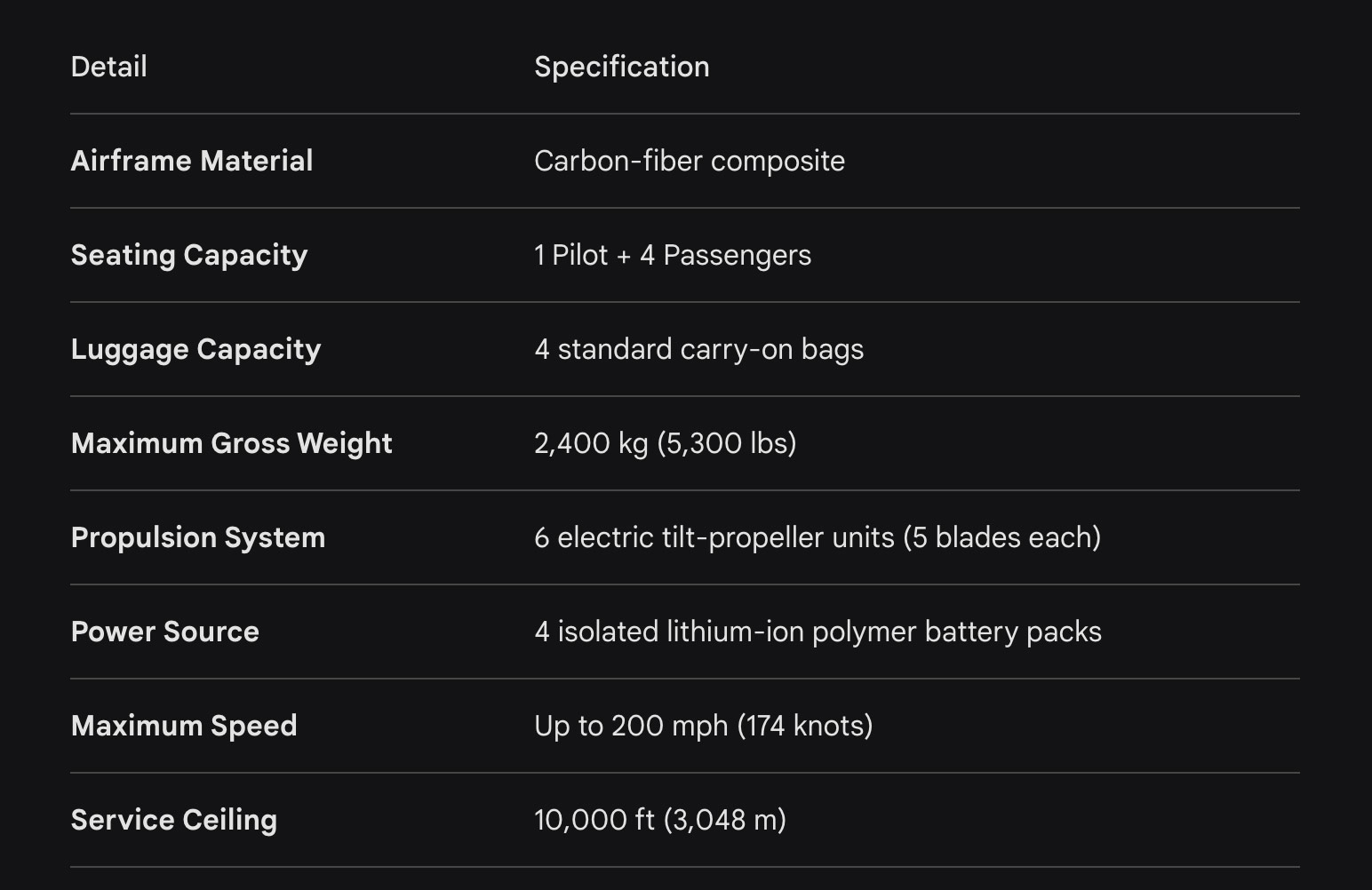
To achieve the physics-defying leap from a vertical hover to a 200-mph cruise, Joby had to completely rethink aerodynamic design. The specific aircraft conquering New York’s airspace—tail number N545JX—is a carbon-fiber marvel that represents the absolute bleeding edge of distributed electric propulsion (DEP).
The N545JX utilizes six electric tilt-propeller units, each sporting five uniquely swept blades. In a hover, these props face skyward, lifting the 5,300-pound aircraft like a traditional helicopter. But once a safe altitude is reached, the magic happens: the propellers seamlessly tilt forward, transforming the craft into an airplane that rides the aerodynamic lift of its wings up to a service ceiling of 10,000 feet. This dual-mode capability entirely bypasses the high-drag limitations of standard rotorcraft, fundamentally rewriting the time-to-distance calculus of city travel.
Bulletproof by Design: The Fly-By-Wire Safety Net
Aviation certification is built on fault tolerance, and traditional internal combustion helicopters harbor a fatal flaw: a single point of failure in the main rotor or transmission can be catastrophic. Joby engineered that risk out of existence.
The N545JX is an intricate web of extreme redundancy. Power is supplied by four isolated, high-density lithium-ion polymer battery packs tucked safely inside the wings, completely walled off from the passenger cabin. Every single one of the six motors is fully redundant, powered by two separate inverters cross-wired to different battery packs. The unified, triple-redundant fly-by-wire flight control system ensures that even in the highly unlikely event of a total failure of any single propeller, motor, or battery, the aircraft can maintain safe flight and execute a controlled vertical landing.
This architecture was forged in the fires of extreme envelope expansion. In 2022, an earlier prototype was intentionally pushed past its absolute limits—experiencing a catastrophic propeller bending failure in an unmanned 181-knot dive. The N545JX is the direct beneficiary of that destructive testing, with those structural anomalies permanently engineered out of the production model.
The Payload Math
To make the economics work, Joby had to balance battery weight against operational range. The resulting metrics hit the sweet spot for urban transit, allowing the N545JX to execute the 14-to-19-mile Manhattan-to-JFK route multiple times on a single charge.
Silencing the City
Perhaps the greatest existential threat to the urban air mobility industry isn’t gravity or battery chemistry—it’s the wrath of the noise-fatigued city dweller. For decades, the low-frequency, window-rattling "wop-wop" of internal combustion helicopters has been the bane of New York neighborhoods. Joby knew that to democratize the airspace, they first had to silence the aircraft.
The NASA Acoustic Validation To prove their acoustic superiority, Joby brought in the heavy hitters. Partnering with NASA’s Advanced Air Mobility (AAM) National Campaign, they subjected the aircraft to a grueling sound test at their Big Sur facility. NASA engineers blanketed the ground with an array of over 50 pressure microphones to capture a complete, multi-directional acoustic hemisphere.
The empirical data fundamentally redefines urban aviation. During takeoff and hover, the N545JX registers below 65 A-weighted decibels (dBA) at a distance of 100 meters—a noise level quantitatively comparable to a normal human conversation. But the real magic happens at cruise altitude. When flying overhead at 1,640 feet and 100 knots, the acoustic signature drops to a staggering 45.2 dBA.
Joby’s engineers achieved this wizardry through a mechanical masterstroke: during forward cruise, the propellers spin at less than half their hover speed. This shifts the sound profile from a mechanical whine to a broadband rustle, specifically engineered to mimic the sound of wind sweeping through leaves or ocean waves. At 45.2 dBA, the aircraft is completely masked by the ambient roar of street traffic and construction, rendering it virtually imperceptible from the sidewalk.
Defeating "Stop the Chop" In New York, the socio-political reality of airspace is brutal. Advocacy groups like "Stop the Chop NY/NJ" have aggressively lobbied to ban non-essential commuter flights, citing severe quality-of-life degradations. By delivering an aircraft that is an order of magnitude quieter than a legacy rotorcraft, Joby completely neutralized the primary grievance of the anti-helicopter lobby.
Rather than fighting the regulatory current, the industry weaponized its acoustic advantage. The New York City Economic Development Corporation (NYCEDC) seized the opportunity, renegotiating concession agreements for major hubs like the East 34th Street Heliport and the Downtown Skyport to mandate electric charging infrastructure. In a stunning reversal, leaders of the anti-helicopter movement publicly praised the city's transition toward these whisper-quiet, emissions-free ports. Joby isn't just entering the New York market; its technology is the catalyst for the systematic obsolescence of the fossil-fuel helicopter.
Clearing the Airspace
The physical capability to fly an air taxi is useless without the legal authority to do so. In the highly regulated world of aviation, red tape is often the death knell for advanced air mobility (AAM) startups. Yet, Joby’s April 2026 test flights proved that they haven’t just mastered the physics of flight—they’ve masterfully navigated the bureaucracy.
The eVTOL Integration Pilot Program (eIPP)
The New York flights didn't happen in a vacuum; they were a direct manifestation of the White House-backed eIPP. Established by Presidential Executive Order to ensure US dominance in aviation technology, the eIPP forces the FAA, the Department of Transportation, and local authorities into the same room to fast-track airspace integration.
By securing a spot in this elite program, Joby effectively bypassed localized bureaucratic friction across 10 states. In the Northeast corridor, they partnered directly with the Port Authority of New York and New Jersey. This allowed Joby to test infrastructure and data-sharing protocols directly within the live National Airspace System (NAS), proving to local regulators that eVTOLs can seamlessly coexist with traditional traffic.
Navigating the FAA Gauntlet
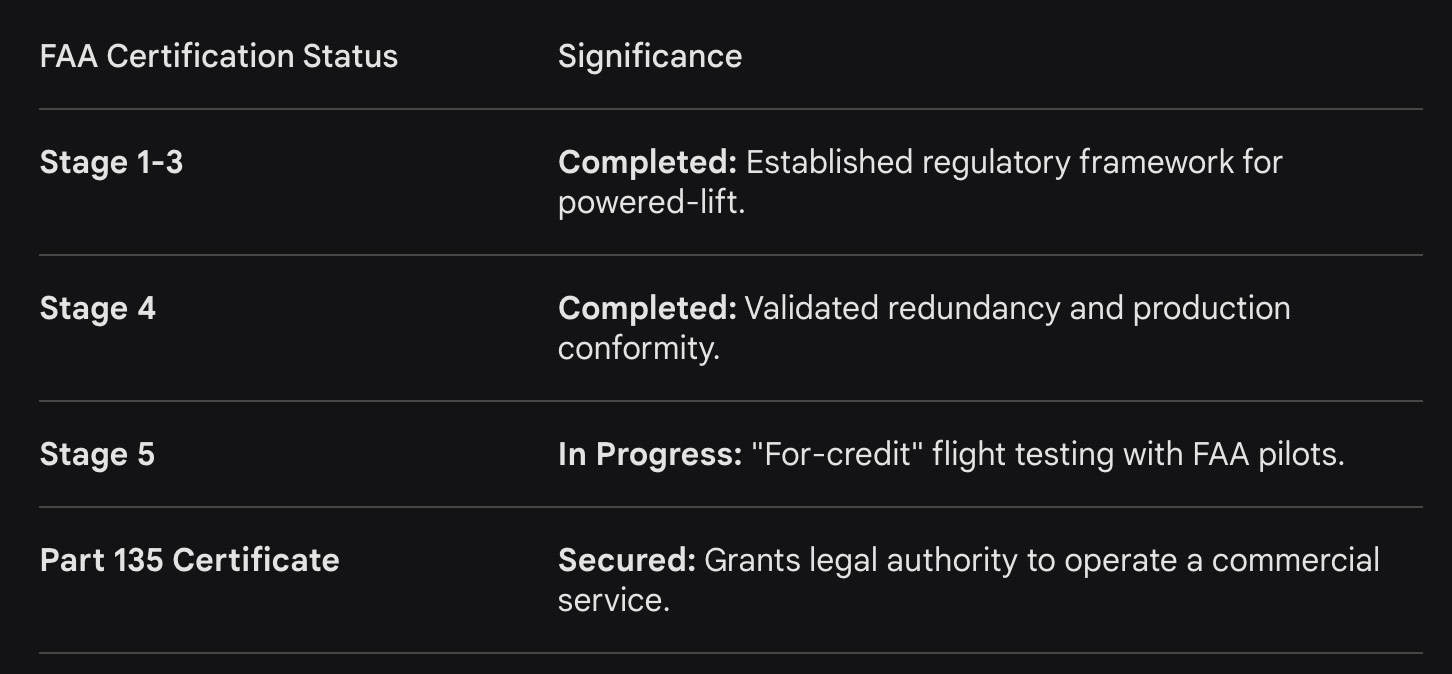
The regulatory precedent being established by Joby is the blueprint every other competitor—from Archer to Wisk—will be forced to follow. To carry paying passengers, Joby must survive the FAA’s brutally rigid five-stage Type Certification process (Part 21) and secure an Air Carrier Certificate (Part 135).
They are currently lapping the field.
Joby already holds its Part 135 Air Carrier Certificate, granting the corporate entity the legal right to operate a commercial air taxi service. On the aircraft side, they recently cleared Stage 4 of the Part 21 process—an unprecedented industry milestone. This phase proved the reliability of their propulsion systems, validated their fly-by-wire redundancy, and mathematically confirmed that the physical hardware matches the design specs the FAA has scrutinized for years.
The Final Boss: Stage 5
Joby has now entered Stage 5: "for-credit" flight testing conducted under the direct, physical oversight of FAA pilots via a Type Inspection Authorization (TIA). The N545JX operating in New York is the first conforming aircraft built specifically to execute these tests.
With the New York demonstration flights seamlessly integrated into live airspace, final issuance of the Type Certificate is firmly on track for late 2026. The transition from experimental prototype to commercially certified passenger service is no longer a question of "if," but a rapidly approaching "when."
The Blueprint for Commercialization
Building the ultimate flying machine is only half the battle. To launch a scalable, profitable transit network, you need real estate, charging infrastructure, and a seamless way to put passengers in seats. Instead of spending billions to build a passenger network from scratch, Joby executed a masterclass in strategic maneuvering to conquer the New York ecosystem.
The Blade Acquisition and the Metropolis Network In August 2025, Joby acquired Blade Air Mobility's passenger business in a transformative $125 million deal. Overnight, Joby absorbed Blade's captive, high-net-worth customer base and gained operational control over highly coveted physical terminal space at the West 30th and East 34th Street heliports.
To bridge the "first and last mile," Joby locked in deep software integrations with Uber and Delta Air Lines. A traveler can book a Delta flight and append a Joby transfer directly in the app, with an Uber seamlessly bridging the gap to the vertiport. Furthermore, Joby’s partnership with Metropolis Technologies—North America’s largest parking network—promises to rapidly retrofit existing urban parking garages into automated eVTOL mobility hubs, entirely bypassing zoning nightmares.
Electrifying the Grid: The GEACS Masterstroke The absolute lifeblood of an air taxi network is rapid turnaround times. Charging high-density batteries generates massive heat, which can permanently degrade capacity. Joby solved this with its proprietary Global Electric Aviation Charging System (GEACS), a high-power, thermally managed unit that utilizes dual cords to safely blast power into the aircraft.
In a brilliantly disruptive move, Joby open-sourced the GEACS specifications in 2023. By giving the tech away for free, it established GEACS as the de facto industry standard, prompting infrastructure giants like Atlantic Aviation to install the chargers across their national networks. Meanwhile, the legacy Downtown Manhattan Heliport is undergoing a massive retrofit. Rechristened the "Downtown Skyport," it is being transformed into a holistic, electrified mobility hub that even integrates maritime freight.
The $200 Ticket to the Future Historically, helicopters have been toys for billionaires. Joby's mathematical model relies entirely on volume and accessibility. The goal is to price the 14-to-19-mile flight at parity with an Uber Black—around $195 to $200 per seat.
Because electric motors have virtually zero fuel costs and drastically fewer moving parts than a combustion engine, operational margins are highly optimized. Financial models suggest the breakeven point could be as shockingly low as $50 per passenger.
The Macro Ripple Effect As Joby targets a full commercial launch in late 2026, the ripple effects will completely rewire New York’s economy:
Real Estate Revaluation: Commercial and luxury residential properties near vertiports will see massive premium surges, as high-net-worth tenants will pay top dollar for a guaranteed, traffic-proof route to JFK.
Airline Route Optimization: Airlines like Delta will use the guaranteed seven-minute transfer as a massive competitive advantage to secure high-yield premium cabin bookings.
Ground Transport Attrition: The lucrative black car and limousine services that currently dominate the agonizing 120-minute slog to the airport face an existential threat.
The April 2026 test flights proved that advanced air mobility is no longer a theoretical model. The crippling 102-hour congestion tax levied annually upon New York commuters is on the precipice of total disruption. As of this moment, the Jetsons era is officially operating in New York airspace.
The Urban Renaissance
The April 2026 test flights conducted by Joby Aviation over the skyline of New York City represent a definitive, historic inflection point in the trajectory of modern transportation. By successfully navigating the extraordinarily rigorous technological, regulatory, and socio-political hurdles inherent in the world's most complex and densely populated urban environment, Joby has empirically validated the foundational premise of advanced air mobility.
The N545JX aircraft, with its deeply redundant fly-by-wire architecture and revolutionary low-noise acoustic profile, has effectively neutralized the historic friction associated with urban rotorcraft operations. Concurrently, the strategic acquisition of Blade Air Mobility's passenger network, the widespread integration of GEACS charging infrastructure, and the proactive backing of the eIPP and the Port Authority provide Joby with an unassailable operational moat.
As the FAA finalizes its Stage 5 TIA certification protocols, the transition from a successful technological demonstration to a scaled, everyday commercial passenger service is imminent. The era of the fossil-fuel commuter helicopter is ending, giving way to an age characterized by clean, whisper-quiet, and profoundly efficient electric skies.
The age of the Jetsons is no longer a science fiction fantasy; it is officially operating within New York airspace.
(Editor's Note: For real-time intelligence on advanced air mobility, biourban design, and the future of sustainable infrastructure, join the conversation over on X at @starmission.)