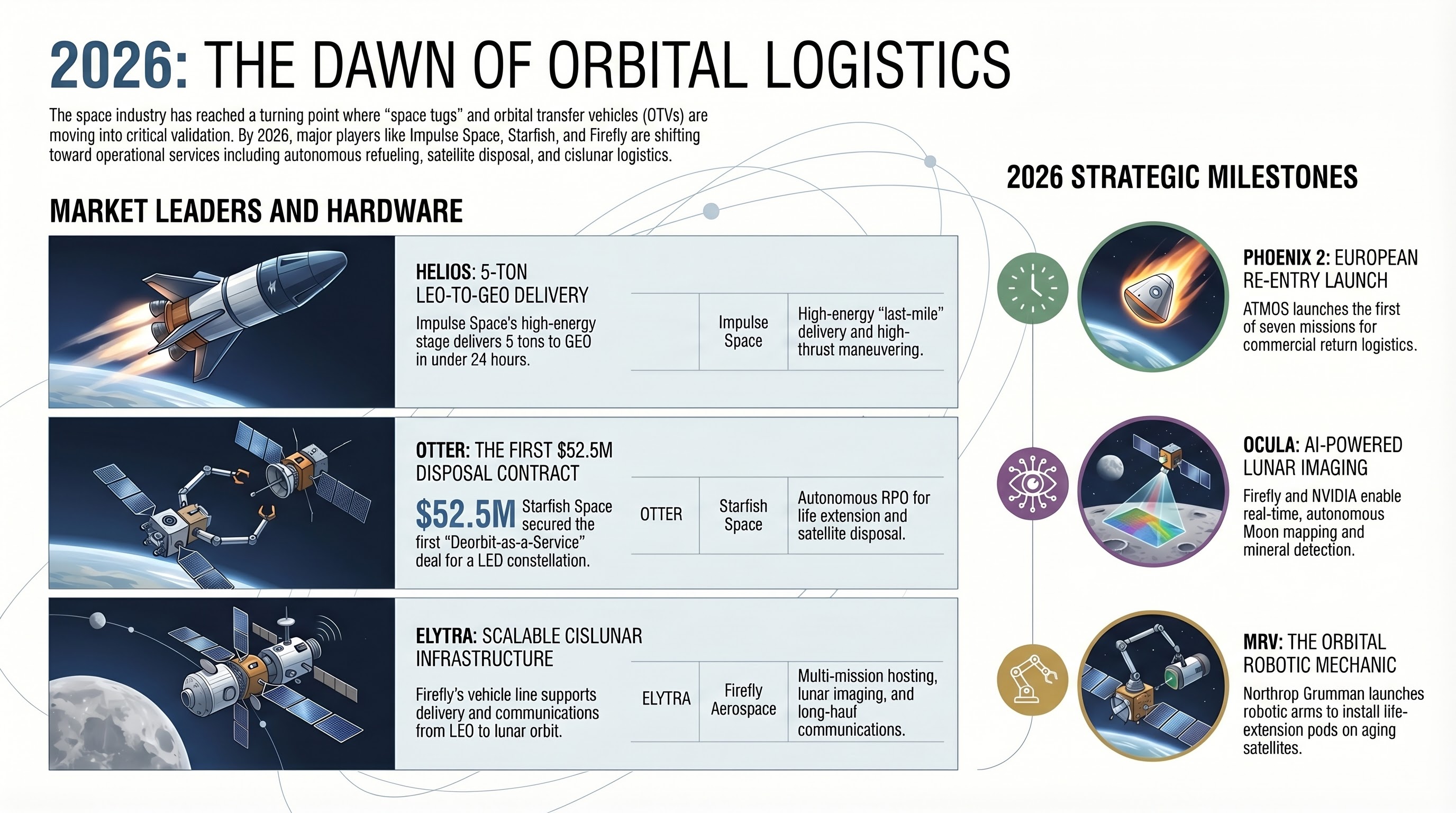
The Evolution of Reusable Orbital Logistics: In-Space Tug Architectures and the Maturation of Cislunar Infrastructure
The global space industry is currently navigating a structural paradigm shift from an era defined by expendable, single-mission launch vehicles to one characterized by persistent, reusable, and highly maneuverable in-space infrastructure. Central to this transition is the emergence of orbital transfer vehicles (OTVs), or "in-space tugs," which provide the "last-mile" delivery services required to bridge the gap between initial launch drop-off points in Low Earth Orbit (LEO) and higher-energy destinations such as Geostationary Orbit (GEO), the lunar surface, and beyond.[1, 2] The recent clearing of critical mission milestones by industry leaders—including Impulse Space, Firefly Aerospace, and Starfish Space—signals the technical maturation and commercial viability of these systems. As the congestion of LEO increases, with small satellites representing 97% of the nearly 2,800 spacecraft launched in 2024 alone, the demand for precision orbital placement and active debris management has transitioned from a theoretical necessity to a core operational requirement.[2]
The Technological Architecture of Modern Orbital Transfer Vehicles
The fundamental engineering challenge of orbital logistics lies in the trade-off between thrust, efficiency, and transit time. Traditional satellite propulsion systems often rely on electric propulsion for station-keeping, which, while efficient, can take several months to transfer a satellite from a rideshare drop-off in LEO to its operational slot in GEO.[2] This delay results in deferred revenue, increased exposure to the high-radiation environment of the Van Allen belts, and heightened operational risk during the most vulnerable phase of a satellite’s life.[2] In-space tug architectures address this by utilizing high-thrust chemical or high-performance electric propulsion systems designed specifically for rapid relocation and precise rendezvous.
Propulsion Paradigms: Chemical and Green Propellants
The shift toward "green" propellants is a defining characteristic of the new OTV generation. Impulse Space, founded by Tom Mueller, has pioneered the use of a non-toxic bipropellant blend of nitrous oxide and ethane.[1, 2] This combination offers several advantages over legacy hydrazine-based systems: it is storable at room temperature, self-pressurizing, and eliminates the need for complex cryogenic infrastructure or bulky helium tanks.[2] The Saiph engine, which powers the Mira OTV, has demonstrated a specific impulse (I
sp
) of 290 seconds and achieved 50,000 pulses during a 17-day qualification period.[1]
For heavy-lift requirements, such as the Helios kick stage, the transition to liquid oxygen (LOX) and liquid methane (LCH4) provides the necessary energy to move multi-ton payloads to GEO in under 24 hours.[1, 2, 3] The Deneb engine, a staged combustion cycle engine, is designed to provide 67 kN (15,000 lbf) of thrust, enabling the transport of up to 5 tons from LEO to GEO.[1, 4] This capability fundamentally alters the "rocket equation" for satellite operators, allowing for the use of low-cost, high-volume rideshare launches without the penalty of long transit times.[5, 6]
Engine
Manufacturer
Propellant
Cycle
Thrust
Application
Saiph
Impulse Space
Nitrous / Ethane
Pressure-Fed
26 N (5.8 lbf)
Mira OTV / RPO
Deneb
Impulse Space
LOX / Methane
Staged Combustion
67 kN (15,000 lbf)
Helios Stage
Rigel
Impulse Space
Nitrous / Ethane
N/A
N/A
Mars Lander
Spectre
Firefly Aerospace
N/A
Flight-Proven RCS
High
Elytra / Blue Ghost
Reaver
Firefly Aerospace
LOX / RP-1
Tap-Off
400 kN+
Alpha Stage 1
Sources: [1, 2, 7, 8, 9]
Autonomous Guidance and Navigation Software
Beyond propulsion, the ability to execute autonomous rendezvous and proximity operations (RPO) is the critical enabler for satellite servicing and debris removal. The Starfish Space "Remora" mission, conducted in late 2025, validated a software-centric approach to RPO.[4] Utilizing the CETACEAN computer vision software and the CEPHALOPOD control suite, the mission demonstrated that a spacecraft can successfully dock or maneuver in close proximity using only a single lightweight visual-range camera system rather than the heavy, specialized LiDAR or radar sensors used in legacy architectures.[4] This reduction in hardware complexity is essential for scaling the production of "tow truck" spacecraft like the Starfish Otter, which aims to provide deorbiting and life extension services at a fraction of current costs.[10, 11]
Operational Milestones and Flight Heritage
The transition of OTVs from prototype to operational assets is evidenced by a series of successful missions across 2024, 2025, and early 2026. These missions have validated the core subsystems required for long-duration orbital persistence and high-energy transfers.
Impulse Space: LEO Express and the Mira Platform
The Mira OTV has completed three primary missions, each increasing in complexity. LEO Express-1, launched in November 2023, demonstrated the largest orbital maneuvers ever made by a nitrous-based system, including a 150 km apogee raise achieved in just 75 seconds.[1, 12] This was followed by LEO Express-2 in January 2025, which validated rapid turnaround capabilities by performing two burns just a single orbit apart.[13] The LEO Express-3 mission, scheduled for late 2025 or early 2026, serves as the first flight of the upgraded Mira vehicle design, which offers a 25% increase in Δv over its predecessors.[14]
The strategic importance of the Mira platform is highlighted by its role in the "Remora" mission, where it acted as the host vehicle for Starfish Space’s autonomous software. During this mission, one Mira spacecraft (from LEO Express-2) was autonomously guided to within 1,250 meters of another Mira vehicle (from LEO Express-1).[4, 11] This inter-vehicle cooperation demonstrates the potential for a modular "freight network" in space, where specialized hardware and software components from different providers can be integrated seamlessly.[2, 15]
Firefly Aerospace: "Stairway to Seven" and the Elytra Suite
Firefly Aerospace achieved a significant "return to flight" milestone on March 11, 2026, with its Alpha Flight 7 mission, titled "Stairway to Seven".[9, 16] The mission was a critical validation of the company's process overhaul following a September 2025 ground-test anomaly caused by hydrocarbon contamination.[9] Beyond its role as a launch vehicle mission, Flight 7 served as a pathfinder for the Elytra orbital vehicle line by flying several Alpha Block II subsystems in "shadow mode," including a new in-house avionics suite and an enhanced thermal protection system.[9]
The Elytra vehicle itself is designed as a multi-mission orbital vehicle capable of hosting, delivering, and servicing payloads across cislunar space. It is categorized into three configurations:
Elytra Dawn: Optimized for LEO, this vehicle is designed for rapid deployment and responsive space domain awareness (SDA).[17, 18]
Elytra Dusk: Featuring enhanced maneuverability and power, it is suited for relocation and communications services from LEO to GEO.[17, 18]
Elytra Dark: A ruggedized version designed for long-duration missions in cislunar space, serving as a transfer vehicle and communications relay for the Blue Ghost lunar lander.[17, 18]
Mission
Vehicle
Date
Primary Objective
Result
LEO Express-1
Mira (Impulse)
Nov 2023
Propulsion Validation
Success (150 km raise)
LEO Express-2
Mira (Impulse)
Jan 2025
Responsiveness Demo
Success (Rapid burns)
Remora Mission
Mira (Impulse)
Dec 2025
Autonomous RPO
Success (1.25 km approach)
Stairway to Seven
Alpha (Firefly)
Mar 2026
Subsystem Heritage
Success (Lockheed Payload)
Blue Ghost-1
Lander (Firefly)
2025
Lunar Landing
Success (Collier Trophy)
Sources: [4, 8, 9, 12, 13, 19]
Strategic and National Security Implications
The development of in-space tugs is increasingly intertwined with national security objectives, specifically the concept of Tactically Responsive Space (TacRS). The U.S. Space Force (USSF) has recognized that the ability to launch on short notice is insufficient if the satellite cannot be rapidly moved to its operational theater. Impulse Space recently secured a 34.5 million contract for the "Victus Surgo" and "Victus Salo" missions to enhance military readiness through ultra-mobile spacecraft operations.[20]
The Victus Program and Space Domain Awareness
The Victus missions represent a shift in USSF strategy toward persistent, on-demand orbital presence. Unlike traditional missions where a satellite remains in a fixed orbit, the Mira vehicles used in these demonstrations will remain in orbit until tasked to intercept or monitor an "object of interest".[21] This capability is crucial for understanding potential threats and maintaining situational awareness in the increasingly contested cislunar domain.[17, 22]
Firefly Aerospace is also a major participant in this ecosystem, having achieved the only successful commercial landing on the Moon with Blue Ghost Mission 1, which operated for 14 days—the longest commercial lunar operation to date.[23] This mission earned the team the 2025 Robert J. Collier Trophy, acknowledging its role in redefining cislunar access.[19] The integration of SciTec’s AI-enabled defense software following its acquisition by Firefly has further positioned the company as a full-service provider for national security customers, managing data processing for programs like FORGE (Future Operationally Resilient Ground Evolution).[23, 24]
Edge Computing and AI in Lunar Orbit
The collaboration between Firefly and NVIDIA to embed Jetson modules on the Elytra spacecraft introduces edge computing to lunar logistics. The Ocula imaging service, targeted for launch in late 2026 on Blue Ghost Mission 2, will utilize this hardware to process high-resolution imagery on-orbit.[22, 25] By performing data fusion and processing at the source, the spacecraft can mitigate the downlink constraints of deep-space communication, providing real-time, actionable insights for mineral detection, lunar mapping, and reconnaissance.[22, 26] This autonomous capability is essential for operations occurring beyond the reach of Earth-based ground stations and persistent human oversight.
Financial Maturity and Market Trajectory
The maturation of the OTV sector is reflected in the substantial capital flowing into the leading firms. In early 2026, Starfish Space closed a 100 million+ Series B round, while Impulse Space secured a 300 million Series C in June 2025.[2, 27, 28] These investments are driven by a recognized gap in the space logistics market: while launch costs have plummeted due to reusability (Falcon 9 and eventually Starship), the cost and time required for in-space maneuvering have remained high.[2, 6]
Revenue and Backlog Growth
Firefly Aerospace reported a record annual revenue of 159.9 million in 2025, a 163% increase year-over-year, with a backlog reaching 1.4 billion.[23, 24] The company’s 2026 guidance projects revenue between 420 million and 450 million, underpinned by an increased Alpha launch cadence and the scaling of lunar and defense programs.[24] Similarly, Impulse Space has entered into multi-launch agreements with major commercial operators like SES, which plans to use the Helios kick stage to lift four-ton satellites from LEO to GEO starting in 2027.[1, 3]
Company
Recent Funding Round
Amount
Lead Investors
Primary Vehicle
Impulse Space
Series C (June 2025)
300M
N/A
Mira / Helios
Starfish Space
Series B (April 2026)
100M+
Activate / Shield
Otter
Firefly Aerospace
IPO (2025)
N/A
Public (FLY)
Elytra / Blue Ghost
Atomos Space
Seed (2021)
5M
Cantos Ventures
Quark / Gluon
Atmos Cargo
Seed (2024)
€4M
MÄTCH VC
Phoenix
Sources: [2, 6, 20, 23, 27, 28, 29]
Cost-Benefit Analysis of In-Space Tugs
Market analysis suggests that utilizing OTVs can save satellite operators between 20% and 50% in total mission costs.[6] These savings are derived from two primary factors:
Dollar Output: The ability to use bulk rideshare launches (e.g., SpaceX Transporter) rather than dedicated, expensive launches to high-energy orbits.[6]
Opportunity Cost: By reducing the LEO-to-GEO transfer time from six months to less than one day, satellites can begin generating revenue significantly earlier.[2] Impulse Space estimates that Helios could reduce the cost of reaching precise orbits by up to ten times compared to current direct-launch methods.[3]
Future Roadmaps: To the Moon, Mars, and Beyond
The current milestones in Earth orbit are paving the way for a sustained human presence in deeper space. Impulse Space and Firefly Aerospace have both articulated roadmaps that extend their logistical networks to the Moon and Mars.
Lunar Infrastructure and Cargo Delivery
Impulse Space has unveiled a roadmap for delivering medium-sized payloads to the Moon by 2028. This plan envisions a Helios kick stage carrying a lunar lander capable of delivering 3 tons of cargo per mission.[30] This architecture targets a "critical gap" in current capabilities: it sits between the small-scale deliveries of the CLPS landers (e.g., Intuitive Machines' Nova-C at 130 kg) and the massive human-rated deliveries of SpaceX's Starship (100 tons).[30] Potential payloads for this niche include lunar terrain vehicles, communication relays, and habitation modules.[30]
Firefly Aerospace is similarly advancing its lunar presence with Blue Ghost Missions 2, 3, and 4.[22, 23] Mission 2, targeted for late 2026, will be the first U.S. mission to land on the Moon's far side, utilizing a stacked configuration where the Elytra Dark orbital vehicle carries the lander before deploying a lunar pathfinder satellite into orbit.[3, 31]
The Commercial Mars Attempt
The partnership between Impulse Space and Relativity Space aims to execute the first commercial mission to Mars as early as 2026 or 2029.[1, 20] Impulse is responsible for the cruise stage, entry capsule, and the lander itself, which will utilize the Rigel engine.[1] This mission represents the ultimate validation of the OTV architecture: the ability to manage complex, long-duration transits and autonomous landings on another planet without direct government supervision of the engineering process.[2, 20]
Advanced Propulsion and Nuclear Aspirations
As orbital logistics mature, some firms are looking toward nuclear propulsion to enable even more ambitious maneuvers. Atomos Space has expressed intent to develop a nuclear propulsion system for its next-generation tugs.[6] Such a system could provide 100 meganewton-seconds of impulse, allowing for the relocation of massive infrastructure—such as space stations or heavy manufacturing modules—between Earth and lunar orbits.[6] This technology would move the industry from "towing" small satellites to "ferrying" entire sections of orbital habitats.
Sustainability and Orbital Stewardship
A critical byproduct of the OTV revolution is the potential for a more sustainable orbital environment. The proliferation of space debris, particularly in the crowded LEO and GEO bands, poses a severe threat to future operations.[32] Only 20% of cataloged objects in space are currently operational satellites.[32]
Deorbit-as-a-Service (DaaS)
Starfish Space has secured the first-ever contracted end-of-life disposal mission for a LEO constellation.[33] Under a 52.5 million contract with the USSF Space Development Agency, Starfish will use its Otter spacecraft to safely deorbit satellites from the PWSA network starting in 2027.[33] This "tow truck" model allows operators to maximize the operational life of their satellites, knowing that a specialized vehicle can provide a controlled re-entry once the primary propulsion system is exhausted or the mission concludes.[10]
On-Orbit Refueling and Servicing
The longevity of OTVs themselves is also being addressed through refueling and modularity. Impulse Space has contracted with Orbit Fab to refuel its Mira OTV with hydrazine for a USSF mission planned for 2025/2026.[20] Similarly, Atmos Space Cargo is developing the Phoenix return capsule, which can return payloads—and potentially entire rocket stages—from space to Earth, utilizing inflatable heat shields and advanced re-entry logistics.[29, 34] The integration of "In-space Servicing, Assembly, and Manufacturing" (ISAM) capabilities is expected to change the space operations paradigm, moving away from "launch-and-forget" assets toward a circular economy in space.[35]
Conclusion: The New Space Logistics Paradigm
The mission milestones achieved by the current generation of in-space tugs represent more than isolated technical successes; they are the foundation of a new industrial architecture. By decoupling launch from orbital positioning, firms like Impulse Space, Firefly Aerospace, and Starfish Space are enabling a tiered logistics system that mirrors terrestrial shipping networks. The shift from months-long spirals to under-24-hour LEO-to-GEO transits, the validation of autonomous visual docking, and the integration of edge AI in lunar orbit are all indicators of a maturing infrastructure.
As these vehicles move into regular operational cadence in 2026 and 2027, the constraints on satellite design will fundamentally change. Operators will no longer be forced to compromise on payload mass for the sake of onboard fuel, nor will they be tethered to specific launch windows for high-energy orbits. Instead, they will rely on a fleet of resilient, mobile, and reusable tugs to move, service, and eventually dispose of their assets. This transition is essential for the long-term economic viability of the cislunar economy and the strategic resilience of national space programs. The era of the "space tug" has arrived, transforming orbital space from a vast, static graveyard into a dynamic, managed, and sustainable domain for human expansion.
--------------------------------------------------------------------------------
Impulse Space - Wikipedia, https://en.wikipedia.org/wiki/Impulse_Space
Impulse Space Business Breakdown & Founding Story - Contrary Research, https://research.contrary.com/company/impulse-space
12 Amazing Space Missions We Can't Wait for in 2026 - Orbital Today, https://orbitaltoday.com/2026/01/29/12-amazing-space-missions-we-cant-wait-for-in-2026/
Starfish Space Completes Autonomous Rendezvous and Proximity ..., https://www.starfishspace.com/press-release/starfish-space-completes-autonomous-rendezvous-and-proximity-mission-in-leo-with-impulse-space/
Atomos (Katalyst) - Factories in Space, https://www.factoriesinspace.com/atomos
Atomos Space Raises Funds for Orbital Transfer Vehicles, https://payloadspace.com/atomos-space-raises-funds-for-orbital-transfer-vehicles/
Elytra Mission 3 - Firefly Aerospace, https://fireflyspace.com/missions/elytra-mission-3/
Alpha FLTA007 - Firefly Aerospace, https://fireflyspace.com/missions/alpha-flta007/
Firefly Aerospace Returns to Flight with Successful “Stairway to Seven” Mission - SatNews, https://satnews.com/2026/03/12/firefly-aerospace-returns-to-flight-with-successful-stairway-to-seven-mission/
Starfish Space wins $52.5M contract to provide satellite disposal service for Space Development Agency - GeekWire, https://www.geekwire.com/2026/starfish-space-satellite-disposal-space-development-agency/
US Space Force awards 1st-of-its-kind $52 million contract to deorbit its satellites, https://www.space.com/space-exploration/launches-spacecraft/us-space-force-awards-1st-of-its-kind-usd52-million-contract-to-deorbit-its-satellites
LEO Express-1 Mission Updates - Impulse Space, https://www.impulsespace.com/updates/leo-express-1-mission-updates
LEO Express-2 Mission Updates - Impulse Space, https://www.impulsespace.com/updates/leo-express-2-mission-updates
Impulse Space's LEO Express 3 mission updates - SatNews, https://satnews.com/2025/11/09/impulse-spaces-leo-express-3-mission-updates/
Starfish Space Completes Autonomous Rendezvous and Proximity Mission in LEO with Impulse Space, https://www.impulsespace.com/updates/starfish-space-completes-autonomous-rendezvous-and-proximity-mission-in-leo-with-impulse-space
Firefly Aerospace Successfully Launches Alpha Flight 7, https://fireflyspace.com/news/firefly-aerospace-successfully-launches-alpha-flight-7/
Orbit with Elytra - Firefly Aerospace, https://fireflyspace.com/elytra/
Firefly Aerospace Debuts Elytra Orbital Vehicles with Enhanced On-Orbit Mobility and Services, https://fireflyspace.com/news/firefly-aerospace-debuts-elytra-orbital-vehicles-with-enhanced-on-orbit-mobility-and-services/
Firefly Aerospace Selected for the 2025 Robert J. Collier Trophy, https://naa.aero/firefly-aerospace-selected-for-the-2025-robert-j-collier-trophy/
Impulse Space - Skybrokers, https://sky-brokers.com/supplier/impulse-space/
Upgrading To Fly Beyond Low Earth Orbit | Impulse Space Mira - YouTube, https://www.youtube.com/watch?v=PG9uJJxcMtE
Firefly Aerospace Enables On-Orbit Processing for Moon Imaging Service with NVIDIA Jetson, https://fireflyspace.com/news/firefly-aerospace-enables-on-orbit-processing-for-moon-imaging-service-with-nvidia-jetson/
Firefly Aerospace Announces Fourth Quarter and Full Year 2025 Financial Results with Record Annual Revenue Up 163% Year-over-Year - Thu, 03/19/2026 - 16:10, https://investors.fireflyspace.com/news-releases/news-release-details/firefly-aerospace-announces-fourth-quarter-and-full-year-2025
Firefly Aerospace outlines 420M–450M 2026 revenue target as company scales lunar and defense programs, https://seekingalpha.com/news/4566832-firefly-aerospace-outlines-420m-450m-2026-revenue-target-as-company-scales-lunar-and-defense
Firefly Aerospace and NVIDIA Bring Real-Time Moon Imaging to... - Market Chameleon, https://marketchameleon.com/articles/b/2026/4/8/firefly-aerospace-nvidia-ocula-ai-moon-imaging
Firefly Aerospace Enables On-Orbit Processing for Moon Imaging Service with NVIDIA Jetson - Stock Titan, https://www.stocktitan.net/news/FLY/firefly-aerospace-enables-on-orbit-processing-for-moon-imaging-u7pqefwypzht.html
Starfish Closes $100M+ Series B - Payload Space, https://payloadspace.com/starfish-closes-100m-series-b/
Starfish Space Secures $100 Million in Series B Funding Led by Activate Capital and Shield Capital | Raising.fi, https://raising.fi/news/starfish-space-series-b-april-2026
Milestones - ATMOS Space Cargo, https://atmos-space-cargo.com/our-milestones/
SpaceX Veteran Lays Out Impulse Space's Roadmap for Making Deliveries to the Moon, https://www.universetoday.com/articles/spacex-veteran-lays-out-impulse-spaces-roadmap-for-making-deliveries-to-the-moon
Firefly Aerospace Enables On-Orbit Processing for Moon Imaging Service with NVIDIA Jetson - Investing News Network, https://investingnews.com/firefly-aerospace-enables-on-orbit-processing-for-moon-imaging-service-with-nvidia-jetson/
New GEO paradigm: Re-purposing satellite components from the GEO graveyard | Request PDF - ResearchGate, https://www.researchgate.net/publication/340495913_New_GEO_paradigm_Re-purposing_satellite_components_from_the_GEO_graveyard
Starfish Space Awarded First-Ever End-of-Life Disposal Contract for a LEO Constellation, https://starburst.aero/news/starfish-space-awarded-first-ever-end-of-life-disposal-contract-for-a-leo-constellation/
ATMOS MILESTONE REPORT 2024, https://atmos-space-cargo.com/milestones/atmos-milestone-report-2024/
In-space Servicing, Assembly, and Manufacturing (ISAM) State of Play - NASA Technical Reports Server, https://ntrs.nasa.gov/api/citations/20250008988/downloads/NASA_ISAM_State_of_Play_2025_Edition.pdf