
Briefs
Tesla's 'Unboxed' Process Aims to Halve EV Production Costs
Published UndatedBriefs / Transportation / Modular Logistics
Tesla is pioneering its 'Unboxed' manufacturing method, part of its Global Automotive Modular Evolution (GAME) strategy, to slash factory footprints by 40% and production costs by 50%, fundamentally challenging traditional automotive assembly.
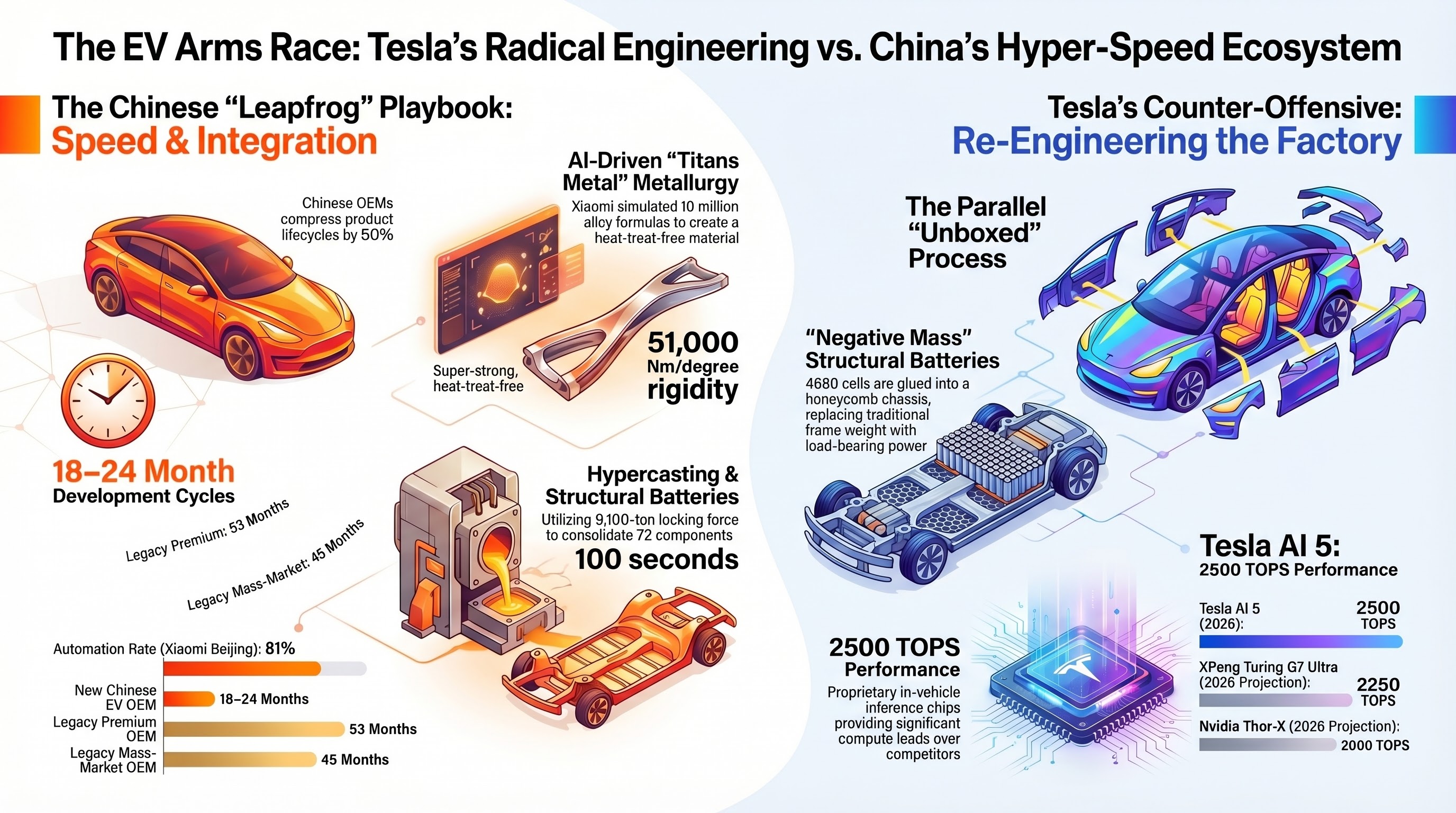
Tesla is fundamentally rewriting the rules of automotive manufacturing with its new 'Unboxed' process, a core component of its Global Automotive Modular Evolution (GAME) strategy. This radical approach abandons the century-old linear assembly line, where components are progressively added to a single vehicle frame. Instead, the Unboxed method deconstructs the vehicle into six major sub-assemblies—such as the front underbody, rear underbody, and structural battery pack—which are built and populated in parallel. According to Automotive Manufacturing Solutions, this parallel processing maximizes the 'actionable surface area,' allowing more robots to work simultaneously without spatial conflict and dramatically increasing production velocity.
The civilian spillover of the GAME strategy is profound, targeting a 50% reduction in production costs and a 40% smaller factory footprint. By eliminating the 'jungle gym' of a traditional car body, Tesla can simplify automation and use advanced techniques like Global Datum Alignment for perfect final assembly. This efficiency directly enables the production of mass-market vehicles like the planned sub-$30,000 Cybercab. For consumers and cities, this isn't just an industrial innovation; it's the catalyst that could make electric and autonomous vehicles affordable for the average household, accelerating the transition to sustainable urban mobility and fundamentally altering the economics of personal transportation.
China represents a major challenge to Tesla in 2026 however.
The "Leapfrog" Playbook: Transforming the Car into a Smart Ecosystem
The global electric vehicle sector has transitioned from a market-share skirmish over battery pricing into an existential conflict over advanced manufacturing physics, materials science, and computational architecture. Chinese automakers like Xiaomi, BYD, and NIO have subverted the traditional model, treating the vehicle as a wheeled, high-power computational node within a broader digital ecosystem rather than a mechanical assembly.
The Digital Brain and the AI Metallurgist Xiaomi uses a "Human x Car x Home" framework, integrating the EV directly into its broader consumer electronics ecosystem. The vehicle operates as a highly mobile edge-computing node that benefits from the relentless, rapid-iteration cycles of the consumer smartphone market.
To bypass the traditional manufacturing bottlenecks of stamping and welding hundreds of individual components, Chinese manufacturers are deploying "Gigacasting" paired with advanced computational materials science. Xiaomi deployed an AI-driven "Material Genome" system that simulated over ten million alloy formulas. The result is "Xiaomi Titans Metal," a proprietary alloy that achieves a staggering torsional rigidity directly out of the mold, entirely eliminating the need for a heat-treatment phase. This metal is injected into the Hypercasting cluster, which operates with a massive locking force. The cycle time to produce a complete rear underbody structure—consolidating dozens of stamped components and eliminating hundreds of weld points—is just one hundred seconds.
Reinventing the Battery: From Dead Weight to Structural Foundation Chinese manufacturers have aggressively pursued Cell-to-Body and Cell-to-Chassis architectures, fundamentally altering the role of the battery from a parasitic payload to a primary load-bearing structural member.
Xiaomi engineers executed a radical redesign by inverting the orientation of the battery cells. By flipping the cells upside down, any potential thermal exhaust is directed downward toward the road rather than toward the passenger cabin. This geometric reorientation allows the top structural plate of the battery pack to serve directly as the passenger cabin floor, maximizing vertical cabin space and lowering the vehicle's center of gravity.
Meanwhile, BYD has refined structural integration through its new architecture, employing an aerospace-grade aluminum honeycomb structure to house its proprietary "Blade" battery cells. BYD focuses exclusively on Lithium Iron Phosphate chemistries. The long, flat prismatic format of the Blade cell facilitates massive surface-area heat dissipation, drastically reducing the need for the complex, heavy, and expensive liquid-cooling manifolds required by high-nickel cylindrical cells. This integration yields a significant manufacturing cost advantage compared to Western architectures.
Visualizing the "Leapfrog" Speed The synthesis of flat organizational structures, AI-driven R&D, and deep supply chain localization has resulted in drastically reduced product development lifecycles for Chinese automakers. This speed is clearly illustrated in the report's first major data visualization:
The New Standard: A new tech-entrant EV maker completes the entire concept-to-production lifecycle in a staggering twenty-four months.
The Legacy Drag: In contrast, traditional mass-market automakers take forty-five months.
Sports & Premium Delay: Sports car makers trail behind at forty-eight months, while premium automakers require up to fifty-three months to reach the start of production.
Tesla’s Radical Factory Reboot: Rebuilding the Machine
Tesla recognizes that attempting to compete with Chinese automakers on traditional iteration speed and sheer labor scale is a mathematically losing battle. To protect its market share and pave the way for its highly anticipated, affordable Cybercab, Tesla is executing a massive pivot. They are not just redesigning their cars; they are completely reinventing the factory itself.
The "Unboxed" Process: Dismantling the Assembly Line For over a century, the automotive industry has relied on the linear assembly line pioneered by Henry Ford. In this old model, a car is built as a hollow metal box moving sequentially from station to station. This creates massive physical bottlenecks because human workers and robots must maneuver awkwardly inside a cramped frame to install seats, screens, and wiring. Furthermore, doors have to be put on to paint the car, taken off to install the interior, and put back on at the end—a highly inefficient loop.
Tesla's solution is the "Unboxed" process. This strategy forcefully dismantles the traditional assembly line by breaking the car down into six distinct, massive sub-assemblies—such as the front, rear, left side, right side, and a structural battery pack with the seats already bolted in. These modules are built independently on parallel, easy-to-reach assembly lines and only converge at the very final stage.
Super Adhesives and Absolute Precision When bringing these massive, pre-painted sub-assemblies together, traditional heat welding would warp the metal or melt the integrated electronics. To solve this, Tesla relies on a "global datum" system. Instead of aligning parts relative to one another, automated robots use an absolute mathematical coordinate system to ensure perfect, microscopic alignment.
Once aligned, the vehicle is essentially glued together using advanced, high-strength structural adhesives. The robots apply temporary mechanical "tacks" to hold the vehicle together precisely, allowing the production line to keep moving while the industrial glue fully cures further down the line. By operating on open, flat modules rather than reaching inside a cramped 3D box, this parallel strategy is projected to reduce the necessary factory footprint by 40% and slash manufacturing costs by up to 50%.
The "Negative Mass" Illusion To further optimize the vehicle's design, Tesla approaches battery integration through an engineering principle called "negative mass". In traditional car design, the heavy battery pack is treated as a dead-weight payload that the car has to carry.
Tesla flips this concept by using the robust steel casings of its cylindrical battery cells as primary, load-bearing structural components of the chassis. Because the battery becomes the frame, the traditional steel and aluminum cross-members that used to support the car are entirely removed. The mass of those removed parts is subtracted from the vehicle's total weight. This not only increases the car's energy efficiency but also centralizes its center of gravity, dramatically improving how the vehicle handles on the road.
Replacing Human Hands with AI While Chinese factories utilize closed-loop software to monitor their machines, Tesla’s ultimate factory automation strategy hinges on the physical deployment of artificial intelligence via the Optimus Gen 3 humanoid robot. Designed specifically to radically slash manufacturing labor costs in the United States, Optimus operates autonomously using the exact same vision-based neural network that powers Tesla's self-driving cars.
Featuring newly engineered hands designed for the fine-motor manipulation of delicate car parts, Optimus is transitioning from a conceptual prototype to an industrial tool. The culmination of this extreme automation, advanced metallurgy, and modular manufacturing is the Cybercab. By completely eliminating mechanical human interfaces—featuring no steering wheel, no pedals, and no side mirrors—Tesla is attempting to force a societal paradigm shift. It is a sub-$30,000 vehicle built largely by robots, designed entirely to be operated by software.