The Port That Cannot Stop: Hong Kong Rebuilds the Machinery of Global Trade
Hong Kong is introducing autonomous trucks, remote cranes and shared cargo data while its container terminals remain in service.
Published November 18, 2026Analysis / Transportation / Advanced Surface & Marine
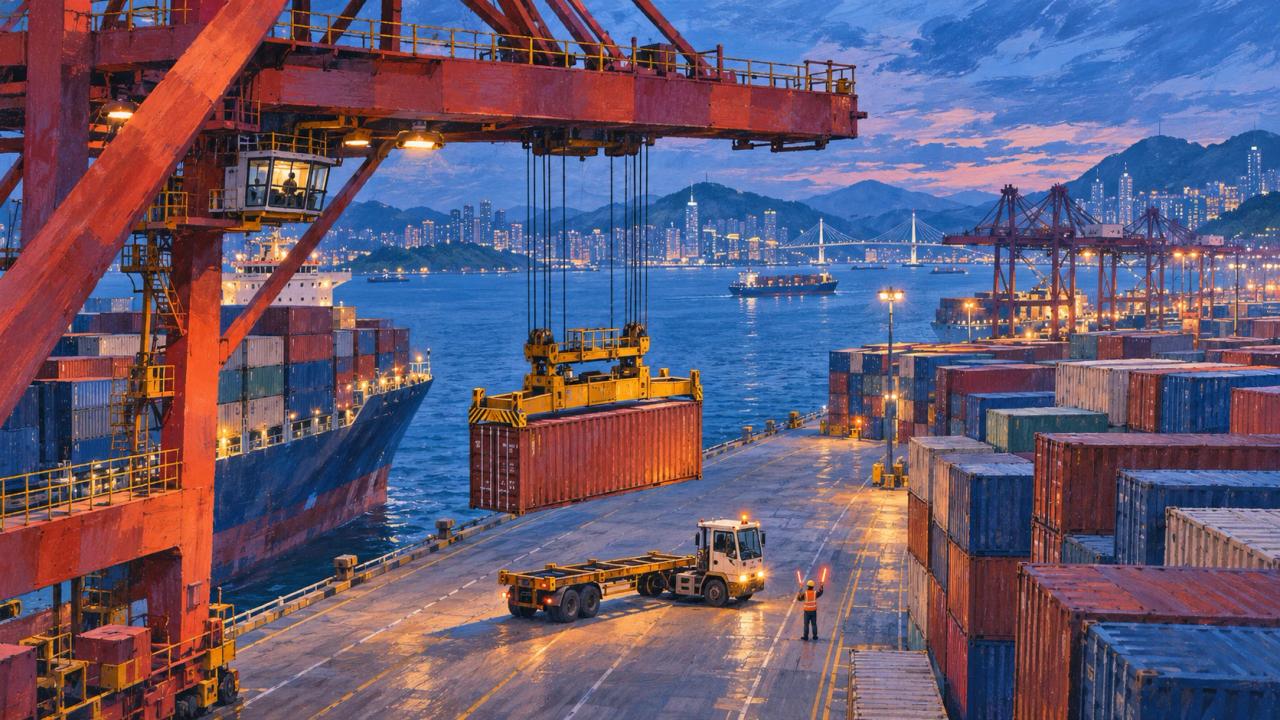
Proposed headline: The Port That Cannot Stop: Hong Kong Rebuilds the Machinery of Global Trade
Deck: Driverless trucks, remotely operated cranes and a shared cargo-data network are changing how Hong Kong moves containers. The larger test is whether an established port can modernize while the ships keep coming.
A container’s journey is a succession of handoffs. A crane lifts it from a ship. A vehicle carries it across the terminal. Another crane places it in a stack, where it waits for its next connection. Each move depends on the equipment, people and information needed for the move after it.
At Hong Kong’s Terminal 4, six autonomous trucks have entered that chain. Their bodies have no driver’s cab. According to terminal operator Hutchison Port Holdings Trust, they work alongside conventional vehicles rather than requiring every vehicle around them to become autonomous. The fleet launched on April 21, 2026. HIT launch announcement
Hong Kong’s operators are bringing new machinery into terminals already full of working equipment. A recent government update describes a gradual conversion across Kwai Tsing’s nine container terminals, where five private operators manage 24 berths. November 11 government reply
For ports built around decades of investment, that is a practical question with global consequences. How much can they change without starting again? Hong Kong’s answer is taking shape in the yard, in the crane control room and in the data exchanged before a container arrives.
A working port changes one operation at a time
The government’s November 11 account records six autonomous electric vehicles and 67 remotely operated cranes across Kwai Tsing, with the cranes representing about 16 percent of its total. These are a snapshot of the equipment already in use, not a fleet newly installed that month. Officials are developing a smart-transition roadmap with operators, taking account of their investment capacity, technical feasibility and operational flexibility. Government reply
The truck deployment illustrates the sequence behind such a conversion. HPH Trust’s 2025 annual report records the purchase of six autonomous trucks for testing ahead of planned Terminal 4 barge operations in 2026. It also describes continuing crane conversions and work on positioning technology to support further automation. The April launch followed that preparation. HPH Trust annual report
A remotely operated crane moves under instructions from a person in a control room. Automated stacking delegates particular movements to machinery. A driverless terminal truck handles another part of the journey. These capabilities can coexist without making an entire port autonomous.
At HIT’s Container Terminal 9 North, the operator describes automated stacking combined with remote crane operation, supported by cameras and sensors. Operators work from an office rather than a crane cabin. HIT says the conversion was carried out while maintaining full operations. Its history also includes remote crane technology at Terminal 6 beginning in 2012. HIT technology overview
The upgrades leave operators coordinating equipment from several generations in the same yard.
The difficult space between machines
The new trucks make that coordination visible. HPH Trust chief executive and HIT managing director Ivor Chow described them as “designed to operate seamlessly alongside conventional vehicles.” That is the operator’s description of the system, not an independently measured reliability result. Launch announcement
Mixed traffic is consequential because it offers a route to introducing driverless equipment before replacing an entire vehicle fleet. It also places demands on the operation: the system must account for vehicles driven by people, changes in the yard and situations that require intervention. Fleet size alone tells readers little about how consistently that works.
The terminal’s software is another part of the machinery. HIT says its nGen management system has operated since 2005, coordinating vessel and yard planning, equipment use and gate operations. Its truck-identification system uses radio tags to help track vehicle movements. These quieter systems provide the information needed to assign work and locate equipment. HIT technology overview
For a shipper, the useful outcome would be a more predictable connection. A truck that reaches its destination quickly offers limited value if the next crane is unavailable or the paperwork is unresolved. The commercial case depends on the whole sequence.
The paperwork moves too
Hong Kong is also building a common information layer outside individual terminals. Its Port Community System allows businesses to track cargo and exchange customs-related information through a shared platform. In a June government feature, an early user described previously having to reconcile conflicting information across multiple systems. The service now supplies customs-clearance status directly to the company’s own system. Government report and video
That is an everyday source of friction that faster machinery cannot solve alone. If a logistics team has to chase the location or release status of a shipment, physical capacity and usable capacity become different things.
On November 16, Secretary for Transport and Logistics Mable Chan said the platform had close to 10,000 registered enterprises since its January rollout. She linked the port’s modernization to a wider effort to connect rail, sea, road and river transport and expand its cargo hinterland. Registration demonstrates reach; it does not establish how frequently each participant uses the service or how much time it saves. November 16 remarks
For readers of JetsonsAge’s 60-Second Frontier, this is a closely related development at the maritime end of the network. Inland connections and terminal machinery have to work as one transport service. A dependable handoff can matter as much as a fast individual move.
A different route from Rotterdam
Automation already has substantial precedents elsewhere. At Rotterdam’s APM Terminals Maasvlakte II, which opened in 2015, the operator reports that approximately 80 percent of crane movements are automated, with the remaining manual operations performed remotely. Automated areas are fenced off, separating people and machines. Documentation is exchanged through the Dutch Port Community System, Portbase. APM Terminals
The comparison reveals different operating arrangements rather than a simple league table. APM’s figure measures crane movements; Hong Kong’s 16 percent measures cranes equipped for remote operation. They cannot be compared as equivalent automation scores. Nor can a single terminal’s configuration stand in for a whole port.
Hong Kong’s mixed-traffic deployment makes it a useful case to follow for operators considering staged upgrades to existing facilities. Whether that approach costs less, scales more readily or produces better service than alternatives remains an operational question. The public announcements reviewed here do not answer it.
The next evidence that matters
To judge this transition, watch the handoffs. Does a container spend less time waiting between stages? Are truck turnaround times and vessel service more predictable during busy periods? How often do autonomous vehicles need intervention? How much work can a trained operator supervise safely, and what happens when communications or equipment fail?
Those measures would connect the machines in a press photograph to the experience of a customer waiting for cargo. They would also show whether incremental conversion can extend the useful life of existing infrastructure without allowing each upgrade to introduce another source of delay.
Hong Kong has working equipment to examine, a long modernization history and an expanding data network. Its next contribution could be a practical model for changing a port while keeping it in service. For an industry that moves through fixed berths, expensive machines and tightly connected schedules, that is a frontier worth watching.
Primary source register
Hong Kong government legislative reply, November 11, 2026: current equipment footprint and roadmap.
HIT fleet launch, April 21, 2026: deployment date, vehicle operation and Chow quotation.
HPH Trust 2025 annual report: preparation and testing before rollout.
HIT improving efficiency: historical systems and crane-operation descriptions.
Government PCS feature, June 7, 2026: customer workflow and multimedia candidate.
Secretary for Transport and Logistics remarks, November 16, 2026: updated registration count and network strategy.
APM Terminals Maasvlakte II: international comparison.
Sources · 6
- https://www.tlb.gov.hk/eng/legislative/transport/replies/2026/20261111a.html
- https://www.hphtrust.com/misc/ar2025/41/
- https://www.news.gov.hk/eng/2026/06/20260605/20260605_105953_929.html
- https://www.info.gov.hk/gia/general/202611/16/P2026111600461.htm
- https://www.jetsonsage.com/intelligence/china-expands-automated-container-port-upgrades-inland
- https://www2.apmterminals.com/en/maasvlakte/about/our-terminal