Factorial Reports 450 Wh per Kilogram Aviation Battery Cells
Its latest lithium metal result joins a crowded field where power delivery, battery life and aircraft integration determine how much of the promised energy reaches a flight.
Published November 11, 2026Analysis / Energy / Advanced Battery Tech
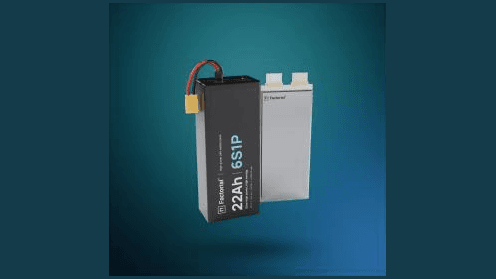
Factorial says its aerospace battery cells have reached 450 watt-hours per kilogram, about 15 percent above the cells used in its July drone endurance flight. Announced on November 10, the result brings a concrete possibility for aircraft designers: carrying the same stored energy with less cell weight, leaving more room for equipment, payload or flight reserves. The company achieved the figure ahead of its year-end target. 1,2
The flight evidence belongs to the earlier generation. Factorial says a Titan Dynamics drone stayed airborne for more than eight and a half hours in July. A pack built from the new cells needs its own flight results. The company also reported approximately $26,000 in third-quarter aerospace revenue, placing the technical milestone inside a young commercial program whose initial cell costs exceed expected selling prices. 2
Competition has moved during that development. In September, California-based Amprius announced a silicon-anode cell delivering a claimed 500 Wh/kg at a 1C continuous discharge rate, with commercial availability expected in the fourth quarter of 2026. In China, EHang has flown an aircraft using an Inx lithium-metal solid-state battery. In Europe, Saft has delivered semi-solid cells to Safran for evaluation, while H55 has been testing the safety functions of a complete energy storage system. Each is advancing a different part of the problem. 7,10,12,13
For a utility inspecting power lines, lighter batteries could extend the territory covered between landings. A vertically lifting passenger aircraft needs enough power to rise, enough energy to cruise and a dependable reserve for landing. The value of a chemistry therefore depends on the work the aircraft performs, its charging schedule and how its battery behaves after repeated service. A long-endurance drone and an air taxi can favor quite different cells.
Factorial's lithium-metal anode is the energy-storing electrode that distinguishes its aerospace cells. Lithium metal offers a route to lighter storage, while repeated charging and discharging can produce damaging reactions and uneven deposits at the electrode surface. Department of Energy research has shown how some of those reactions obstruct lithium movement or damage the separator between electrodes. Managing that interface is central to getting useful life and safety alongside high energy density. 2,4
The electrolyte carries lithium ions between the electrodes. Factorial Electrolyte System Technology (FEST) uses a polymer-based solid electrolyte with a small liquid component; its website describes a quasi-solid system paired with lithium metal and a high-capacity cathode. Solstice is a separate sulfide-based all-solid platform. Those labels cover different materials and manufacturing choices, even when a headline energy figure looks similar. 3,5
The precise recipe of the new 450 Wh/kg aerospace cell remains undisclosed in the reviewed announcement. Factorial's securities filing also describes development of advanced liquid-electrolyte systems for demanding markets. Its broader cathode options include nickel-manganese-cobalt and nickel-cobalt-aluminum materials, but the new cell's cathode composition, electrolyte fraction, electrode thickness and applied pressure need product-specific disclosure. Specifications for the company's larger automotive cells belong to those products. 2,3
Manufacturing is another substantial part of Factorial's approach. The company says up to 80 percent of its equipment and cost base can be shared with conventional lithium-ion production, while steps such as rolling electrodes to thickness, cutting them and stacking the layers require modification or replacement. Its intended model combines early production on its own lines with manufacturing partners and licensing. Equipment compatibility can reduce the capital needed to expand; repeatable yield, consistent cell quality and customer qualification still determine useful output. 3
An aircraft then adds its own weight and operating limits. A pack needs electrical connections, mechanical protection, monitoring and a way to handle heat and faults. Some stored energy also stays outside the normal operating window or is held in reserve. In a National Aeronautics and Space Administration (NASA) study, Jeffrey Chin and colleagues wrote that the cell-to-pack scaling relationship “varies depending on pack requirements, cell chemistry, and architecture.” Their analysis shows why a cell specification alone leaves substantial aircraft design work. 6
The arithmetic also deserves care. If energy per kilogram rises by 15 percent and everything else stays equal, the cells needed for a fixed amount of energy weigh about 13 percent less: one divided by 1.15 is roughly 0.87. That is an illustrative cell-mass calculation. Pack hardware, usable charge, aircraft aerodynamics and payload alter the eventual benefit. A measured 15 percent improvement in cell energy density is not a measured 15 percent increase in flight range.
Amprius offers a useful American comparison because it publishes both ambitious launch claims and individual product sheets. Its September 500 Wh/kg announcement targets sustained discharge in high-altitude platforms and fixed-wing drones, with initial production planned in Fremont and expansion through contract manufacturers. Its current catalog advertises a portfolio reaching 500 Wh/kg. A complete set of matched cycle, charge and temperature specifications for that new model would make the comparison with Factorial much stronger. 7,8
The catalog illustrates the choices through other named cells. The preliminary SA147 sheet lists 445 Wh/kg measured at a slow C/10 discharge, a 1C continuous current limit and a 1C maximum charge current. The SA02 lists 340 Wh/kg measured at 1C discharge and permits 3C continuous discharge or 5C pulses lasting up to 30 seconds. Its 700-cycle rating uses full depth of discharge, charging and discharging at 1C, to an endpoint of 80 percent remaining capacity. The SA02 permits charging from 0 to 55°C and discharge from minus 20 to 55°C. Those conditions attach to that cell. 8
A C-rate expresses current relative to a cell's capacity: for a 10 amp-hour cell, 1C means 10 amperes. It helps compare electrical loading, while actual power also depends on voltage. A permitted maximum charge current alone leaves the elapsed charging time unresolved because voltage limits, tapering and temperature affect the session. Equally, cycle counts become meaningful when the charge window, currents, temperature and remaining-capacity endpoint accompany them. Factorial's new aerospace announcement leaves these operating details open. 2,8
Amprius also has substantial flight heritage. Its batteries supplied the overnight energy for AALTO's solar-powered Zephyr during a 67-day stratospheric flight completed in April 2025; solar panels recharged them during daylight. That validates a demanding, repeated overnight mission with the cells used then. The record predates September's new cell and addresses a flight profile quite different from repeated vertical takeoffs. Civilian uses include communications and environmental observation, alongside the platform's defense applications. 9
China's Contemporary Amperex Technology Co. Limited (CATL) announced an up-to-500 Wh/kg condensed battery in 2023, describing a structured electrolyte and work with aircraft partners. Its 2025 annual report supplies more tangible industrial context: an AutoFlight cargo battery passed a Civil Aviation Administration of China manufacturing compliance review, and an aircraft program completed flight verification. The report leaves the battery's exact relationship to the original 500 Wh/kg announcement unresolved. Those milestones establish activity in an aircraft supply chain; they leave a product-matched energy, power and lifetime comparison for further disclosure. 14,15
EHang and Inx offer more explicit flight evidence for a lithium-metal design. Their November 2024 announcement described an oxide-ceramic electrolyte, quoted 480 Wh/kg for the “battery” and reported a continuous EH216-S flight lasting 48 minutes and 10 seconds. It left the complete installed-pack mass basis, payload and detailed flight profile unspecified. A March 2026 filing adds a December 2025 demonstration: a 22-kilometer crossing of the Qiongzhou Strait, taking 18 minutes, powered by the jointly developed solid-state battery. 10,11
Those flights show hardware operating beyond a bench, while commercial status requires a separate assessment. The 2024 release targeted large-scale production of certified solid-state batteries by the end of 2025. The later flight account establishes a demonstration rather than confirmation of that production target or approval of every battery configuration. Comparable cycle curves, continuous and pulse power, charging windows and temperature limits remain absent from these releases. An aircraft's existing approvals apply to its approved configuration. 10,11
Europe presents another route through the same engineering work. Saft inaugurated Bordeaux lines in October 2026 capable of developing and producing batteries using sulfide and polymer electrolytes at room temperature. It had already delivered semi-solid cells for aviation evaluation. Safran's Niort test center is to perform most validation and integration work, with the partnership planning to extend to solid-state cells and batteries from 2027. The announcements describe an industrial and evaluation milestone, with product-specific aviation density, power, cycle and charging figures still to come. 12,16
Swiss company H55 concentrates on turning commercial lithium cells into an aviation energy storage system. It says regulator-required, European Union Aviation Safety Agency-witnessed module tests were completed in December 2025. An April 2026 campaign brought modules, battery management, power distribution and charge control together and tested functions including automatic disconnection under predefined faults. This provides evidence about the system surrounding the cells. H55 described progress toward certification; the milestone's scope is narrower than final approval of an installed aircraft propulsion system. 13,17
Across these programs, three kinds of evidence are emerging at different speeds: detailed cell specifications, flights with identified battery configurations, and manufacturing or regulatory milestones. United States Federal Aviation Administration guidance on rechargeable battery installations addresses the operating environment and safety of the installation within the aircraft categories it covers. Its September 2026 advisory circular offers an acceptable compliance approach, with applicability determined by the aircraft and certification basis. A transport test or a manufacturer's quality-system approval answers a different question. 18
Factorial's next useful disclosure would connect its 450 Wh/kg cells to a published pack specification and a repeatable mission, then show how energy, power and temperature change as that pack ages. For an operator, the result becomes commercially persuasive when the aircraft repeatedly completes its route, carries its equipment and returns with the required reserve, at a battery replacement cost the service can support.
Sources
1. Factorial third-quarter results announcement November 10 2026
2. Factorial third-quarter shareholder letter November 10 2026 especially pages 4 7 and 9
3. Factorial registration statement technology and manufacturing sections
4. Department of Energy research explanation of lithium metal battery failure September 2023
5. Factorial technology descriptions of FEST and Solstice
6. NASA Battery Cell to Pack Scaling Trends for Electric Aircraft 2021
7. Amprius SiCore 500 launch September 2 2026
8. Amprius fourth-quarter 2026 product catalog especially SA02 page 4 and preliminary SA147 page 24
9. Amprius account of the AALTO Zephyr 67 day flight May 21 2025
10. EHang and Inx solid-state battery flight announcement November 13 2024
11. EHang March 12 2026 filing with Qiongzhou Strait flight account page 4
12. Saft Bordeaux battery production lines October 19 2026
13. H55 integrated energy storage system safety tests April 29 2026
14. CATL condensed battery announcement April 19 2023
15. CATL 2025 annual report aviation manufacturing and flight milestones
16. Saft and Safran semi-solid cell delivery and roadmap October 15 2026
17. H55 certification scope and module test milestones
18. FAA Advisory Circular 20 184A rechargeable aircraft battery installations September 18 2026
Sources · 18
- https://ir.factorialenergy.com/news-releases/news-release-details/factorial-announces-third-quarter-2026-results-begins-generating
- https://www.sec.gov/Archives/edgar/data/2049662/000162828026072699/factorialq32026sharehold.htm
- https://www.sec.gov/Archives/edgar/data/2049662/000110465926079324/tmb-20260331xs1.htm
- https://www.energy.gov/science/bes/articles/why-it-so-hard-make-batteries-smaller-and-lighter
- https://factorialenergy.com/technology/
- https://ntrs.nasa.gov/api/citations/20210017488/downloads/Battery_Cell_to_Pack_Scaling_Trends_for_Electric_Aircraft_6_14.pdf
- https://ir.amprius.com/news-events/press-releases/detail/174/amprius-introduces-sicore500-high-energy-density-cells-for-unmanned-aviation
- https://amprius.com/documents/Amprius_Product_Catalog.pdf
- https://ir.amprius.com/news-events/press-releases/detail/133/aalto-zephyr-achieves-world-record-67-day-flight-powered-by-amprius-ultra-high-energy-batteries
- https://ir.ehang.com/news-releases/news-release-details/ehang-and-inx-achieve-breakthrough-solid-state-battery/
- https://ir.ehang.com/static-files/d74c5894-7bed-42bc-b661-5e3baf6809f9
- https://saft.com/en/media-resources/press-release/saft-launches-production-frances-first-solid-state-batteries
- https://h55.ch/en/h55-successfully-completes-system-safety-function-verification-testing-of-integrated-energy-storage-system/
- https://www.catl.com/en/news/6015.html
- https://www.catl.com/en/uploads/1/file/public/202603/20260310105310_46xjbwckvn.pdf
- https://saft.com/en/media-resources/our-stories/saft-and-safran-pioneers-semi-solid-batteries-aviation
- https://h55.ch/en/certification/
- https://www.faa.gov/documentLibrary/media/Advisory_Circular/AC-20-184A.pdf