TransAstra’s Giant Capture Bag Closes After a Prototype Gear Fails
The 10-meter Mantis ground test examined inflation, structural behavior and closure. A smaller system previously demonstrated deployment aboard the space station.
Published November 19, 2026Intelligence / Space Development / Asteroid Mining
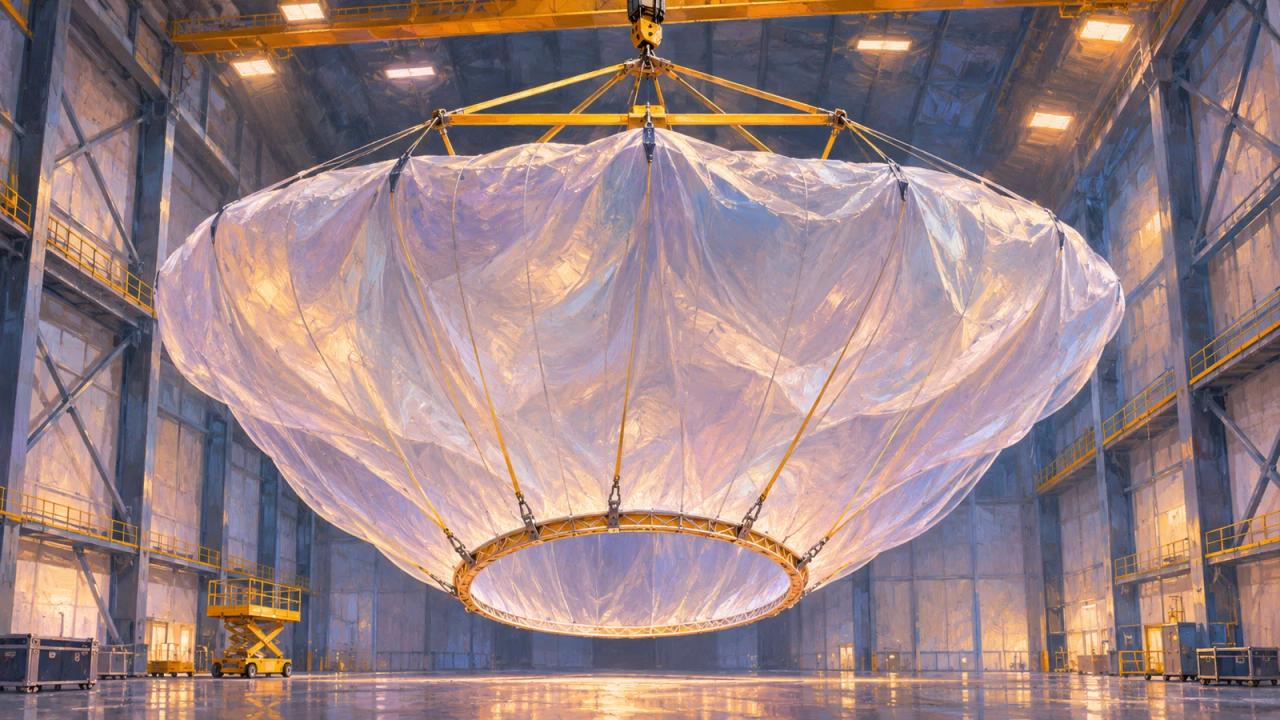
A failed gear gave TransAstra an unexpected test of its 10-meter Mantis Capture Bag. With one of four drawstring mechanisms unavailable, the inflated enclosure still closed using the remaining three, the company reported November 16. Engineers plan to replace the prototype gearing before further tests.
Mantis is intended to surround an asteroid or an old spacecraft and cinch it inside a flexible bag. That approach could accommodate irregular objects that offer few convenient attachment points. A carrier spacecraft would bring the enclosure to the target and move the captured object afterward.
What engineers measured on the ground
During the 11-day campaign, engineers recorded inflation-rate data to inform the flight gas-handling system. They pushed on the inflated structure at several locations and measured its displacement; TransAstra says the response matched its mechanical model.
For camera testing, the team placed an asteroid simulator inside the enclosure, darkened the high bay and used two lamps to represent sunlight. Video from an internal camera will support work on detecting a target under dim or off-axis lighting. The campaign also exercised mouth closure and cinching.
These are company-reported ground results. Approaching a free-moving target and retaining it in space remain flight-development tasks.
A flexible structure in microgravity
The larger prototype follows a one-meter deployment demonstration aboard the International Space Station in 2025, according to TransAstra. The two systems address different development questions: the station experiment explored deployment in microgravity, while the new ground rig let engineers examine the larger structure and its mechanisms.
Before the station test, chief engineer Thibaud Talon explained why gravity mattered: “The system is designed around an inflatable, pressurized structure.” On Earth, that structure hangs under its own weight. Testing in orbit helps engineers understand how it opens when that load is removed.
The ISS National Laboratory described a planned test inside Voyager Technologies’ Bishop Airlock, using four airlock cameras and another inside the bag. The airlock could be depressurized to expose the enclosure to conditions outside the station’s normal cabin atmosphere.
Capture and transport
The mission sequence described by the ISS National Laboratory calls for a carrier to open the bag, maneuver it around a target and cinch it shut. Proposed destinations for captured material include disposal orbits and future facilities that could repurpose it.
Each destination imposes additional requirements on the carrier’s propulsion and control. Securing a target also changes the mass and motion the spacecraft must manage. The closure test addresses an important mechanical step within that sequence; a complete mission will have to establish approach control, retention and transport together.
The two prototype sizes answer different questions. Increasing the opening diameter from one meter to ten multiplies the area enclosed by a circular mouth by a factor of one hundred. A much larger mouth gives the carrier more room around its target. It also gives an off-center contact a longer lever arm about the carrier. The material, attachment points and control system all participate in what happens next. An enclosure photographed open at full size answers a real engineering question about deployment while leaving the motion after contact largely open.
That is why the ground test with one drawstring mechanism out deserves attention on its own terms. The team observed the remaining mechanisms complete a closure in a particular configuration. A useful follow-up would measure how far the opening remains off center, how the loads redistribute and whether the bag can retain a moving test object after the same fault. Those results would tell a mission designer more than a simple count of three working mechanisms out of four. Company ground-test account and scale details
The capture idea has a longer engineering history than the broken gear. In 2019 NASA selected TransAstra’s Mini Bee optical-mining concept for a Phase III advanced-concepts study. In that proposal the prize was material harvested from a small asteroid. A flexible enclosure had to contain the work. Removing a derelict satellite sets a different finish line: the combined spacecraft must reach a disposal trajectory. NASA’s selection funded concept development. It was never a record of an asteroid captured. NASA’s 2019 technology selection
ESA’s separate ClearSpace-1 mission illustrates the difference between specifying the mouth of a bag and specifying a mission. ESA identifies a particular target, the 95-kilogram PROBA-1 spacecraft launched in 2001. Its mass can inform the design of the approach, retention and disposal maneuvers. TransAstra’s ten meters describes an opening and sets no equivalent rating in kilograms. A flight test with a target of known mass and motion would finally let customers compare enclosure performance with what a particular removal job requires. ESA’s ClearSpace-1 mission description
The gear failure now gives the development team a specific component to improve. Its next tests can examine both the replacement mechanism and how consistently the bag closes under the conditions expected in flight.
Sources
TransAstra: November 16 ground-test announcement
ISS National Laboratory: station experiment and proposed capture sequence