AI’s Power Problem Is Moving Beyond the Server Rack
Vertiv’s expanded 800-volt systems offer different routes for feeding denser computing installations, from existing facilities to purpose-built campuses.
Published November 18, 2026Intelligence / Energy / Grid Technology
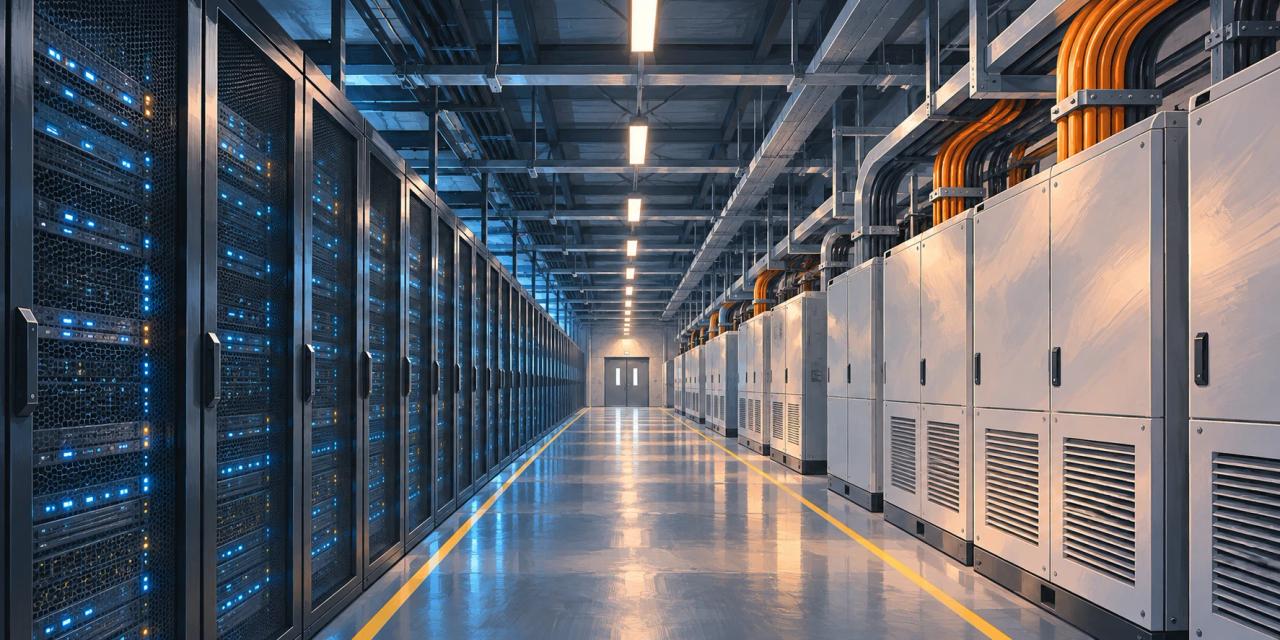
Inside an AI data center, space devoted to electrical equipment competes with space for computers. As more processing power is concentrated in each rack, the equipment carrying electricity to it becomes a larger part of the design problem.
One emerging approach is to distribute electricity at 800 volts direct current. Higher voltage allows the same amount of power to travel at lower current, easing the burden on conductors. Depending on the building’s electrical layout, it can also simplify the sequence of conversions between incoming power and computing equipment.
Vertiv has expanded its portfolio with systems rated at 1.5 megawatts for a row or group of racks and 5 megawatts for a data hall. The additions bring a practical question into focus: how far upstream should a data center move its power conversion?
The answer will differ between an existing building receiving new AI servers and a campus designed around them. Vertiv says pilot programs and technical validation are underway. Operating results from those deployments will establish how the designs perform under sustained workloads.
Moving the conversion equipment
The 1.5-megawatt PowerDirect 9000 converts 480-volt alternating current into 800-volt direct current for a row or computing pod. Centralizing that function can reduce the need for separate power racks beside individual computing racks.
The larger PowerNexus MV SST converts medium-voltage AC directly to 800-volt DC. Vertiv describes an outdoor, liquid-cooled, containerized system, rated at 5 megawatts, with AC-to-DC efficiency of up to 98%. That figure describes the converter; assessing a building’s overall efficiency also requires accounting for cooling, distribution and the rest of its equipment.
NVIDIA’s architecture similarly accommodates several entry points, from equipment beside existing racks to power systems serving larger computing clusters. Its guidance makes the facility design central to the choice: electrical protection, available space and the transition plan all affect what can be installed.
A common electrical foundation
This shift reaches beyond one supplier. Google, Microsoft and NVIDIA are working through the Open Compute Project to align interfaces and requirements for 800-volt systems. Shared specifications could help manufacturers supply multiple customers without redesigning equipment for each one.
“AI infrastructure is becoming a full facility-scale engineering challenge,” said Melissa Lott, Microsoft’s partner for energy technology, in an OCP statement.
That work includes safety and certification. OCP describes collaboration with standards organizations alongside efforts to align power quality, load smoothing and equipment interfaces. These details determine whether components can function together reliably when computing demand changes rapidly.
The resulting transition can proceed in stages. Existing AC systems can remain in service while selected rows adopt DC equipment; new facilities can consider conversion nearer the incoming medium-voltage supply.
For operators, the useful comparison will be the complete installation: usable computing capacity, equipment footprint, conversion losses, reliability and cost. Vertiv’s new systems offer additional configurations to test. Their significance will become clearer as pilots produce measured results.
Primary sources
Sources · 3
- https://www.vertiv.com/en-in/about/news-and-events/news-releases/2026/vertiv-advances-800-vdc-power-architectures-to-support-growing-ai-data-center-demands/
- https://www.nvidia.com/en-us/data-center/technologies/800-vdc-architecture/
- https://www.opencompute.org/news/powering-the-next-era-of-ai-how-google-microsoft-and-nvidia-are-standardizing-and-accelerating-the-industry-transition-to-lvdc/