Quantum Test Narrows Where a Remote Operation Could Have Occurred
Two stations on NIST’s Boulder campus used entangled photons and precise timing to verify a location under defined experimental conditions.
Published November 19, 2026Intelligence / Frontier Tech / Experimental Systems
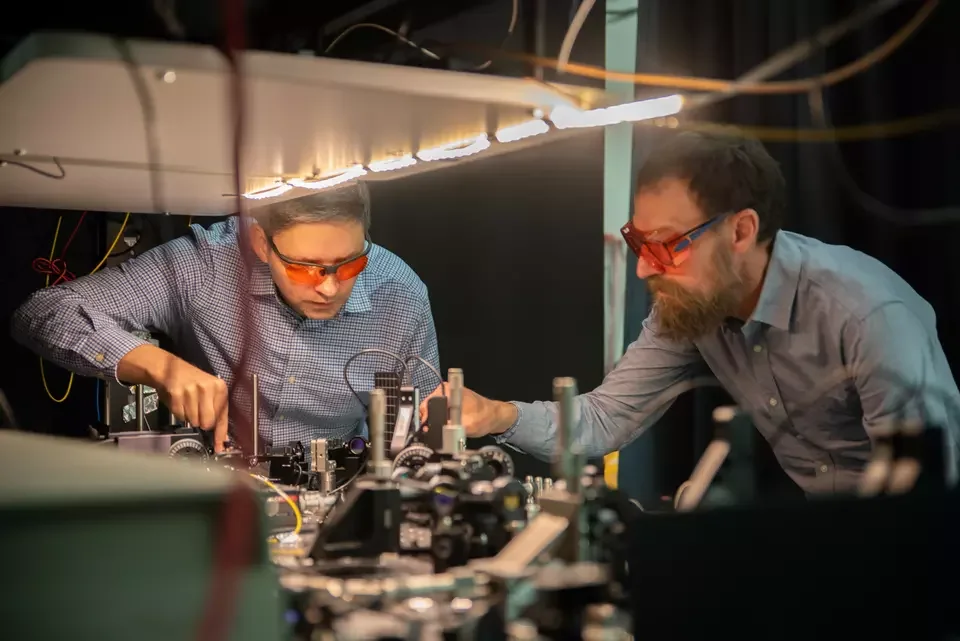
Two verification stations 195 meters apart on the National Institute of Standards and Technology’s Boulder campus have demonstrated a way to establish where a remote quantum operation occurred. The experiment combines the travel time of signals with measurements of entangled light particles, placing a tighter boundary around the operation’s possible location.
The result, published November 18 in Nature, could eventually let a security system require evidence that an operation took place at an approved location. Identifying the operator and deciding what that operator may access remain separate tasks.
Light, timing and a measurable boundary
The stations challenge a responding device to perform a measurement and return its answer. One station supplies a photon whose properties are linked, through entanglement, to a photon it retains. The answers must arrive within the required time and exhibit the correlations expected from the quantum experiment.
Those correlations are evaluated with a loophole-free Bell test. In this setting, the test supplies evidence that the observed results have the required quantum relationship. Signal timing supplies the spatial constraint. Together, they limit the region in which the requested operation could have taken place.
The published abstract reports a one-dimensional localization region about 2.47 times smaller than that of the best classical comparison identified by the researchers. That classical comparison itself requires a non-remote arrangement. A separate comparison, using classical protocols with the same latencies, produced a localization volume about 4.53 times smaller. The two figures describe different comparisons and geometries.
The conditions attached to the result
The demonstrated protocol assumes limits on the entanglement available to collaborating adversaries before each trial. The broader theoretical protocol addresses adversaries with greater quantum resources. Its scope extends beyond the particular experimental configuration tested.
“Device-independent” describes how the protocol treats its quantum hardware: the evidence comes from observed correlations rather than a detailed assumption that each quantum component behaves as specified. The author manuscript also makes clear that classical timing, distance measurements and recorded results require trusted equipment. These assumptions define the circumstances in which a location claim is valid.
For a future access-control system, the output would be evidence about an operation within a calculated region. A deployment would have to establish how that region fits the physical area it intends to protect, then combine the result with its other authentication and authorization checks.
The research team ran 335 instances over two days. Each lasted two or four minutes, depending on which assumptions the researchers were testing. The stations were 195.1 meters apart, and the responding station sat 92.8 meters from one verifier. Those surveyed distances describe where the scientists put the apparatus. They could then ask what region the timings and measured correlations actually allowed an observer to infer. In the team’s geometry, two timing constraints gave spheres with radii of 157.3 and 116.7 meters. Two others gave ellipsoids. Only positions in the overlap of all four satisfied the test. A result can exclude a distant operation without being precise enough to isolate one desk. Author manuscript, experiment and table 3
The duration matters just as much as the distances. An access system that needs a decision before a door opens has a different timing requirement from a laboratory accumulating enough trials to establish a statistical result. The experiment supplies a measured advantage for a particular threat model and hardware arrangement. To turn that into a specification for a secure room, an engineer would also need to know how often the test can run, the boundary of the accepted region and what happens when too few events are recorded.
A bank offers a mundane example of what the measurement could buy. A transaction might require a signature and evidence that a particular operation happened within a room at headquarters. The signature governs who may authorize the transfer. The physics supplies a bound on where the operation could have happened. If that region extended across the wall into a public lobby, even a technically successful measurement would be too coarse for the bank’s purpose. A useful deployment would have to publish that boundary along with the assumptions used to derive it.
NIST physicist Scott Glancy places practical applications more than a decade away. Reliable quantum communications networks and suitable measurement hardware remain part of that work. The experiment gives those systems a concrete research target: a location claim with a measured boundary and explicit security assumptions.
Sources
NIST: experiment and practical outlook