India’s Renewable Power and Storage Push Reaches Data Centers
India’s renewable-power companies are beginning to plan the electricity system and the computing campus together.
Published November 16, 2026Intelligence / Energy / Next-Gen Renewables
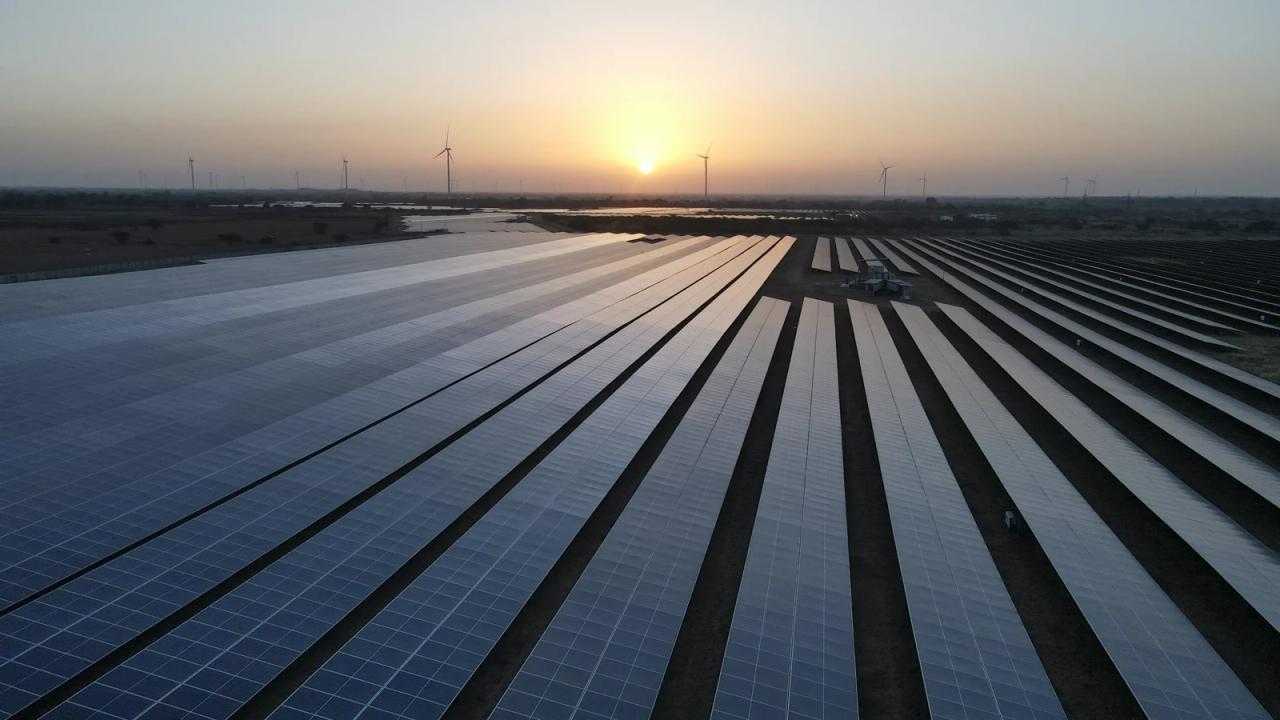
India’s renewable-power companies are beginning to plan the electricity system and the computing campus together. Two proposals in Andhra Pradesh would put large data centers alongside investments in generation, storage and manufacturing, bringing the country’s clean-energy expansion closer to the servers that will consume its output.
CleanMax’s November 12 memorandum links a proposed 2-gigawatt computing park in Kurnool with wind, solar, pumped storage and batteries. ReNew announced a separate 1 GW data center in Anakapalli as part of a broader industrial investment package.
The attraction for computing is renewable electricity that can keep reaching the machines after sunset. Batteries and pumped storage can hold energy produced earlier, while transmission lines connect customers to generation across a wider area.
Those proposals arrive during a national expansion that already extends well beyond data centers. India reported about 308 GW of installed non-fossil electricity capacity in September. Earlier this month, its cabinet approved financial support for another 92 gigawatt-hours of grid-scale storage.
Turning renewable capacity into an evening supply
India’s 2030 target is 500 GW of non-fossil generating capacity. The category includes nuclear power as well as renewables. In March, the power ministry released a transmission plan intended to accommodate more than 900 GW by 2035–36, with an estimated ₹7.93 lakh crore investment in lines and substations.
That network would move electricity between generating regions and the cities, factories and digital infrastructure using it. Storage handles another part of the job: carrying electricity from an hour when it is abundant into an hour when customers need more.
The International Energy Agency’s November 3 assessment forecasts about 530 GW of renewable capacity in India by 2030, with solar accounting for more than 80 percent of additions. It identifies grids, storage and system flexibility among the investments needed to sustain that expansion.
“India’s experience shows how consistent policies can help drive down renewable energy costs and attract investment,” IEA executive director Fatih Birol said in the agency’s announcement.
For a computing campus, the timing of generation affects how much work can run directly on renewable supply and how much electricity has to come through storage or other sources. Solar panels add daytime output; a store can deliver some of it later, losing energy in the process.
CleanMax brings the power system into the campus plan
Mumbai-headquartered CleanMax supplies renewable electricity to commercial and industrial customers. Its Andhra Pradesh proposal calls for nearly ₹50,000 crore of investment, including 3 GW of wind and solar and 1 GW of pumped-storage power over five years.
AI-cloud provider Neysa would anchor the computing park with 1 GW of IT load. CleanMax plans at least 1.5 GW of renewable capacity by 2029, with a project company seeking a distribution licence for the park’s own power network.
Compute “needs clean energy that is available every hour of the day,” founder and managing director Kuldeep Jain said in the filing.
Pumped storage uses electricity to move water uphill into a reservoir. When power is needed, the water runs back through a turbine. Batteries store energy electrochemically and can respond quickly to changes in demand.
A 1 GW storage rating describes the rate of discharge. Supplying that output for four hours requires 4 GWh of usable stored energy. CleanMax has yet to disclose the energy capacity or duration of its proposed pumped storage and batteries.
Andhra Pradesh already has experience with this kind of equipment. In June, turbine supplier ANDRITZ reported a year of operation and maintenance at Greenko’s 1,680 MW Pinnapuram pumped-storage project. Its account describes frequent starts, stops and changes between pumping and generating.
ReNew couples computing with an industrial supply chain
ReNew, whose Indian headquarters is in Gurugram, approaches the opportunity as both a power producer and a solar manufacturer. Its proposed Andhra Pradesh package totals approximately ₹80,000 crore, including ₹67,000 crore for the Anakapalli data center.
It also allocates ₹11,000 crore to polysilicon and metallurgical-silicon facilities and ₹1,500 crore to a permanent-magnet plant in Rambilli. The magnet factory is expected by March 2029.
“These investments bring together two of India’s biggest growth opportunities, digitalisation and decarbonisation,” founder and chief executive Sumant Sinha said.
Silicon refining sits near the beginning of the solar supply chain. Manufacturers turn purified material into ingots, slice them into wafers, make the wafers into cells and assemble cells into modules. ReNew’s materials proposal would extend its investment upstream from an existing 6.5 GW ingot-and-wafer project at Anakapalli, targeted for commissioning by March 2028.
ReNew describes the future data center as renewable-powered. Its announcement leaves the generation mix, storage duration and hourly supply arrangements unspecified.
Storage is becoming national infrastructure
The government’s November 4 scheme offers ₹14,500 crore of viability-gap funding, public support intended to improve projects’ financial feasibility. It is designed to support 60 GWh of pumped storage, 30 GWh of batteries and 2 GWh of emerging storage technologies through fiscal 2030–31.
Capacity would be allocated through competitive bidding. The approved support covers projects awaiting commissioning, and its battery component carries a minimum 40 percent domestic-content requirement. The program serves the wider electricity system, including distribution companies and renewable integration.
A November 2 government account put operating pumped-storage capacity at 7.43 GW across ten projects as of August, with another 15.87 GW under construction or implementation. Separately, the November 4 cabinet announcement cited a national requirement of about 411 GWh of grid-scale storage by 2031–32.
These stores can serve households, industry and other electricity users alongside computing. Their charging source also matters: a battery or reservoir shifts electricity in time, so its contribution to clean supply depends on the generation used to fill it.
For India, the emerging opportunity is to make renewable power easier to use throughout the day while building a domestic market for the equipment that delivers it. In Andhra Pradesh, CleanMax and ReNew are proposing large new customers for that system. Their campuses would turn part of the country’s renewable expansion into an operating service for computing, with storage and transmission carrying electricity to the hours and places where the servers need it.
Sources
Sources · 12
- https://nsearchives.nseindia.com/corporate/CLEANMAX_12112026160851_Press_Release.pdf
- https://www.renew.com/press-release/renew-announces-inr-80-000-crore-investment-in-andhra-pradesh-across-green-data-centre-and-solar-manufacturing
- https://www.pib.gov.in/PressNoteDetails.aspx?ModuleId=3&NoteId=160679&id=160679&lang=2®=48
- https://www.pib.gov.in/PressReleasePage.aspx?PRID=2242673&lang=1®=1
- https://www.iea.org/news/indias-rapid-renewables-growth-is-strengthening-its-role-in-global-energy-markets-iea-report-finds
- https://www.pib.gov.in/PressReleasePage.aspx?PRID=2332486&lang=1®=3
- https://www.andritz.com/hydro-en/about-andritz-hydro/locations/india/local-news-india
- https://www.energy.gov/cmei/water/pumped-storage-hydropower
- https://www.eia.gov/energyexplained/electricity/energy-storage-for-electricity-generation.php
- https://www.energy.gov/cmei/systems/solar-photovoltaic-manufacturing-basics
- https://www.cleanmax.com/contact-us
- https://www.renew.com/contact-us