IBM, NVIDIA and Fermilab Plan a Test Bed for Connected Quantum Computers
IBM, NVIDIA and Fermilab plan a shared research platform for interconnected quantum computers, while NVIDIA releases a faster tool for testing error-correction designs.
Published November 17, 2026Intelligence / Frontier Tech / Experimental Systems
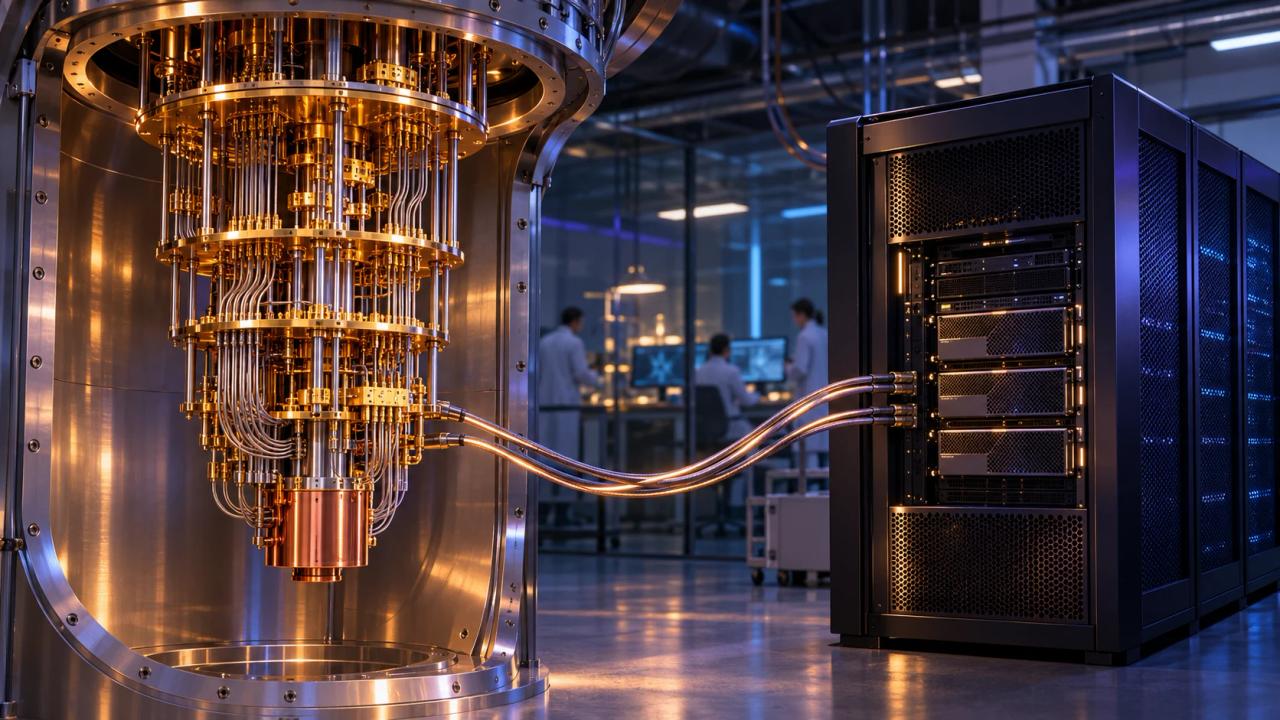
IBM, NVIDIA and Fermilab announced plans on November 16 to bring quantum processors and accelerated computers together in a research platform aimed at making larger quantum systems work. The project would pair IBM quantum computers, including its Nighthawk processor, with NVIDIA DGX B200 systems. IBM
The practical problem extends beyond building a better quantum chip. Researchers need to coordinate processors, manage errors and determine which designs can sustain demanding calculations. Fermilab wants physicists studying particles and nuclei to help set the requirements for those machines from the beginning. Fermilab
Alongside the collaboration, NVIDIA released TCBP-JOBS, software that speeds the classical calculations used to study quantum error correction. The company reports a best-case serial-decoding speedup of 13,000 times. In a separate batched benchmark, its paper reports completing work in 45 minutes on one GPU that would take an estimated 12 weeks on a 64-core server. That result concerns evaluating quantum-computer designs, rather than a completed fault-tolerant machine performing a scientific calculation. NVIDIA
“Realizing quantum computing’s potential requires quantum processors and accelerated computing to evolve together as accelerated quantum supercomputers,” said Krysta Svore, NVIDIA’s vice president of applied research for quantum computing, in IBM’s announcement. IBM
Connecting the pieces
The platform would initially let researchers model and emulate communication between quantum modules. They would study how delays, errors in the connections and feedback affect performance, then use those findings to guide physical interconnect development. Fermilab
A later phase would incorporate superconducting cavities from Fermilab’s Superconducting Quantum Materials and Systems Center. The researchers would investigate their use as quantum memories, buffers for entanglement and components of error-correction schemes. Fermilab also envisages coordinating researcher access and software workflows through its HEPCloud infrastructure. Fermilab
Why the decoder matters
Error correction distributes quantum information across multiple physical qubits. Measurements reveal clues about errors, and a conventional computer runs a decoder to infer the likely correction. NVIDIA’s new decoder is available in CUDA-Q QEC 0.9.0. Faster decoding during research lets scientists evaluate more candidate codes and settings. NVIDIA
TCBP-JOBS combines a learned estimate of error probabilities with many parallel searches on a GPU. Its largest reported speedup comes against the unsparsified long-beam configuration of Google Quantum AI’s Tesseract decoder on bivariate-bicycle codes, one family of error-correction designs. Against Tesseract settings that simplify the error model to save work, the paper reports speedups ranging from 10 to 7,400 times. Research paper
Accuracy also varies by code and noise level. For the batched bivariate-bicycle comparison, the paper reports Tesseract-to-TCBP-JOBS logical-error-rate ratios of 0.97 to 1.57: values above one favor TCBP-JOBS, while values below one favor Tesseract. At lower physical error rates in a separate test, Tesseract was more accurate. Research paper
NVIDIA’s documentation uses stored Tesseract results whose processor hardware and software version were unspecified. The paper also includes newly measured CPU comparisons. A CPU thread and a whole GPU supply different computing resources, and the paper separates the time needed to decode one measurement from the throughput achieved by batching many measurements. Technical documentation
For researchers, those distinctions determine where the software is useful. High throughput helps explore designs before hardware is built; a working machine also needs individual corrections delivered within its own timing budget. The proposed platform would give those software choices, hardware connections and scientific requirements a shared place to be tested. Research paper Fermilab
Sources
Sources · 5
- https://newsroom.ibm.com/2026-11-16-ibm,-fermilab,-and-nvidia-announce-plans-for-new-co-design-platform-to-accelerate-the-development-of-next-generation,-modular-quantum-computers
- https://news.fnal.gov/2026/11/fermilab-ibm-and-nvidia-plan-modular-quantum-computing-co-design-platform-to-advance-scientific-discovery/
- https://nvidianews.nvidia.com/news/nvidia-announces-collaboration-with-ibm-and-fermi-national-accelerator-laboratory-to-launch-quantum-classical-codesign-platform-plus-error-correction-breakthrough-to-advance-practical-quantum-computing
- https://d1qx31qr3h6wln.cloudfront.net/publications/TCBP_JOBS_Paper.pdf?VersionId=SKMmV4ZR2a.1FDUn406nJU6oMSjWjyFB
- https://nvidia.github.io/cudaq-qec/performance/nv_qldpc_tcbp_jobs_user_guide.html