Auckland’s Living Seawall Gives Marine Life a Foothold
Oysters, sponges and crabs have colonized 3D-printed concrete modules at Westhaven Marina.
Published November 19, 2026Intelligence / Biourbanism / Sustainable Infrastructure
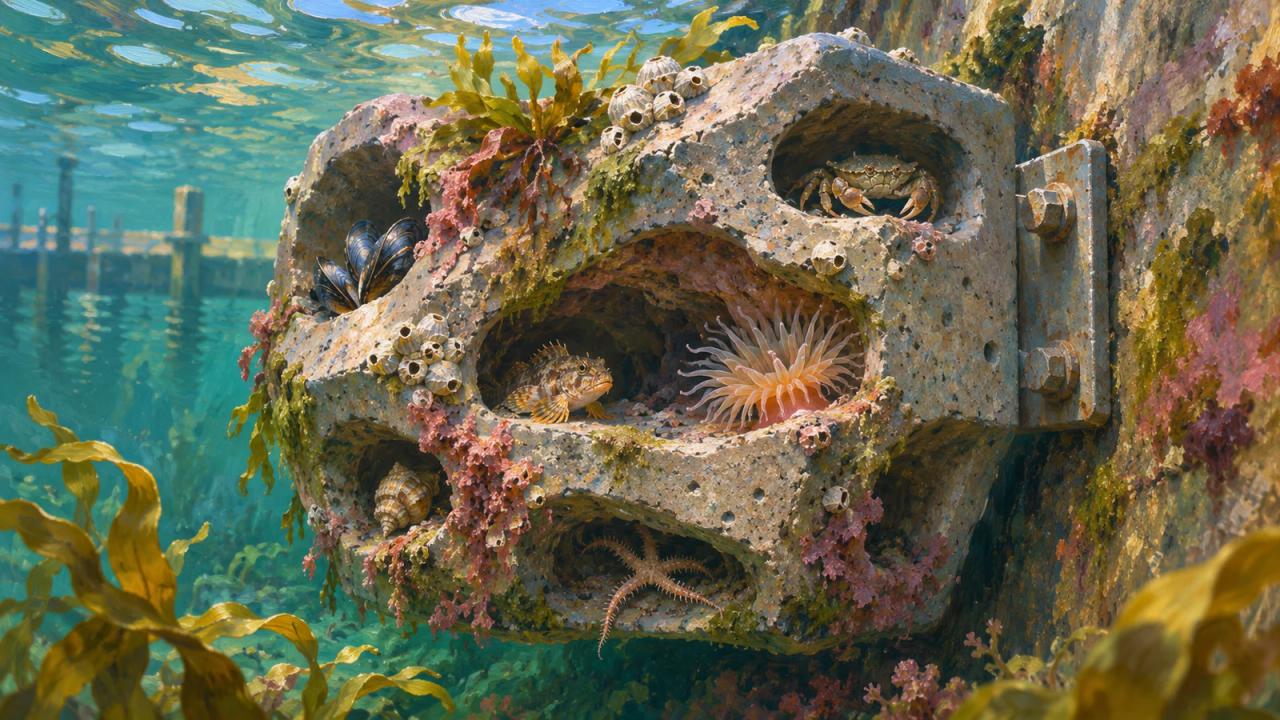
Below the promenade at Auckland’s Westhaven Marina, the concrete has crevices and openings an animal can swim through. An August 2026 survey found seaweeds, barnacles, oysters, sponges, crabs and cushion stars on the 12 habitat modules. A year after installation, every module was intact despite severe weather and heavy waves. Auckland Council published the findings on November 2.
The shapes draw on limpets and barnacles from the rocky shores of the Waitematā Harbour. Marine ecologist Jarrod Walker worked with mana whenua, the Māori groups with ancestral ties to the area, and with designers, engineers and concrete-printing company Qorox. The rough surfaces give organisms places to attach. The holes and recesses offer shelter on a shore otherwise shaped by the needs of a marina.
Flood defense and habitat
Flooding at especially high tides and during major storms led Auckland to renew the seawall near the Harbour Bridge. The main upgrade, reported complete in January 2025, used large rocks placed by barge to dissipate wave energy. A wider promenade and longer lookouts opened up the view from above.
The rocks do the work of the coastal defense. The underwater survey was meant to find out what settled on the modules and whether they survived a year at the waterline. Measuring any effect on flood protection would take a separate test of waves and water crossing the wall.
Two years on a Sydney seawall
An earlier trial in Sydney Harbour shows what a longer comparison can reveal. At Milsons Point in 2018, researchers installed panels patterned after mangrove roots alongside flat panels. Over two years, they sampled different heights on the wall and compared the installation with nearby stretches of unmodified seawall.
At the middle and upper tidal levels, the mangrove-patterned panels supported significantly more species than the flat panels. At the lowest level, the difference was inconclusive. A recess higher on a seawall can matter more because organisms there spend longer exposed to heat and drying between tides. The study also found mussels and native kelp on the shaped panels; it identified filtration and carbon cycling as subjects for direct measurement.
One consequence of the Sydney result is easy to overlook from the promenade. A panel a little higher up the wall can spend hours in air while another stays submerged. A shaded crevice that retains moisture through low tide may give an animal enough time to survive until the water comes back. Lower down, moisture may already be plentiful. Pooling counts from the two heights could conceal precisely the benefit the designers wanted to find.
Westhaven’s next survey could use its twelve modules as twelve repeat observation sites. Photograph the same area on each at the same tide and season, and photograph comparable stretches of ordinary wall at the same elevation. Record native and introduced species separately and follow whether juveniles persist into a second year. If an uncommon animal turns up once, that is valuable natural history. If particular shapes repeatedly shelter animals through the driest part of the tidal cycle, Auckland has something more useful for the next construction contract: a reason to specify those shapes at those heights.
A second Sydney research result gives Auckland a reason to keep some apparently ordinary stretches of wall in its survey. Researchers tested four complex panel designs against flat controls, then compared the installation as a whole with unmodified walls and natural rocky shores. After two years, local biodiversity effects ranged from neutral to positive. Three of the four complex designs supported species unique to that design. The honeycomb design was the exception. A count of species on the single most popular panel would have missed the value of using several shapes side by side. Peer-reviewed panel and site comparison
For Westhaven, that changes the design decision. A marina can commission more of its busiest panel, or it can buy a mixture that supplies a greater variety of refuges at different tidal heights. The evidence for choosing between them lies partly outside the modules. Comparing nearby bare rock and ordinary wall would help distinguish animals newly supported at the site from animals drawn a few meters away from an existing refuge. For a waterfront already committed to a seawall, that distinction determines how much ecological benefit the additional concrete buys.
Auckland’s first survey shows what took hold on the Westhaven modules. The council says colonization was faster than it usually sees on conventional walls, but the public summary gives no paired species counts. A comparison like Sydney’s would help Auckland decide which shapes to repeat and how high or low to put them. The council expects the work to inform future waterfront projects, including the regeneration of Wynyard Point.
Sources
Auckland Council: Westhaven first-year survey, November 2, 2026
Auckland Urban Development Office: seawall upgrade completed, January 22, 2025
Sydney Institute of Marine Science: 24-month biodiversity assessment at Milsons Point