Optical AI Takes on the Work of Learning
A Tokyo–NTT study improves image recognition while cutting computation by about 40 percent in one comparison. Its results show how simpler AI designs could make better use of both electronic and optical hardware.
Published November 6, 2026Analysis / Artificial Intelligence / Generative Models
Researchers at the University of Tokyo and NTT have developed a way to simplify both the design of artificial intelligence models and the process of teaching them. In a study published November 5 in Nature Computational Science, their approach improved performance while reducing computational requirements by about 40 percent in a tested image-recognition architecture.
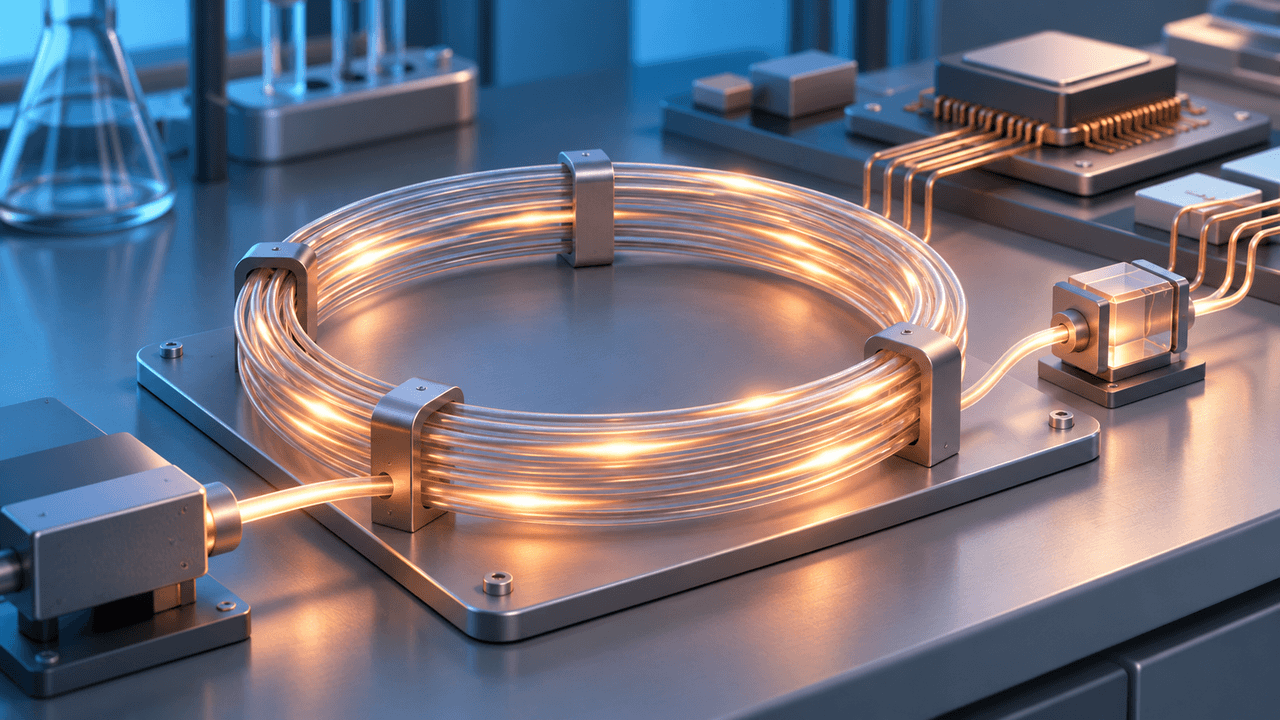
The team also demonstrated its ideas in a physical system built around 200 meters of optical fiber. Information entered as an electrical signal, became light traveling through the loop, and returned to electronics for analysis. The experiment shows how the learning method can operate in real optical hardware.
The approach could help an industry trying to get more computing from limited electricity. Training has its own costs: a model repeatedly makes predictions, checks its errors and adjusts. A physical processor must support that learning cycle as well as perform calculations quickly. Measuring, storing and retrieving its internal activity can consume some of the advantage that optical hardware promises.
The results cover several comparisons: about 40 percent less computation in a modified image-recognition model, larger calculated reductions in a separate architecture comparison, and a working optical demonstration. Larger-model trials and complete-system energy measurements are the next steps toward establishing the practical savings.
Learning with less to remember
Graduate student Yongbo Zhang explained the motivation in the university’s announcement: “we wanted to rethink the learning process itself.”
The researchers paired two changes. One addresses how the system learns; the other simplifies what happens inside it. Together they reduce the amount of detailed supervision needed to make a physical process useful for AI.
Conventional backpropagation calculates how a model’s adjustable parameters contributed to its error. When a physical system evolves through a sequence of states, applying this method through time can require access to the intervening states. Recording and retrieving that history adds work as the computation unfolds in light or another changing physical quantity.
The new method, state-skipping direct feedback alignment, or SS-DFA, sends information about the final error more directly to the trainable layers. Fixed random mappings carry that feedback. The update uses the initial state and limited information about the system, letting it learn from a much smaller record of its activity. The university’s technical release explains how the paired architecture further reduces the information required.
That architecture replaces dense internal connections with independent units following a simple nonlinear rule. Each unit repeatedly transforms its own value. The surrounding input and output layers still perform useful work. Inside the system, simple operations on individual values take the place of a large matrix calculation at every step.
Small differences between inputs can grow during this evolution, helping the model distinguish patterns. The researchers examined settings near transitions in the system’s behavior and regimes where differences temporarily expand. This offers a way to extract useful complexity from a simple physical structure.
What 40 percent means in practice
The researchers tested image recognition using MNIST, a collection of handwritten digits, and CIFAR-10, which contains small images in ten categories. In the CIFAR-10 experiment behind the roughly 40 percent figure, they inserted their single-map module into ResMLP, a residual multilayer perceptron. Both versions used ordinary backpropagation for training, allowing the comparison to examine the architecture itself.
The published Figure 5 source data put the standard model at 4.7246 trillion floating-point operations per training epoch. The modified version required 2.8368 trillion. An epoch is one pass through the training data; a floating-point operation is a numerical calculation, such as adding or multiplying numbers.
Subtracting the two gives about 1.8878 trillion operations saved per pass. Dividing that saving by the original 4.7246 trillion gives 39.96 percent, rounded to 40 percent. Put simply, this version did about 60 calculations for every 100 required by the standard design.
Recognition accuracy held up. The best point on the five-run mean accuracy curve was 65.432 percent for the standard model and 65.806 percent for the best tested single-map setting. That is a small increase of about 0.37 percentage points, alongside the substantial reduction in computation. The simpler structure used its calculations more effectively on this task.
This design can also be implemented digitally. Its rules are mathematics that conventional electronic processors can execute, and the ResMLP comparison was a numerical experiment. Researchers can therefore explore the architecture in software while optical engineers develop hardware that performs its operations physically.
Where the larger reduction comes from
The university’s report of reductions up to about 90 percent draws on a separate set of architecture comparisons. Here the researchers examined how the amount of computation changes as the number of internal units grows.
At a width of 10,000 units, the Figure 3 source data give the conventional multilayer perceptron a calculated MNIST training cost of 38.862 trillion operations per epoch. The single-map design requires 2.895 trillion. The saving is 35.967 trillion, or about 92.55 percent. That leaves roughly 7.5 calculations for every 100 in the conventional design. The corresponding 10,000-unit CIFAR-10 comparison gives a reduction of about 76 percent, reflecting the different workload.
Those 10,000-unit figures describe calculated computational requirements. The reported width-scaling accuracy tests extend to 5,000 units. Comparisons reporting both accuracy and computation show how much work the models required to maintain recognition quality.
One such comparison appears in Supplementary Table 3. On MNIST, a fully connected reservoir trained with backpropagation through time reached 98.31 percent accuracy after an estimated 14.1 trillion cumulative operations. The single-map system trained with SS-DFA reached 98.33 percent after 6.4 trillion. It achieved essentially the same recognition quality with about 55 percent less total training computation to its best result.
The simpler designs maintained image-recognition accuracy while reducing the computation required for the tested tasks. Reasoning, language generation and multimodal performance are questions for larger-model studies.
The fiber experiment tests physical implementation. The authors’ preprint reports 97.10 percent test accuracy on handwritten digits. Its procedure jointly adjusted input and output weights for five epochs, then trained the output weights for another 195. That demonstration establishes a working way to combine the learning method with optical dynamics.
Following the electricity through the system
The published supplementary analysis estimates about 1.14 watts and 9.51 picojoules per operation for the specified components, including the optical source and conversion interfaces. Measuring complete training jobs would establish full-system electricity use.
The supplement also reports a measured delay of 6.1 microseconds at 60 gigabaud, with about 64,000 pulses and five internal steps. Its figures for a future integrated design are projections.
The current optical design processes work serially. Highly parallel GPUs currently lead this prototype in throughput and energy efficiency, according to the authors. Their proposed integrated design would run multiple optical cavities in parallel.
Practical operation brings other demands. In the published peer-review response, the team describes temperature control for its modulators and recalibration of their bias points every 20 minutes. Stability and control are part of the engineering problem that must accompany gains in the computing core.
For a developer paying to train a model, the benefit depends on how fewer calculations translate into faster execution on the chosen hardware. GPU utilization, memory access, data movement and software all affect that translation. An operation count describes the arithmetic; billed GPU hours describe how long rented hardware is occupied.
Consider a hypothetical $1,000 GPU-rental job that spends half its billed time on the work improved by the new design. Assume that portion finishes 40 percent sooner, with the same learning quality, the same remaining work and the same hourly rental rate. The saving would be $1,000 multiplied by one-half and then by 40 percent: $200. The resulting bill would be $800. These assumptions illustrate how a 40 percent improvement in part of a job could produce a 20 percent reduction in its total rental cost.
Electricity has a separate calculation: average power multiplied by running time. If average power also stayed the same in that example, a 20 percent shorter job would use 20 percent less electricity. Its electricity cost would depend on the tariff. Actual savings would be established by timing and metering the complete workload, including supporting processors, memory, signal conversion and thermal control.
Optical computing for training and inference
The work adds a training-focused strand to the developments covered in JetsonsAge’s recent Lumai analysis. Lumai’s announced deployment at ARIA’s Scaling Inference Lab concerns inference: using an already-trained model to answer requests. Its optical servers are intended to handle the compute-heavy processing of prompts, with conventional silicon handling the subsequent generation of responses.
The November 3 announcement describes a setting where the technology’s commercial value can be tested. ARIA chief science and technology officer David Lewis said the lab would “test that potential openly and independently at rack scale.” Its planned evaluation and the Tokyo experiment address different workloads, at different stages of development.
For the Tokyo team, the opportunity is to make physical AI easier to teach and build. If the simpler module remains effective in more demanding architectures, researchers could explore it both in conventional software and in specialized hardware. The learning method could also reduce the measurement burden on other physical computing platforms.
Associate professor Kohei Nakajima described the possibilities if the system can be miniaturized and integrated onto a chip: “it could process data directly inside phones, cameras or self-driving cars.” That path calls for further work on miniaturization, stability and manufacturing, alongside tests on today’s largest AI models.
Developers can test the simpler architecture in software and build optical hardware around its operations. Larger benchmarks and complete-system measurements will show how far those savings carry.
Sources
Nature Computational Science: published paper and abstract, November 5, 2026
University of Tokyo: researcher announcement and quotations
University of Tokyo: technical release, including the learning method and architecture
Published Figure 5 source data: ResMLP accuracy and computation
Published Figure 3 source data: width-scaling computation and parameter counts
Published supplementary information: Table 3 and hardware analysis
Authors’ open preprint: ResMLP training method and optical experiment
University of Tokyo: Japanese announcement and approximately 90 percent claim
Published peer-review response: hardware stability and calibration
JetsonsAge: Lumai and the Race to Get More AI From Every Megawatt
Sources · 12
- https://www.nature.com/articles/s43588-026-01075-w
- https://www.u-tokyo.ac.jp/focus/en/press/z0508_00471.html
- https://www.i.u-tokyo.ac.jp/news/files/20261105scalable_physical_deeplearning.pdf
- https://static-content.springer.com/esm/art%3A10.1038%2Fs43588-026-01075-w/MediaObjects/43588_2026_1075_MOESM7_ESM.xlsx
- https://www.i.u-tokyo.ac.jp/news/press/2026/202611052921.shtml
- https://static-content.springer.com/esm/art%3A10.1038%2Fs43588-026-01075-w/MediaObjects/43588_2026_1075_MOESM5_ESM.xlsx
- https://static-content.springer.com/esm/art%3A10.1038%2Fs43588-026-01075-w/MediaObjects/43588_2026_1075_MOESM1_ESM.pdf
- https://assets-eu.researchsquare.com/files/rs-8145052/v1_covered_3968542d-f4a6-4897-8991-3e5cd0bf500d.pdf
- https://static-content.springer.com/esm/art:10.1038%2Fs43588-026-01075-w/MediaObjects/43588_2026_1075_MOESM1_ESM.pdf
- https://static-content.springer.com/esm/art:10.1038%2Fs43588-026-01075-w/MediaObjects/43588_2026_1075_MOESM2_ESM.pdf
- https://www.jetsonsage.com/analysis/lumai-ai-photonics-energy-efficiency
- https://lumai.ai/resources/arias-scaling-inference-lab-deploys-lumais-optical-compute-technology-to-help-power-ai-era