Lumai and the Race to Get More AI From Every Megawatt
Optical networks are already improving how large computers work. Lumai’s coming rack-scale trial will test a more ambitious step: doing AI arithmetic with light. The results could change the choices facing a country increasingly resistant to building data centers.
Published November 5, 2026Analysis / Artificial Intelligence / Generative Models
As American voters demanded tighter limits on data centers, an Oxford spinout was advancing a different response to the power those buildings consume: change the machinery inside them.
Lumai announced on November 3 that its optical inference servers would enter the Advanced Research and Invention Agency’s (ARIA) Scaling Inference Lab, operated by CommonAI CIC. The lab’s schedule places optical computing deployment in the first quarter of 2027. Its planned cluster will pair eight Iris Nova optical servers with NVIDIA graphics processing units (GPUs). The experiment will ask whether dividing work between photons and electronics can substantially reduce the energy needed to run large language models.
The timing connects two arguments that are often conducted separately. Technology companies want more electricity to expand artificial intelligence (AI). Communities want protection from the bills, water demands and disruption that expansion can bring. Photonics offers a reason to reconsider assumptions about the equipment a future data center will contain. It does not relieve developers of responsibility for the infrastructure they are proposing today.
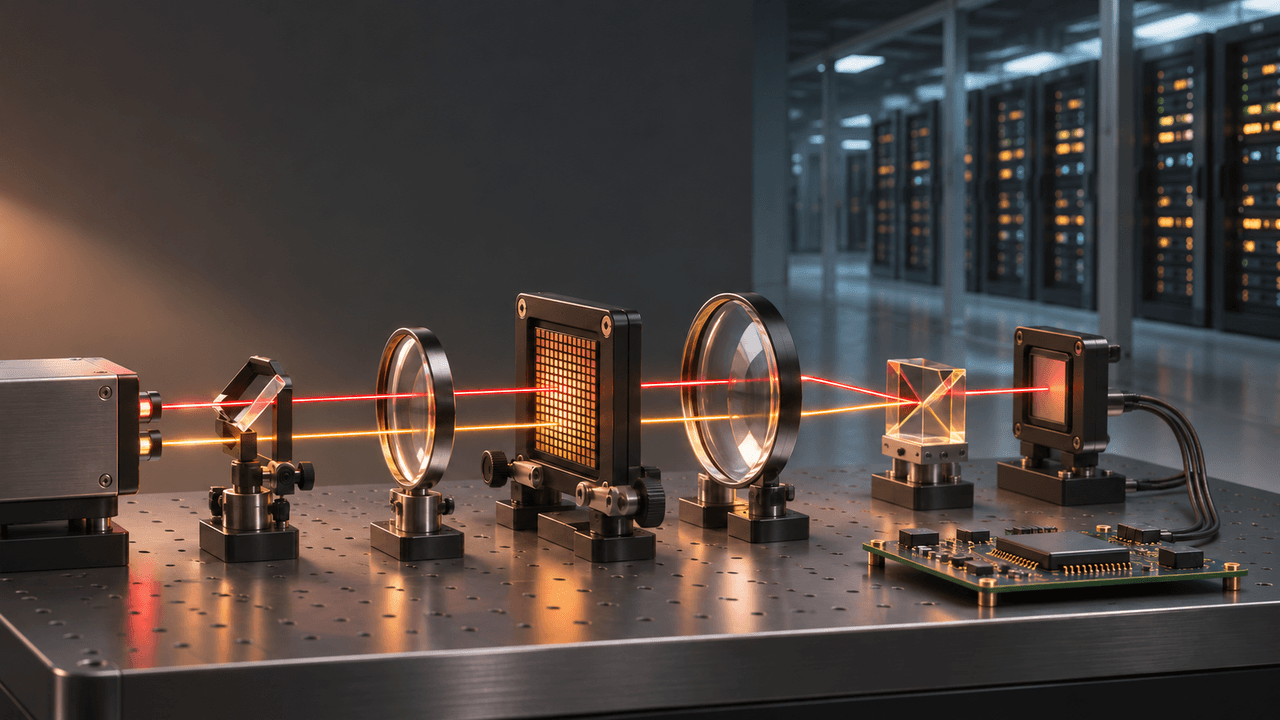
Lumai is attempting something more ambitious than replacing a copper connection with fiber. Its hardware performs matrix operations, the repeated combinations of numbers at the heart of neural networks, using light. The company’s April launch announcement described a hybrid system running Llama models with 8 billion and 70 billion parameters, and made Iris Nova available for evaluation. Electronics still manage the system around its optical engine.
Lumai grew out of University of Oxford optics research. Its optical engine allows many matrix operations to happen simultaneously as light passes through an arrangement of lenses and other components. That parallelism underlies the company’s promise of handling more calculations with less electronic switching.
At the lab, the optical servers will process the prompt, a stage called prefill, while GPUs generate the response through successive decoding steps. Prefill can make heavy use of matrix computation; decoding often puts greater pressure on memory bandwidth. How the work divides between them depends on the model, batch size and lengths of the input and answer. Reading a long document and returning a short classification presents a different energy problem from producing a lengthy response.
Lumai’s November announcement attaches two ambitious figures to the project: up to 90 percent lower data-center power consumption and at least sixteenfold better energy efficiency per inference for an optical-and-silicon configuration. The headline states the power reduction as a result, while the body describes a potential the deployment will evaluate. In April, the company had already claimed up to 90 percent lower energy consumption.
Power describes the rate at which equipment draws electricity; energy per inference counts the electricity used to complete the work. A sixteenfold efficiency improvement would imply about 94 percent less energy for equivalent work within the same measurement boundary. The announcement leaves the workloads, comparison hardware and full power boundary unspecified, so the relationship between the two figures remains unclear.
To establish the gain, researchers will need to meter the complete optical-and-electronic system as it finishes requests at comparable accuracy and response requirements. That includes the supporting electronics and decoding hardware, with cooling accounted for consistently. Comparing it with a modern electronic system that also separates prefill and decode would help isolate what the optical processor contributes.
In the networks connecting AI machines, optical technology already has an operating history. Fiber has carried data for decades. Co-packaged optics (CPO) brings the conversion between electronic and optical signals closer to the main switching chip, shortening the electrical path across a circuit board. Optical circuit switching (OCS) redirects light between connections, potentially avoiding intermediate conversion and layers of electronic networking. Lumai’s optical arithmetic extends the role of light into another part of the computer.
NVIDIA’s suppliers are preparing for much larger production volumes, a shift examined in the earlier analysis of its manufacturing expansion. In its October 21 announcement, the company said Siliconware Precision Industries (SPIL) was targeting fifteen times its optical-engine manufacturing capacity by mid-2027, with another doubling sought by the end of 2028. Manufacturing yields, packaging and service procedures will determine how much usable hardware reaches operators and how reliably it runs.
Broadcom began shipping its Tomahawk 6 Davisson switch in October 2025, claiming a 70 percent reduction in optical-interconnect power compared with traditional pluggable solutions. Lightmatter is working through a different stage of development: its October 2026 announcement presented a switch platform for production validation and a separate accelerator-tray demonstration.
Google’s experience shows how an optical network can evolve while carrying production traffic. Its Jupiter research reported a 41 percent reduction in the power used by its network fabric across a decade of architectural changes. Optical switches and software-controlled connections were part of that broader redesign.
PsiQuantum’s move into AI networking draws on a photonics platform developed for quantum computing. In its October 28 announcement, the company disclosed an eight-by-eight demonstration switch and samples for prospective customers. Customer trials will provide a way to examine how the low optical losses reported in its laboratory translate into a conventional AI network and its electricity consumption.
For operators running jobs held back by communication, faster connections can shorten the time processors spend waiting for one another. Lower networking consumption can also free electrical capacity for other equipment at a site whose connection cannot grow. The benefit then depends on how the operator uses that capacity and how well the network suits the workload.
Consider a hypothetical facility in which the optical subsystem consumes 5 percent of the total electricity. Cutting that subsystem’s consumption by 70 percent would save 3.5 percent across the facility if other loads stayed fixed. This example uses an assumed optical share and leaves any further effects from cooling or faster job completion to be measured separately.
Lumai is aiming at a larger part of the electricity bill by tackling computation itself. Its reach will depend on the share of energy spent on the calculations Iris performs, how much the supporting electronics consume and the range of workloads the system can handle.
Lawrence Berkeley National Laboratory’s June 2026 update projects U.S. data-center electricity use at 649 terawatt-hours in its 2030 reference case, equivalent to 11.8 percent of U.S. electricity. Its modeled scenarios range from 9.5 to 15.3 percent.
Globally, the International Energy Agency’s (IEA) April outlook projects data-center electricity consumption roughly doubling from 485 terawatt-hours in 2025 to 950 in 2030. Efficiency is improving as demand shifts toward reasoning, video and agentic applications, which can consume much more energy than a simple text query.
Cheaper computing can also draw in more users. An operator that reduces the electricity needed for each request can serve more customers within the same power limit, or combine those savings with additional capacity. Total consumption will depend on whether efficiency improves faster than the volume and intensity of the work.
China is expanding the power system on which its own computing ambitions depend. The National Energy Administration’s September figures report 1,310 gigawatts of installed solar capacity and 700 gigawatts of wind. Output from those resources varies with weather and time, so the scale of the buildout is better understood alongside the electricity it produces.
Ember’s 2026 electricity review finds that Chinese clean generation increased by 561 terawatt-hours in 2025, exceeding the 503-terawatt-hour increase in electricity demand. Fossil generation fell, although coal still supplied 54 percent of the country’s electricity.
An AI developer needs electricity at a particular connection and in the hours its equipment runs. Estimating the emissions added by a new Chinese facility requires evidence about generation in that province and at those times; the annual national balance leaves that question open. Turning available power into useful AI also requires processors, memory, networks and software.
In parts of the United States, securing dependable electricity has become a problem of timing and location. PJM Interconnection’s October 29 filing announcement describes an amended procurement proposal to address an approximately 6,800-megawatt capacity shortfall for 2028–29. Under the proposal, procurement would begin in March 2027, with costs assigned to the large loads driving the growth.
The U.S. Energy Information Administration (EIA) reports that power-sector emissions rose 4 percent in 2025, reflecting higher electricity demand and a larger coal share. Weather, data centers and manufacturing all contributed to demand growth. The supply choices made as that demand expands will shape the climate cost of the next wave of facilities.
For a hypothetical 100 terawatt-hours of electricity, an assumed operational emissions intensity of 400 grams of carbon dioxide (CO₂) per kilowatt-hour would produce 40 million metric tons of CO₂. At 100 grams, the same electricity use would produce 10 million tons. These cases cover operating emissions, excluding construction and upstream fuel emissions.
Keeping renewables central to the buildout will require transmission, storage and dependable clean resources that can serve facilities through changing conditions. Annual renewable-electricity purchases leave open the question of what supplies a site overnight or during periods of low wind and sun. Batteries can shift some of the available electricity into those hours. The EIA reports that more than 16 percent of new utility-scale solar capacity added through September was paired with operating batteries.
Following the November 3 election, the Associated Press called Democratic control of both chambers of Congress. The National Conference of State Legislatures (NCSL) identified five new Democratic trifectas—control of the governorship and both legislative chambers—in Michigan, Minnesota, Nevada, Pennsylvania and Wisconsin. Its November 4 tally remains unofficial, with races still unresolved.
Voters favored limits on data-center development in 40 of the 41 measures in Ballotpedia’s November 3 results table. Its year-to-date tally is 46 restrictive outcomes among 47 decided measures. The measures covered bans, temporary moratoriums, financial requirements and advisory questions. In Joliet, voters rejected an advisory question asking them to support construction.
Texas Governor-elect Gina Hinojosa campaigned for a moratorium until lawmakers established protections and gave communities a role in deciding whether projects should proceed. Public concern was visible before the election: Pew Research Center’s September publication reported that 54 percent of U.S. adults viewed data centers as mostly bad for the environment and 50 percent for home energy costs.
How much the issue contributed to the congressional outcome is harder to establish. The AP’s election account also identifies high prices, the Iran war and concerns about corruption as major sources of dissatisfaction. The local results reveal what those communities wanted on specific development questions; the national election brought together voters with many concerns.
Rules that assume every new project will have the resource demands of an older design could exclude more efficient facilities. American businesses and researchers could then lose opportunities to benefit from improvements in computing. The case for a particular facility will depend on what it can demonstrate about its equipment and supply, alongside the costs its neighbors would bear.
Microsoft’s announced cooling design shows how the water calculation could change for new projects. It recirculates liquid without evaporating water for cooling, with some additional energy use compared with evaporative designs. The company’s announced rollout includes new sites expected to begin operating in late 2027. A full assessment of their water demand would also account for the electricity supply, while existing facilities continue to use a range of cooling systems.
Communities have reasons to seek enforceable commitments on peak demand, water consumption, noise and responsibility for grid upgrades, along with financial protection if promised demand fails to materialize. Verified efficiency gains could help developers meet some of those terms. Local governments and regulators would still have to resolve land use, transmission spending and how the costs are shared.
For Lumai, the first-quarter 2027 trial offers a chance to measure how much energy the complete system uses, which requests benefit and how the advantage holds up under realistic operating conditions. Companies bringing optical networks into wider use face the work of producing reliable hardware in volume and maintaining it in service.
Changing the machinery inside a data center could change the terms on which it is built. Developers able to demonstrate more useful computing per megawatt, obtain cleaner electricity and cover the local costs would have a stronger case to take back to those voters.
Sources
Scaling Inference Lab — deployment schedule, including optical computing in Q1 2027
Lumai — Iris inference-server launch and evaluation availability, April 28, 2026
Lumai — ARIA optical-computing deployment announcement, November 3, 2026
JetsonsAge — NVIDIA and the race to make computing more efficient with light, October 25, 2026
NVIDIA — supply-chain and optical-engine capacity expansion plan, October 21, 2026
Broadcom — Tomahawk 6 Davisson shipping announcement, October 8, 2025
Lightmatter — open-rack CPO switch and accelerator-tray demonstrations, October 12, 2026
Google Research — Jupiter Evolving, ACM SIGCOMM 2022, original paper
JetsonsAge — PsiQuantum Aims to Get More Useful AI Work From the Network, October 30, 2026
PsiQuantum — optical circuit-switch demonstration and customer samples, October 28, 2026
International Energy Agency — Key Questions on Energy and AI, executive summary, April 2026
Ember — Global Electricity Review 2026, China generation and demand
PJM Interconnection — amended reliability backstop proposal, October 29, 2026
Associated Press via MPR News — congressional election calls, November 4, 2026
Ballotpedia — 2026 ballot-measure results, including dated local data-center measures
Pew Research Center — Americans’ views of data centers, September 22, 2026
Microsoft — next-generation non-evaporative cooling design, December 9, 2024
Sources · 25
- https://www.scalinginference.org/
- https://www.scalinginference.org/cluster-4
- https://lumai.ai/resources/lumai-launches-the-worlds-first-optical-computing-system-for-real-time-billion-parameter-llm-inference
- https://innovation.ox.ac.uk/news/entering-quantum-era
- https://lumai.ai/resources/arias-scaling-inference-lab-deploys-lumais-optical-compute-technology-to-help-power-ai-era
- https://www.jetsonsage.com/analysis/nvidia-photonics-computing-efficiency
- https://nvidianews.nvidia.com/news/nvidia-and-supply-chain-partners-expand-capacity-to-accelerate-ai-infrastructure-buildout
- https://investors.broadcom.com/news-releases/news-release-details/broadcom-announces-tomahawkr-6-davisson-industrys-first-1024
- https://lightmatter.com/press-release/lightmatter-delivers-open-rack-cpo-switch-and-xpu-scale-up-server-through-independent-collaborations-with-flex-and-other-industry-partners/
- https://storage.googleapis.com/gweb-research2023-media/pubtools/6752.pdf
- https://www.jetsonsage.com/analysis/psiquantum-optical-circuit-switch-ai-network
- https://www.psiquantum.com/news-import/psiquantum-unveils-optical-circuit-switch-technology-built-on-advanced-low-loss-silicon-photonics-platform
- https://eta.lbl.gov/publications/united-states-data-center-energy-2025
- https://www.iea.org/reports/key-questions-on-energy-and-ai/executive-summary
- https://www.nea.gov.cn/20261026/7e48f52542c94c0f99c166262453627d/c.html
- https://ember-energy.org/latest-insights/global-electricity-review-2026/major-countries-and-regions/#china
- https://insidelines.pjm.com/pjm-files-amended-reliability-backstop-proposal/
- https://www.eia.gov/environment/emissions/carbon/
- https://www.eia.gov/todayinenergy/detail.php?id=68384
- https://www.mprnews.org/story/2026/11/04/democrats-win-the-us-house-and-take-unified-control-of-congress
- https://www.ncsl.org/state-legislatures-news/details/2026-state-legislative-elections-the-results-and-what-they-mean
- https://ballotpedia.org/2026_ballot_measure_election_results
- https://ginafortexas.com/priority/data-centers/
- https://www.pewresearch.org/short-reads/2026/09/22/americans-views-of-data-centers-have-turned-more-negative/
- https://www.microsoft.com/en-us/microsoft-cloud/blog/2024/12/09/sustainable-by-design-next-generation-datacenters-consume-zero-water-for-cooling/