Joby Tests an Electric Air Taxi at Orlando Airport
Joby Aviation flew its electric air taxi at Orlando International Airport on November 4, using a new landing pad near Terminal C and the airport’s train station.
Published November 6, 2026Analysis / Transportation / Urban Air Mobility
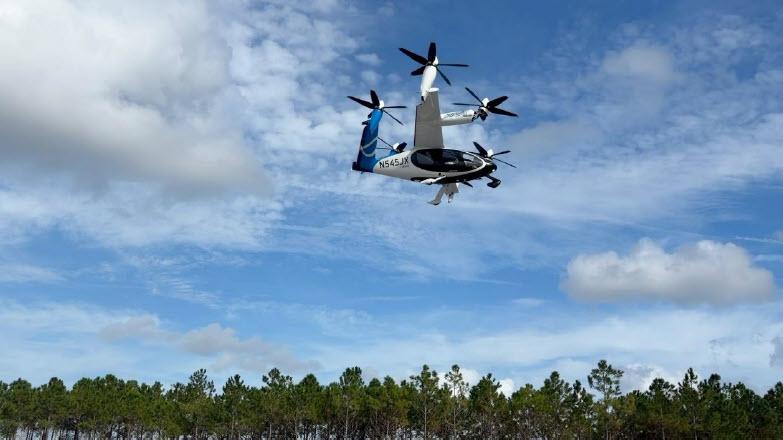
Joby Aviation flew its electric air taxi at Orlando International Airport on November 4, using a new landing pad near Terminal C and the airport’s train station. Florida transportation officials and the airport authority said it was the first use of Vertipad Atlantis, which they describe as the nation’s first dedicated landing site for these aircraft at a commercial airport. The flight put an aircraft designed for short regional trips into the daily working environment of a major airport. [1–3]
For a traveler arriving in Orlando, the possible payoff is easy to picture: collect your bags, change aircraft near the terminal, and fly toward your destination instead of joining highway traffic. Joby’s chief policy officer, Greg Bowles, described the ambition as getting “from the gate to the parks in minutes instead of an hour on the highway.” Passenger timetables and fares remain to be announced. [1–2]
Reaching this point took two years of simulation and coordination involving the Federal Aviation Administration, NASA, airport officials and Orlando air traffic controllers, according to Joby. The demonstration used routes and procedures developed through that work. A pilot approaching the new pad has to fit into an airport where airliners are already arriving and departing, with controllers responsible for keeping each aircraft safely separated. [2–4]
Atlantis now gives those teams a real location at which to test their plans. The airport describes the small pad as groundwork for a future commercial vertiport, with a fuller facility envisioned by 2030. Its position near the rail station also puts the experiment beside an existing connection between air and ground travel. For a future passenger, the usefulness of an air taxi will depend on how much time the entire transfer saves, including the walk, boarding and wait for departure. [2–3,5]
Making room in the air
Joby designed its electric vertical takeoff and landing aircraft, or eVTOL, for a pilot and four passengers. Six electric tilt-propellers provide vertical lift, then rotate for forward flight as the wing supports the aircraft. Joby advertises speeds of up to 200 mph. Those design features make a compact airport landing area possible, while the aircraft still needs a carefully managed route through the surrounding airspace. [6]
The FAA’s February 2026 Orlando assessment shows what the planning involved. Researchers simulated three proposed airport vertiport locations and added eVTOL traffic to conventional airport traffic. Scenarios examined both northbound and southbound runway flows, with planned traffic levels ranging from four to 26 eVTOL operations per hour. The figures describe simulated traffic levels. [7]
The report found a need for a dedicated Class B controller position in the tower even with one vertiport operating. Class B is the controlled airspace around major airports. Adding more sites increased coordination and workload. Researchers adjusted routes, including turns and arrival paths, to reduce potential conflicts. They also identified work on wake turbulence, contingency procedures and controller training. A flight path has to account for the air disturbed by large aircraft as well as their position on a radar screen. [7]
The report’s findings give the November flight a practical purpose: taking a route developed with controllers into actual operation, where pilots, aircraft and airport staff must work together. Joby airspace engineer Eric Mueller has described route changes that give departing aircraft more time to climb before encountering conventional traffic. He also says Joby aircraft carry ADS-B In and Out, a surveillance system that shares aircraft position information and helps pilots and controllers maintain awareness. [2,4]
The work between flights
On the ground, a passenger service will need clear paths between the terminal and aircraft, controlled access to the operating area, and a place to prepare each aircraft for its next trip. FAA vertiport guidance addresses parking, charging, fire safety and the fast-moving air pushed down and outward by rotors. It also calls for coordination over airport security and any passenger screening required before entry to secured areas. Those details determine where people can wait and how safely they can reach their seats. [8]
Battery charging is another part of that ground operation. Joby’s Global Electric Aviation Charging System, or GEACS, combines electrical connections, coolant exchange and a data connection. Its published description explains that an external system controls battery temperature during charging and can condition the batteries before flight. Multiple channels charge isolated battery packs, while the data connection allows flight records to be downloaded during the same stop. [9]
The battery’s temperature, available electrical power and the time needed to ready the next flight all influence how quickly an aircraft can return to service. The FAA advises airport operators to consider charging equipment in their overall site plans, including its compatibility with surrounding facilities. A sustained airport-transfer service will need that ground operation to keep pace with its flight schedule. [1–2,9–10]
Testing before commercial service
The Florida demonstrations are part of the FAA’s eVTOL Integration Pilot Program, which collects operating experience through government and industry partnerships. The FAA says every selected project uses aircraft in an active type-certification project and increases operational complexity in phases. In its November 4 results announcement, Joby reported completing a range of formal testing in the fifth and final stage of FAA type certification. Certification work remained underway on the day of the Orlando flight. [11–12]
FAA Administrator Bryan Bedford described the purpose of the Florida campaign in Joby’s October 30 announcement: “Each flight provides crucial data and lessons learned that will help establish safety standards for everyday operations.” For MCO, those lessons now include operating at the new pad with the airport’s controllers involved. Further flights can help show how the procedures hold up when operations become more frequent and the demands on crews and equipment grow. [2–3,11]
Orlando’s prepared landing site has now hosted a piloted electric-aircraft demonstration using procedures shaped by years of airport planning. Repeat operations will test those procedures as the airport and Joby develop their passenger-service plans. Travelers will eventually judge the idea by a simple experience: how reliably they can get from their arriving flight to the place they came to visit. [1–3]
Sources
1. Florida Department of Transportation. FDOT and Orlando International Airport Celebrate Air Taxi Landing at Nation’s First Vertipad at a Commercial Airport. November 4, 2026.
2. Greater Orlando Aviation Authority. MCO Hosts Joby Demonstration Flight at New Vertipad. November 4, 2026.
3. Joby Aviation. Joby Brings Its Vertical Takeoff and Landing Air Taxi to Florida. October 30, 2026.
4. Eric Mueller, Joby Aviation. Integrating eVTOLs at Commercial Airports. April 29, 2026.
5. Greater Orlando Aviation Authority. Vertistop Development and Advanced Air Mobility Initiatives. accessed November 5, 2026.
6. Joby Aviation. Technology and aircraft specifications. accessed November 5, 2026.
7. Federal Aviation Administration. Advanced Air Mobility Initial Services Assessment of eVTOL Aircraft Operations at Orlando International Airport. February 20, 2026; scenarios and conclusions, printed pages 8–22 and 50–52.
8. Federal Aviation Administration. Engineering Brief 105A on Vertiport Design. December 27, 2024; charging and site safety, pages 48–56.
9. Joby Aviation. Global Electric Aviation Charging System. November 2023; technical description, pages 1–2.
10. Federal Aviation Administration. Advanced Air Mobility Infrastructure. accessed November 5, 2026.
11. Federal Aviation Administration. The eIPP Accelerating AAM into American Skies. updated October 16, 2026.
12. Joby Aviation. Joby Reports Third Quarter 2026 Financial Results. November 4, 2026.
Sources · 12
- https://fdot.gov/info/co/news/2026/11042026/
- https://www.flymco.com/media/press-releases/item/mco-hosts-joby-demonstration-flight-at-new-vertipad/
- https://www.jobyaviation.com/news/joby-brings-its-vertical-takeoff-and-landing-air-taxi-to-florida
- https://www.jobyaviation.com/news/integrating-evtols-at-commercial-airports
- https://flymco.com/elevatingmco/current-projects/vertistop-development-and-advanced-air-mobility-initiatives/
- https://www.jobyaviation.com/technology
- https://www.faa.gov/air-taxis/MCO_HITL_90_day_Report_Feb2026.pdf
- https://www.faa.gov/airports/engineering/engineering_briefs/eb_105a_vertiports
- https://joby-site.cdn.prismic.io/joby-site/5f82ea34-645e-4468-8e3f-14a16e298941_Joby-Charging-GEACS-final.pdf
- https://www.faa.gov/airports/new_entrants/aam_infrastructure
- https://www.faa.gov/aam/eipp
- https://www.jobyaviation.com/news/joby-reports-third-quarter-2026-financial-results