A Robot Builds an Antenna Framework in Orbit
Caltech’s DARPA-backed experiment joined lightweight structural parts while deploying reflective mesh, testing a construction method for much larger space systems.
Published November 6, 2026Analysis / Space Development / Base Development
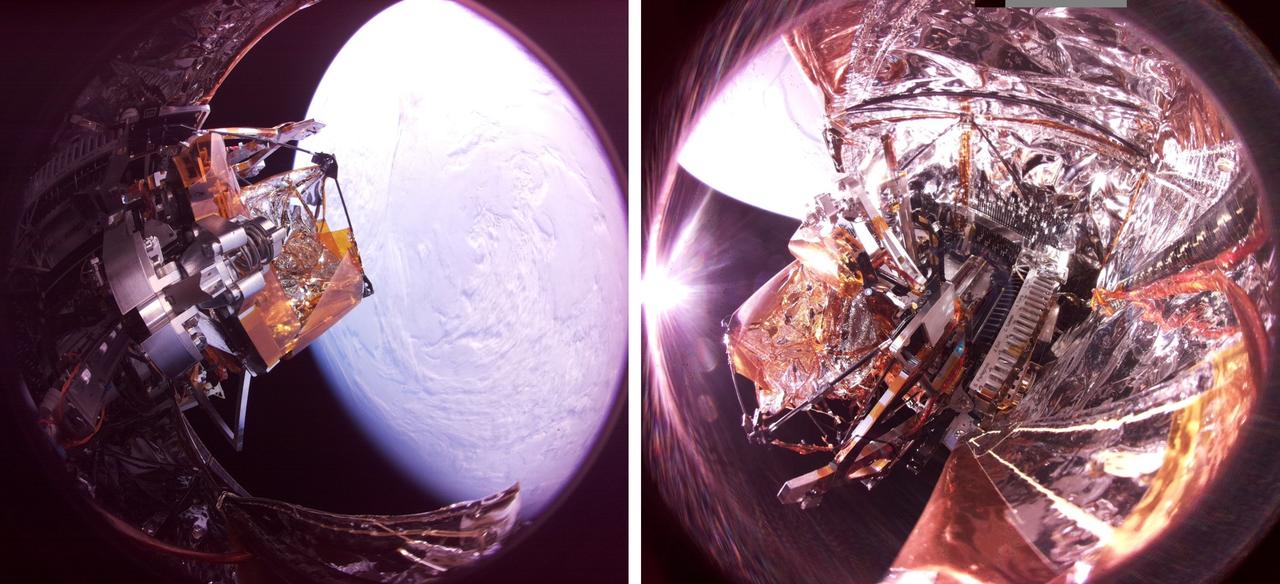
A robot operating in Earth orbit has assembled a lightweight framework from individual parts while deploying a thin reflective mesh, DARPA announced on November 5. Built by the California Institute of Technology, the experiment demonstrates a way to construct antenna-like structures after launch, with the assembly machinery traveling alongside the building materials. DARPA’s announcement
The payload used a gantry robot that moves along three straight axes. It connected composite truss members with specially designed joints and attached the mesh as construction proceeded. Completed sections moved out of the assembly box, making room for the next section. Repeating the sequence lets a compact machine build a structure larger than its own work area.
The experiment flew on Momentus’s Vigoride 7 spacecraft, which launched on March 30 aboard SpaceX’s Transporter-16 mission. Momentus supplied power, communications, imaging and other support. DARPA confirmed the assembly result in November.
Large antennas, solar arrays and other orbital structures could eventually benefit from the approach. The immediate result is a structural proof of concept. DARPA’s preflight description called for a circular truss 1.4 meters across, representing the support structure of an antenna. The payload was designed to test assembly, without the electronics needed for a working radio antenna.
Building the rim one section at a time
A truss gains stiffness from a framework of connected members. In an antenna, that framework can support a much lighter surface that collects or reflects radio waves. Maintaining the surface’s intended shape is essential: a large reflector loses usefulness if its geometry drifts too far from the design.
The engineering behind Caltech’s experiment appears in a 2024 design study by Jong-Eun Suh, Sahangi Dassanayake, Mark Thomson and Sergio Pellegrino. Their proposed reflector uses a perimeter truss surrounding two tensioned cable networks. A reflective surface attaches to the front network, while ties connecting the front and rear networks help establish the shape.
In that design, the builder assembles a single bay, attaches the appropriate net connections and pushes the bay outward. The growing rim moves around the builder as successive bays are added. The net unfolds with it. That arrangement lets the work happen at a fixed station while the finished structure expands into the surrounding space.
The team’s subsequent numerical study, published in the January 2026 issue of European Journal of Mechanics – A/Solids, modeled six-sided and twelve-sided structures. It investigated how the assembly sequence behaved across different design parameters, including the interaction with the prestressed cable net. Those simulations and earlier laboratory prototypes form the engineering groundwork for the orbital experiment. The studies describe the development designs and simulations.
A new step in a long construction effort
Space construction has a substantial history. During the STS-61B shuttle mission in 1985, astronauts Jerry Ross and Sherwood Spring conducted the EASE and ACCESS experiments to test assembly methods in space. NASA’s results report describes ACCESS as a test of manually assembling a 45-foot truss in Atlantis’s cargo bay. The International Space Station later brought large-scale orbital assembly into regular practice through successive launches, robotic handling and astronaut work.
Automation also predates this flight. NASA’s 2026 ISAM State of Play records GITAI’s 2021 assembly of a four-panel solar-array mockup inside the station’s Bishop airlock, using autonomous operation and ground teleoperation. GITAI also reported successful robotic tasks outside the station in 2024.
DARPA describes the Caltech result as the first automated in-space assembly demonstration, although earlier projects had already demonstrated robotic assembly in orbit. Caltech’s distinctive contribution is the coordinated construction of a lightweight truss and deployment of its mesh from an assembly box aboard a free-flying spacecraft.
The project belongs to DARPA’s Novel Orbital and Moon Manufacturing, Materials and Mass-efficient Design program, or NOM4D. In March 2022, DARPA announced eight contracted research teams and explicitly said orbital experiments would belong to possible follow-on efforts. Progress changed that plan. By February 2025, the agency had redirected the final phase toward small orbital demonstrations.
NOM4D’s final phase focuses on materials brought from Earth, following DARPA’s decision to end its work on Moon-based technologies within the program.
The engineering still grows with the structure
Orbital assembly offers a way around launch-packaging constraints. A completed spacecraft must fit inside a rocket’s protective cargo fairing and survive launch. Folding allows impressive structures to fit, but introduces its own mechanisms and design constraints. Shipping separate components gives engineers another way to package a large finished structure into a smaller launch volume.
Caltech’s 2024 study examined reflector diameters up to 200 meters and estimated their component mass and packed volume. Those calculations covered the reflector components; the robotic assembly facility would add mass and volume. Total launch requirements and costs would depend on the complete operating system.
Space also imposes loads of its own. DARPA’s program description calls for structures that tolerate spacecraft maneuvers, eclipses, damage and thermal cycling. A delicate structure that avoids sagging under its own weight in orbit still has to maintain its geometry as temperatures change and the spacecraft moves.
“Operating in space is much harder than operating on the ground,” NOM4D program manager Andrew Detor said in the November announcement, adding that “there’s virtually no margin to address issues that may arise.”
Developing a working antenna will require tests of assembly accuracy, structural stability and radio-frequency performance. A repeatable construction process also needs ways to recognize and recover from imperfect connections. Further tests could measure assembly-error rates and long-duration performance, while mission studies could assess costs.
Antennas are a direct extension of this experiment because the payload already combines a supporting framework with a thin surface. Large solar arrays would add power-producing hardware and electrical connections. Depots and habitats would require further systems for storing fluids or supporting people. DARPA identifies those as possible future uses.
The next experiment will make the material
A separate NOM4D team at the University of Illinois Urbana-Champaign is developing the manufacturing step that could eventually supply structural components. Its planned experiment uses carbon-fiber reinforcement and a specially formulated resin, with a heat-triggered chemical reaction that travels through the material and hardens it.
The method, called frontal polymerization, uses the reaction’s own released energy to sustain curing. It offers a way to process composites without enclosing the entire finished structure in a large heated oven. Illinois is working on turning compactly stored feedstock into the rigid material that an assembly system such as Caltech’s could use.
In an April account of the Illinois work, project leader Sameh Tawfick said the team was making something “uniquely suited to the demands of the space environment.” That account described a planned two-foot hollow cylinder that would return to Earth for structural testing. DARPA’s November 5 update places the Illinois launch later in 2026, so the materials experiment remains a forthcoming test in that announcement.
Together, the two approaches suggest a practical sequence for future orbital construction: launch compact supplies, form the necessary members and connect them into a larger structure. Caltech’s flight has demonstrated the assembly portion at small scale. Scaling up will require the process to produce larger structures reliably and with the precision their jobs require.
Sources
DARPA orbital assembly announcement
Momentus Vigoride 7 launch announcement
Caltech 2024 reflector design study
Caltech numerical assembly study
GITAI 2024 exterior demonstration
Sources · 12
- https://www.darpa.mil/news/2026/nom4d-program-demonstrates-automated-in-space-assembly
- https://investors.momentus.space/news-releases/news-release-details/momentus-launches-vigoride-7-orbital-service-vehicle-spacex
- https://www.darpa.mil/news/2025/novel-tech-space-structures
- https://www.its.caltech.edu/~sslab/PUBLICATIONS/2024%20suh-et-al-2024-scalable-concept-for-reflector-antenna-assembled-in-space.pdf
- https://authors.library.caltech.edu/records/mv1rk-sw774
- https://www.nasa.gov/mission/sts-61b/
- https://ntrs.nasa.gov/citations/19860055855
- https://assets.science.nasa.gov/content/dam/science/missions/isam/ISAM_State_of_Play_2026.pdf
- https://gitai.tech/2024/03/19/gitai-completes-fully-successful-technology-demonstration-outside-the-iss/
- https://www.darpa.mil/news/2022/space-based-manufacturing
- https://www.darpa.mil/research/programs/novel-orbital-and-moon-manufacturing-materials-and-mass-efficient-design
- https://grainger.illinois.edu/news/stories/mechse-space-mfg