Data Centers Move Offshore as Wave Power Seeks AI Customers
Floating facilities are attracting customers, while wave-powered developers prepare new AI demonstrations. The opportunity depends on matching the work to the power, network and maintenance the ocean can support.
Published November 15, 2026Analysis / Energy / Next-Gen Renewables
A floating data center under construction in Singapore already has a customer lined up. Keppel says the project is fully pre-leased to a major technology customer and is targeting service in 2028. For a city with scarce land, building on water offers another place to put the computers. Keppel construction update · Project portfolio
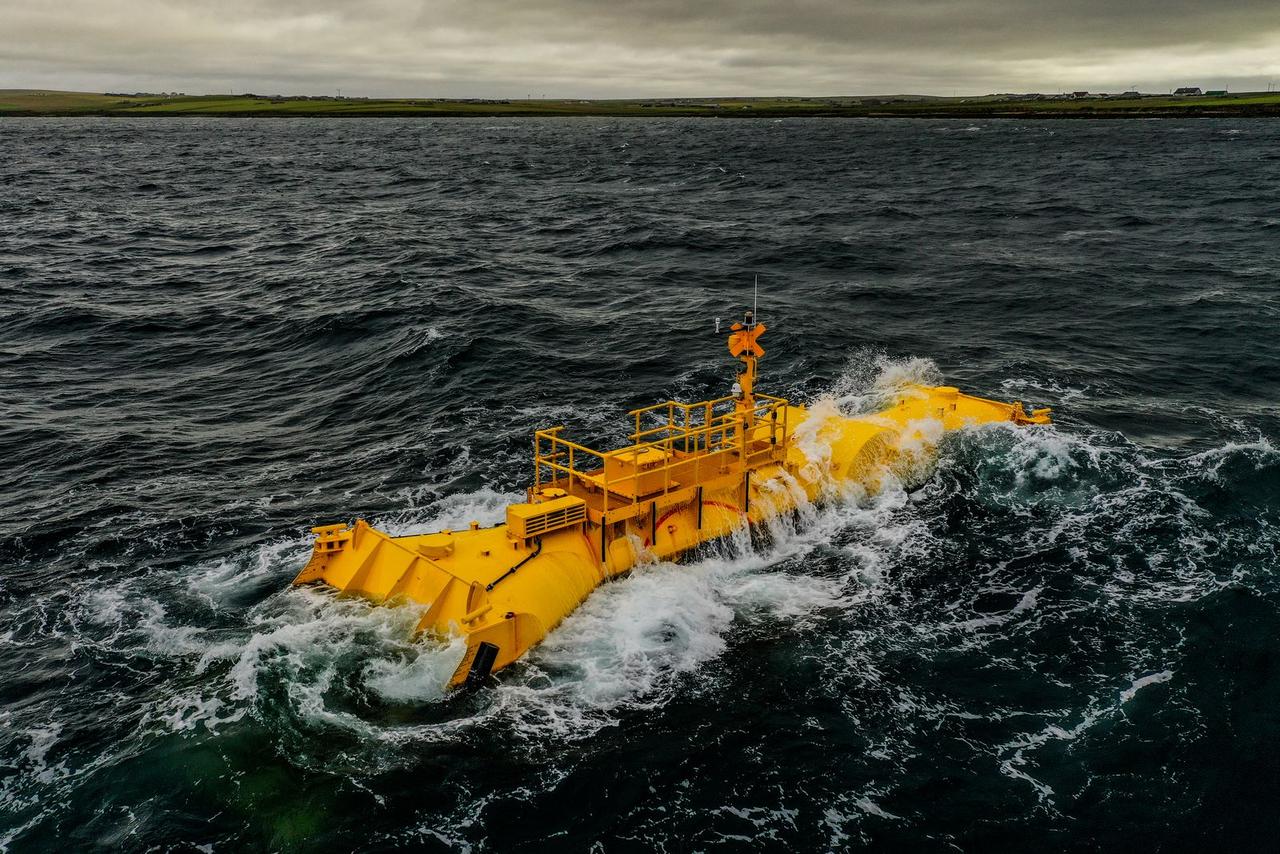
Farther offshore, a more ambitious industry is taking shape. Developers want the sea to supply the electricity as well as the cooling, allowing artificial intelligence to run aboard machines that harvest energy from waves. Panthalassa announced a $140 million financing round in May for that effort; Scotland’s Mocean Energy is developing a system combining waves, solar panels and batteries. Panthalassa · Mocean
The appeal reaches beyond finding an empty site. A successful ocean-powered computer could put a new source of renewable energy to work where it is generated, easing demand for electricity and cooling water on land. It could also give marine-energy developers a customer willing to pay for an expensive first generation of equipment.
These businesses face different tests. A facility beside a port can draw on cables, crews and established supply chains. An autonomous unit far offshore must earn its keep through changing seas, intermittent power and remote maintenance. The clearest commercial progress so far is among facilities close to shore; self-powered fleets must still establish that they can deliver useful computing at a competitive price.
From a submerged experiment to commercial projects
Microsoft supplied an early test of the hardware in 2018, when it lowered its Northern Isles data center to the seabed off Scotland’s Orkney Islands. After two years, it retrieved a vessel coated in marine growth and found a striking result inside: the servers had failed less frequently than those in its land-based comparison. Microsoft’s account
“Our failure rate in the water is one-eighth of what we see on land,” project leader Ben Cutler said. Microsoft attributed the advantage provisionally to the sealed atmosphere of dry nitrogen and the absence of people disturbing equipment. The experiment connected to the Orkney electricity grid by cable. Its achievement was evidence that computers could operate reliably inside a carefully engineered marine enclosure.
At the Port of Stockton in California, Nautilus offers capacity to supply 6.5 megawatts to computing equipment in a facility cooled through heat exchangers using San Joaquin River water. Its specifications also describe a utility electricity feed, backup generators and redundant fiber connections. The operator reports a power usage effectiveness, or PUE, of 1.15: about 1.15 units of facility electricity for every unit consumed by the computing equipment. Nautilus specifications
That ratio measures electrical overhead. The source of the electricity determines much of the climate benefit. A low-overhead facility running on fossil generation and one supplied by renewables can have very different emissions.
Shanghai offers a closer example of computing connected directly to renewable generation. An August municipal report describes a 2.3-megawatt subsea demonstration phase in operation at Lin-gang, within a planned 24-megawatt development. It says more than 95 percent of the project’s electricity comes from renewable sources. Establishing its performance through calm weather and peak demand will require an hourly operating record. Shanghai report
Shipbuilders see another route through familiar equipment and skills. Mitsui O.S.K. Lines and Hitachi announced a feasibility initiative in March to turn used vessels into floating data centers, targeting operations from 2027 onward. Reusing a ship could provide substantial enclosed space and an established maintenance industry. Power supply, fiber access and a suitable berth would determine the usefulness of that space. MOL and Hitachi
Wave power gets a different customer
Panthalassa’s plan changes what leaves the power plant. Its floating nodes would use wave-generated electricity aboard the platform, then send the results of AI work to land by satellite. Selling computation would let the company use energy far from a shore connection.
The Oregon company’s May financing announcement set out a pilot factory and Ocean-3 deployments in the northern Pacific, with commercial deployment targeted for 2027. It describes the intended work as inference: running an already-trained model to produce an answer. South Korea’s NAVER announced an investment in August, adding an established AI and cloud company to the venture’s backers. Panthalassa announcement · NAVER announcement
Mocean’s Blue Core design combines wave generation, solar panels, storage and server racks, with heat transferred to the surrounding water. Its published design includes moorings and Starlink communications; self-transit appears in later phases. The company lists a small computing demonstration for 2027. Blue Core design
Mocean brings relevant experience from a previous offshore-power trial. In 2023–24, its Blue X wave converter worked with Verlume’s Halo underwater battery to supply subsea equipment, including controls and an autonomous underwater vehicle. The European Marine Energy Centre records more than a year of testing, ending in April 2024. That history establishes experience with power, storage and marine operations; the new computing demonstration will test their integration with AI hardware. EMEC test history
A third effort has chosen a particularly concrete assignment. Ocean Power Technologies and Stratum Holdings signed an October letter of intent to explore AI computing on PowerBuoy platforms. Their proposed demonstration centers on inference for uses such as maritime monitoring and scientific sensing, using primarily onboard renewable generation. The agreement is nonbinding, with definitive contracts and integration work ahead. Company release filed with the SEC
For an isolated instrument or offshore camera, processing data nearby could reduce the volume sent ashore. A computer might identify a vessel or a developing equipment fault and transmit a short result. That gives marine computing a possible early market tied to the location itself, alongside the much broader ambition of serving AI users on land.
The electricity and the job have to fit
Wave power follows the weather, solar follows daylight and cloud cover, and tidal generation rises and falls with the current. Storage can bridge gaps; computing that can wait offers another way to use the available electricity.
The unit of comparison matters. A megawatt describes the rate at which electricity is produced or consumed. A megawatt-hour describes an amount of energy. A generator’s rated output, its average production and the power reaching the processors answer different questions. Pumps, communications, controls and any propulsion consume part of the supply.
Consider an illustrative platform with one megawatt of computing load and a PUE of 1.15. Keeping that load running through four hours with zero generation would require at least 4.6 megawatt-hours of usable energy delivered to the facility. A full day would require 27.6 megawatt-hours. Charging losses, battery reserves and other loads outside that assumed facility boundary would add to the requirement. Actual storage requirements would follow the platform’s measured demand and local generation through the year.
Offshore wind introduces another combination. Aikido Technologies proposes a platform with a turbine rated above 15 megawatts, storage described as lasting more than four hours and over 10 megawatts of computing load. Its design retains grid and subsea-fiber connections. Those connections would provide access to outside electricity and a much larger data pipeline, while offshore generation could supply much of the energy. The published figures describe its design ambitions. Aikido’s design
The network also shapes the work. Large AI training jobs can require thousands of processors to exchange data rapidly and repeatedly. Independent requests to an already-loaded model can involve much less communication between locations. Those requirements favor self-contained inference and selected batch jobs as early candidates for satellite-linked nodes. The outcome depends on the model, input size, response deadline and link reliability. NVIDIA’s networking overview
A model still has to reach the platform, receive updates and serve its users. A cloud operator promising an immediate answer has a different problem from one selling an overnight analysis. The business contract will decide how much freedom the operator has to follow the waves.
The price of keeping expensive chips busy
The prospect of cheap electricity is driving investment. Lowercarbon Capital, a Panthalassa investor, lists a target generation cost of two cents per kilowatt-hour. Delivered computing has a wider cost base: the processors, storage, communications, marine structure, maintenance and financing all need to earn their return. Investor’s stated target
Utilization can change that calculation sharply. In a simplified example with identical hardware and identical fixed annual costs, operating productively for 45 percent of available hours instead of 90 percent doubles the fixed cost allocated to each productive hour. Low-cost energy becomes more valuable when the expensive equipment can use it consistently.
That creates a choice between spending on additional generation, storage and backup, or accepting a lower level of service and charging accordingly. Fleets could spread work across locations, although correlated weather, data-transfer limits and spare computing capacity would affect the benefit.
Maintenance introduces a second clock. Servers may need replacement or upgrades while the hull still has years of useful life. Mocean proposes retrieving individual units for servicing. Aikido describes scheduled vessel visits and accommodation for technicians. Microsoft’s Natick deployment and retrieval required calm seas and roughly a day of coordinated marine work at each end. These approaches place different costs on access, downtime and spare equipment. Mocean · Aikido · Microsoft
Corrosion protection, marine growth, moorings or station-keeping, insurance, navigation systems and eventual removal belong in the same account. The most persuasive commercial result would show the cost of completing a specified workload at an agreed level of reliability, with those expenses included.
A new site brings new neighbors
DeepGreen’s two U.S. proposals show how geography changes the project. Its Western Passage filing, near Eastport, Maine, describes up to sixteen 300-kilowatt tidal turbines: 4.8 megawatts of combined rated capacity. The proposed system would supply subsea computing pods through an isolated generation loop. Maine filing
Its Cook Inlet proposal in Alaska is much larger, with approximately 330 to 350 turbines, 66 computing pods and a hybrid power-and-fiber cable to shore. The notice also describes the possibility of exporting spare electricity to the Railbelt grid. The August and September federal notices concerned applications for preliminary permits. Such permits establish priority for later license applications during a study period; construction requires further authorization. Alaska filing
Local acceptance is already part of the development risk. In August, Eastport’s city government reported that its council had unanimously expressed opposition to the proposal. The company’s study and licensing work must address fishing access, navigation and the interests of tribal nations and other communities connected to the water. City statement
Marine-energy research offers a basis for evaluating those concerns. The international OES-Environmental review, summarized by Pacific Northwest National Laboratory in 2024, found that evidence from deployments of one to six devices could resolve several concerns involving underwater noise, electromagnetic fields, habitat and water movement. Animal collisions and the cumulative effects of larger arrays still require further study. The evidence therefore supports project-specific assessment as installations grow. PNNL research summary
Computing adds heat discharge to the assessment, while deployment and servicing add vessel traffic. Intake designs, cables, noise and changes to habitat require examination at each site. In Cook Inlet, NOAA identifies underwater noise as a major concern for the endangered beluga population, which relies heavily on sound in the inlet’s silty water. NOAA Fisheries
Climate accounting has a similar boundary. Renewable generation could reduce the emissions associated with computing, while steel fabrication, batteries, service vessels and replacement hardware contribute over the system’s life. A port-based data center supplied from shore or a power ship inherits the emissions of that electricity supply. Cooling-water savings and carbon savings need separate measurements.
The first customers will set the pace
Keppel’s pre-lease offers evidence of customer demand for a floating facility. Shanghai’s operating demonstration adds experience with subsea computing and direct renewable supply. Panthalassa and Mocean are pursuing a further step: turning marine energy into a product the AI industry can buy at scale.
Success could give wave power the financing, factory volume and operating experience needed to improve. Marine sensing may provide an earlier market, where local computing replaces costly communications and offshore support. Expanding into larger AI services would require power output, availability and maintenance costs dependable enough to price into customer contracts.
The next meaningful milestone is a customer receiving useful computing through a full range of sea conditions, under a contract that puts a price on the service. That would connect the ocean’s energy potential to the economics of the machines consuming it.
Sources
Keppel, first-quarter 2026 business update and data-center fund portfolio — construction, pre-lease and 2028 target.
Panthalassa, May 4, 2026 financing announcement — financing, architecture and deployment targets.
NAVER, August 13, 2026 investment announcement, Korean — cloud-industry participation.
Mocean Energy, Blue Core design — proposed generation, storage, communications, moorings, maintenance and demo stage.
European Marine Energy Centre, Mocean test history — earlier wave-energy and subsea-power trials.
OPT–Stratum announcement, SEC exhibit, October 26, 2026 — nonbinding agreement and proposed edge-computing uses.
Microsoft, Project Natick findings, September 14, 2020 — trial, quotation, shore power and retrieval.
Nautilus, Stockton specifications — offered IT capacity, cooling, PUE and backup infrastructure.
Shanghai, August 7, 2026 direct-power report — operating phase, planned expansion and renewable-share claim.
MOL–Hitachi, March 30, 2026 announcement — vessel-conversion feasibility initiative.
Aikido, technology description — wind, batteries, grid, fiber and maintenance design.
NVIDIA networking overview — AI-cluster networking context.
Lowercarbon Capital, Panthalassa profile — investor-stated generation-cost target.
FERC, Western Passage notice, August 25, 2026 and Cook Inlet notice, September 4, 2026 — proposal scope and preliminary-permit purpose.
Eastport city government, August 3, 2026 update — council position and local process.
PNNL, September 17, 2024 environmental-research summary — evidence on small deployments and larger-array uncertainties.
NOAA Fisheries, beluga-whale account — Cook Inlet status and noise sensitivity.
Jackie Snow, The Wall Street Journal, Facing Backlash on Land Data Centers Look to the Sea — reporting that prompted this analysis. Project details above are linked to the additional primary sources used.