Green Lasers and the Materials Reshaping Aircraft
Researchers in China and Singapore have used a green laser to print a modified aerospace aluminum alloy with a reported yield strength of about 600 megapascals.
Published November 15, 2026Analysis / Materials / Advanced Composites
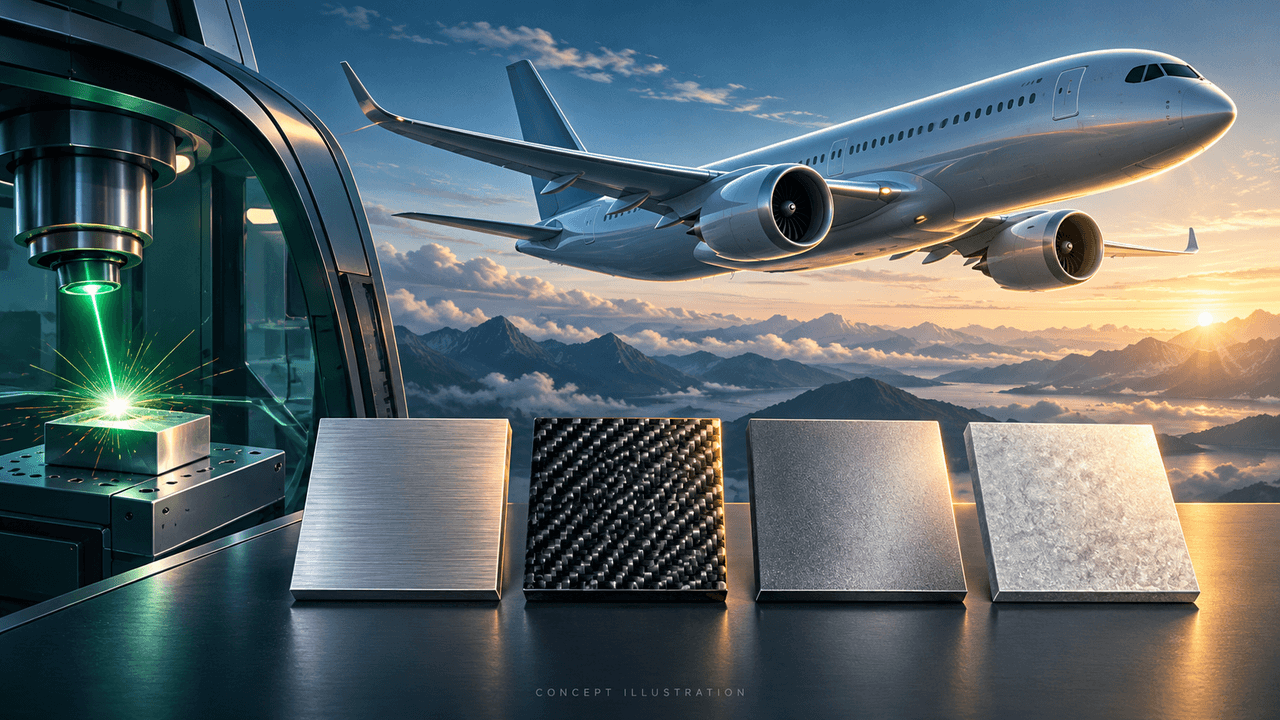
Researchers in China and Singapore have used a green laser to print a modified aerospace aluminum alloy with a reported yield strength of about 600 megapascals. The collaboration includes Soochow University in Suzhou and A*STAR’s Singapore Institute of Manufacturing Technology.
The study, published October 30 in Nature Communications, combines a laser-based deposition process, AA7075 powder containing tiny titanium-carbide particles and heat treatment. Yield strength measures the stress at which permanent deformation begins. The strength result is an early measure of structural potential. Establishing values that engineers can use to design aircraft requires a broader body of test data. [1]
Aircraft manufacturers already divide the work among several materials. Carbon composites form much of the wings and fuselages of modern widebody jets. Titanium serves demanding structural connections. Magnesium alloys have a place in housings, and ceramic composites withstand heat inside engines. Aluminum remains useful wherever its weight, price and established manufacturing methods fit the job.
A new material competes for a particular job: a wing panel, a gearbox casing or a fitting around a cargo door. Its dimensions, loads and operating environment determine what properties matter. The cost of making and maintaining that part can settle a choice that looks quite different in a laboratory strength table.
The aluminum result
Aluminum reflects much of the infrared light commonly used in metal printing. At green wavelengths, it absorbs more of the beam’s energy, making it easier to deliver heat where the powder is melting. The researchers report that this improved energy transfer allows deposition at lower laser power. They also report a steadier pool of molten metal and less evaporation of alloying elements. Powder composition and heat treatment help determine the finished material’s properties. [1,24]
The highest-strength samples averaged 591 megapascals of yield strength and stretched 2.9 percent before breaking. A faster printing setting produced 543 megapascals and 5.5 percent elongation. Those results show a tradeoff between strength and the ability to deform before fracture. The study’s approximately 600-megapascal headline therefore describes one processing condition, rather than a complete ranking of aircraft materials. The accepted paper
The process could make strong aluminum parts whose shapes would be costly to machine or assemble from separate pieces. Establishing its aviation uses would require evidence of fatigue performance, corrosion resistance, consistency between builds and reliable inspection. Those properties determine how a component behaves after years of service, including the effects of flaws and repeated loading.
NASA’s additive-manufacturing standards illustrate the scope of that work: material and process controls are established alongside the requirements for individual parts. Each production route has its own evidence burden. [2]
Better control could yield more usable parts from each build, a benefit manufacturers would need to establish in production. A lower-power beam is one part of the energy calculation: electricity use also depends on the laser’s electrical efficiency, printing speed, cooling and other equipment. Powder preparation, heat treatment, finishing, rejected parts and qualification all contribute to the cost of a finished component.
The international competition in printed aluminum
The China–Singapore work brings together solutions to two stages of printing: melting the powder and controlling how the metal solidifies. Earlier American research helped address the second problem. In a 2017 Nature paper, an HRL-led team showed that nanoparticles added to aluminum powder guided the growth of fine grains as the metal cooled, producing samples free of solidification cracks. The new study combines engineered powder containing titanium carbide with green-laser directed energy deposition and heat treatment. Together, these choices govern how energy enters the material and how its internal structure develops. [1,25]
In California, HRL Laboratories reported yield strengths exceeding 600 megapascals for its 7A77 product line in April 2022. The company had begun selling the material in 2019. Its earlier technical sheet listed a heat-treated yield-strength range of 490 to 585 megapascals, with results dependent on printing parameters, heat treatment and hot isostatic pressing, a process that applies heat and pressure. Those differing figures show why a comparison needs the processing conditions behind each number. [19,20]
Europe’s Scalmalloy illustrates another route: an aluminum alloy containing magnesium and scandium, developed for laser powder-bed fusion and sold through APWORKS and licensed producers. APWORKS currently lists a yield strength of 480 megapascals and elongation of 13 percent, a measure of how far a test sample stretches before breaking. Its commercial powder supply and accumulated process experience are important parts of the comparison. Aircraft use still depends on the qualification of the particular material, manufacturing process and component. [10,21]
Colorado-based Elementum 3D also offers a family of aluminum powders using its reactive additive manufacturing, or RAM, approach. Ceramic additions and reactions during printing help control the resulting material. The company supplies feedstocks, processing information and property data; its current catalog includes A7050-RAM2 among several aluminum grades. That represents a commercial materials offering, with aircraft-service suitability established separately for each application. [22,23]
The new green-laser process enters a field with commercial powders and years of manufacturing experience. Its prospects will turn on tests of equivalent parts: how they withstand fatigue and corrosion, how accurately and consistently they can be made, and how much energy and money it takes to deliver an acceptable component.
Carbon fiber’s established position
Boeing says composites account for about half the 787’s airframe weight. Airbus uses carbon composites extensively in the A350’s fuselage, wings and tail. Those aircraft provide an established record of composites replacing metal in large primary structures. [3,4]
Carbon-fiber-reinforced polymer, usually abbreviated CFRP, consists of strong fibers held in a resin matrix. Engineers arrange layers of fibers to carry loads in chosen directions. That control makes the material well suited to broad, weight-sensitive structures such as wings, fuselage shells and tails.
Manufacturing those structures involves precise material placement, consolidation or curing, assembly and inspection. A large tool may be occupied for hours while a component takes shape. The economics depend on how much equipment and labor are needed to sustain the factory’s output.
Maintenance adds another consideration. An impact can damage layers beneath the surface. FAA guidance addresses inspection access, damage detection, repair methods and the training of the people who perform the work. Those requirements belong in the comparison alongside the weight saved in flight. [5]
A wing must perform economically over years of airline service and move through the factory at an acceptable cost and rate. Manufacturers are pursuing a different class of composite resin to improve that production equation.
Thermoplastics move toward larger structures
The thermoset resins widely used in aircraft composites harden through an irreversible curing reaction. Thermoplastic resins soften when heated, allowing suitable components to be joined by welding. That offers a way to reduce drilling and fastening work during assembly. NASA’s HiCAM program is evaluating thermoplastics alongside other approaches to higher-rate composite manufacturing. [6]
There is already a substantial business in smaller parts. In an account originally published in late 2024 and posted online in 2025, Daher reported that automated lines at its Nantes factory produced 300,000 thermoplastic components annually. The output included ribs, clips, covers and floor-related components for established aircraft programs. The figure describes the company’s production at the time of its report. [7]
Larger structures remain under development. Europe’s Multifunctional Fuselage Demonstrator tested a large welded thermoplastic assembly. Airbus says the project, which concluded in late 2024, exceeded its weight-saving target at a cost comparable to a metallic fuselage barrel. That result applies to the demonstrator and its reference design. [8]
Turning the approach into routine aircraft production requires repeatable joining, dependable inspection and a factory capable of delivering the planned volume.
Aluminum’s economic advantage
A simple aluminum component benefits from decades of industrial investment. Manufacturers can draw on familiar stock forms, forming and machining methods, suppliers and repair procedures. For straightforward parts, especially at modest production volumes, those advantages can outweigh a higher strength figure from a more specialized material.
Aluminum itself covers a broad range of choices. Airbus’s A220 combines an aluminum-lithium fuselage with a composite wing, assigning each material a different structural role. [9]
The price comparison must therefore begin with equivalent requirements. A manufacturer would have to count the powder or stock purchased, machine time, finishing, inspection and qualification needed to deliver the same function. Production volume would determine how widely the development and equipment costs could be spread.
Where magnesium fits
Allite markets “Super Magnesium” as a family of alloys, including AE81, AE70, ZE62 and WE54. The grades serve different manufacturing priorities. The company describes potential aerospace applications; verifying their use in commercial airframes requires named programs and qualification records beyond the application descriptions reviewed here. [11]
Other magnesium alloys have established aviation uses. Luxfer identifies helicopter transmission housings, covers and electronic housings among the applications for its Elektron materials. Such parts can combine substantial volume with complicated shapes, making lightweight castings attractive. [12]
A lighter material may need a thicker section to provide the required stiffness or resistance to buckling. Designers must also account for corrosion, contact with dissimilar metals and exposure to fire. SAE’s guidance for magnesium in aircraft seats covers forming, joining, surface treatment and flammability, reflecting how closely material selection is tied to manufacturing and use. [13]
For magnesium, the strongest near-term case is in such defined applications. A proposed substitution in a wing or heavily loaded fitting would need its own structural and durability case, with the finished component’s weight compared against the existing design.
Titanium makes the case for selective printing
Titanium is valuable in demanding fittings and connections, including interfaces with carbon-composite structures. Its strength, corrosion resistance and compatibility with those structures can justify a premium. Manufacturing waste is a major part of the cost: a producer may buy far more metal than remains in the finished component.
Airbus reports that wire-directed-energy-deposited titanium parts are entering serial production in the A350’s cargo-door surround. The supplier prints a shape close to the finished component; the part is then inspected, machined and installed. Airbus says these replacements for equivalent forged components save money. The reported benefit applies to those particular parts. [14]
Printing can pay when it reduces the amount of expensive metal removed, shortens tooling lead times or simplifies an assembly. Geometry and production quantity determine whether those savings justify the printing process.
NIST’s work on additive-manufacturing costs identifies material consumption, equipment use and production scale as important factors. The study dates to 2014, so current supplier quotations would be needed to put prices against its accounting framework. The central calculation remains the cost of an acceptable finished component. [15]
Materials for the engine’s heat
Inside an engine, heat changes the choice of materials. Ceramic-matrix composites, or CMCs, use ceramic fibers and a ceramic matrix. Their temperature capability can reduce the cooling air required by selected engine components, leaving more air available to contribute to propulsion. Nickel-based superalloys also retain a central role in hot engine environments. [16]
CMCs have a substantial production record in the CFM LEAP engine. GE Aerospace’s Asheville plant shipped its 100,000th CMC turbine shroud in 2021. That milestone counts individual components accumulated over several years. [17]
Engine deliveries offer a more recent measure of the program’s scale. Safran reported 1,802 LEAP deliveries in 2025, up 28 percent from 1,407 in 2024. The increase describes engine output, a useful indicator of the production scale supporting this CMC application. [18]
These components require specialized manufacturing and inspection. Engine designers weigh those costs against temperature capability, cooling requirements and service life. Their economics are tied to the conditions inside an engine, where temperature and durability set the requirements.
How the choices compare
These qualitative cost assessments concern manufacturing effort. Actual prices depend on the component, production quantity and qualification requirements.
Material or route: Conventional aluminum
Principal uses or development targets: Brackets, frames, ribs and metallic skins
Manufacturing cost considerations: Often an economical baseline for simple parts
Adoption evidence: Mature supply chains and extensive service
Material or route: Aluminum lithium
Principal uses or development targets: Weight-sensitive metallic fuselages
Manufacturing cost considerations: Specialized alloy and processing
Adoption evidence: A220 production fuselage
Material or route: Thermoset CFRP
Principal uses or development targets: Large wings, fuselages and tails
Manufacturing cost considerations: Tooling, cure, labor and inspection
Adoption evidence: Major 787 and A350 structures
Material or route: Thermoplastic CFRP
Principal uses or development targets: Small parts today; larger welded structures in development
Manufacturing cost considerations: Faster joining potential; equipment and scale-up costs
Adoption evidence: Serial small parts and large demonstrators
Material or route: Titanium including additive routes
Principal uses or development targets: Demanding fittings and composite interfaces
Manufacturing cost considerations: Premium material; printing can reduce waste and tooling
Adoption evidence: Selected A350 printed production parts
Material or route: Advanced magnesium
Principal uses or development targets: Housings, covers and selected interiors
Manufacturing cost considerations: Forming, protection and qualification
Adoption evidence: Established Elektron uses; Allite program verification pending
Material or route: Printed high-strength aluminum
Principal uses or development targets: Complex lightweight metal parts
Manufacturing cost considerations: Powder, machine time, finishing and qualification
Adoption evidence: Scalmalloy industrial offerings; green-laser route at research stage
Material or route: CMCs and nickel superalloys
Principal uses or development targets: Selected engine hot-section components
Manufacturing cost considerations: Specialized manufacturing for heat and durability
Adoption evidence: LEAP CMC shrouds and established superalloy applications
Production and cost
Thermoset carbon composites are established in large widebody primary structures. Thermoplastics offer an opportunity to expand from established small-part production into larger structures. Printed titanium is already delivering reported savings on selected components, while CMCs support a growing engine program.
Conventional aluminum remains a strong economic reference for simple parts. Complex titanium components, large composite assemblies and CMC engine parts require more specialized production. Their relative prices turn on the geometry, quantity and performance required. Manufacturing quotes for equivalent parts would be necessary to rank them by cost.
Adoption rates are similarly sensitive to the measure chosen. A count of clips captures a different market from aircraft deliveries or tons of material. The available examples establish where each technology is being used and where production is expanding. A common measure tracked over time would be needed to identify the fastest-growing material across the industry.
For green-laser aluminum, repeat builds and tests of representative components would move the evidence closer to an aircraft design decision. Performance under repeated loading and service conditions will determine which parts merit further development. Manufacturers will then weigh those results against the waste, machining time and maintenance costs of the parts they already make.
Sources
Sources · 25
- https://www.nature.com/articles/s41467-026-78822-0
- https://www.trumpf.cn/en_CN/solutions/applications/additive-manufacturing/laser-metal-deposition/
- https://www.nasa.gov/centers-and-facilities/nesc/nasa-additive-manufacturing-standards-support-human-spaceflight/
- https://www.nature.com/articles/nature23894
- https://www.hrl.com/news/2022/04/21/hrl-laboratories-notches-another-milestone-for-3d-printed-aluminum
- https://www.hrl.com/products-services/materials/_assets/7A77-data-sheet.pdf
- https://www.apworks.de/scalmalloy
- https://www.apworks.de/scalmalloy-powder
- https://www.elementum3d.com/aluminum/
- https://www.elementum3d.com/data-sheets/
- https://www.boeing.com/commercial/787/by-design
- https://www.airbus.com/en/products-services/commercial-aircraft/passenger-aircraft/a350-family?lang=en
- https://www.faa.gov/documentLibrary/media/Advisory_Circular/AC_20-107B_with_change_1.pdf
- https://www.nasa.gov/directorates/armd/aavp/hicam/about-hicam/
- https://daher.com/en/aeronautical-composites-towards-the-industrialisation-of-production/
- https://www.airbus.com/en/newsroom/stories/2025-01-fantastic-thermoplastics
- https://www.airbus.com/en/products-services/commercial-aircraft/passenger-aircraft/a220-family
- https://alliteinc.com/super-magnesium/
- https://www.luxfermeltechnologies.com/aerospace/
- https://saemobilus.sae.org/standards/arp6256a-magnesium-alloys-aircraft-seats-engineering-design-fabrication-recommended-practices
- https://www.airbus.com/en/newsroom/stories/2026-01-how-airbus-is-pioneering-aircraft-manufacturing-with-titanium-3d-printing
- https://nvlpubs.nist.gov/nistpubs/specialpublications/nist.sp.1176.pdf
- https://www.geaerospace.com/news/articles/dubai-airshow-product-sustainability/test-early-test-often-how-ge9x-engine-became-ge
- https://www.geaerospace.com/news/articles/product/year-review-first-flights-50-years-service
- https://www.safran-group.com/pressroom/safran-reports-excellent-financial-performance-2025-and-raises-its-2028-ambitions-2026-02-13