Genesis AI Bets on Human Hands to Teach Robots Physical Work
Genesis AI is using human hand movements to teach robots physical tasks. Its next test is whether those skills transfer to sustained work on a factory floor.
Published November 18, 2026Analysis / Robotics / Humanoid Robotics
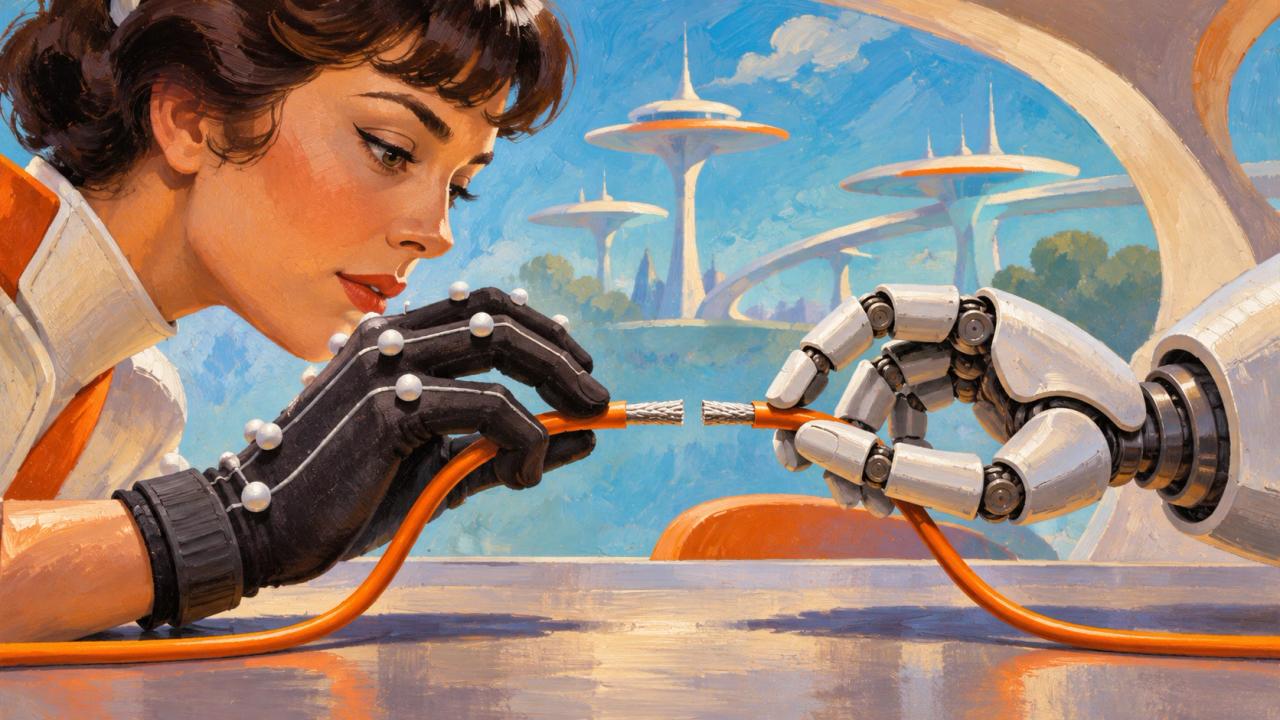
A worker threading a loose wire or positioning a small laboratory tool makes a succession of adjustments almost without thinking. For a robot, those adjustments are the job: knowing where to grip, how hard to squeeze and what to do when an object moves differently than expected. Making that kind of skill transferable could open more of everyday production to automation.
Genesis AI, which operates in Paris and San Carlos, California, is pursuing that opportunity by designing the robot’s hands and its learning system together. People wear gloves that record their movements and touch while doing tasks. A similarly shaped robotic hand is intended to make those examples easier for a machine to use.
On November 17, the company announced a $500 million Series A at a $3.5 billion post-money valuation, led by Premji Invest, Khosla Ventures and Eclipse. The money will support training, recruitment and production of Eno, its general-purpose robot, with manufacturing, logistics and laboratories first in line. Funding announcement
The commercial prize is a machine that can handle changing work without a separate engineering project for every variation. Genesis’s next stage will test how much of that promise survives the repetition, interruptions and changing conditions of a working facility.
A hand that can learn from yours
Genesis introduced its GENE-26.5 robotics model in May alongside a dexterous hand and a data-collection glove. The glove incorporates tactile sensing, which captures contact as well as movement. The company describes a close correspondence among the human hand, glove and robot hand, intended to reduce the translation needed between a person’s demonstration and a robot’s action. Model announcement
This tackles what roboticists call the embodiment gap. A human hand and a simple mechanical gripper have different joints, contact surfaces and ways of holding an object. A demonstration that is effortless for one can be awkward for the other. Genesis’s approach brings their forms closer together.
Its May demonstration video included wire bundling, pipetting and food preparation. These are examples of the capabilities Genesis is developing; their usefulness in a business depends on how consistently the robot repeats them across different objects and conditions. Company demonstration
The company also combines human video data with simulation. Virtual training can expose a model to many variations before it operates physical hardware. The important engineering task is making those variations representative of what the real robot will encounter.
A body built around the work
Eno, unveiled in June, rises from a wheeled base on articulated panels that adjust its height and reach. It can fold down when stored. Its arms end in the company’s human-shaped hands, giving the unusual body a familiar point of contact with tools and workspaces. Eno announcement
The design concentrates on manipulation and mobility in environments suited to wheels. A practical evaluation would ask which shelves, benches, aisles and floor conditions it can reach safely, alongside the precision of its hands. That makes the workplace itself part of the engineering problem.
“By building it all ourselves, we can obsess over every detail and improve the entire robot faster in one closed loop,” co-founder and CEO Zhou Xian said in the funding announcement. Funding announcement
That integrated strategy lets changes in training, controls and hardware inform one another. Its value will be measured in dependable work completed, maintenance requirements and the time needed to learn a new task.
The route into factories
Genesis’s partnership with LG CNS, announced in June, provides a more concrete route into industrial operations. The companies outlined a staged process: identify useful manufacturing and logistics tasks, evaluate the technology and then run a pilot to develop a deployment method.
The proposed pilot includes documenting workflows, collecting data, further training and validation. Initial evaluation is aimed at LG operations and LG CNS customers in the United States, with wider expansion envisioned later. Partnership announcement
Those steps matter because a capable robot still has to fit an existing operation. An integrator must determine where it hands work to another machine, how people supervise it and how production continues when an exception occurs. The partnership establishes a path to answer those questions rather than an already completed fleet rollout.
Genesis now says it is increasing Eno production. The next useful evidence will come from repeated customer operations: successful tasks per shift, human interventions, recovery from mistakes and the full cost of getting useful work done.
Genesis’s funding gives it room to test whether skills captured from people can survive a full shift on the factory floor. Reliable transfer would let manufacturers automate more work without redesigning the machinery for every new task.
Sources
Sources · 4
- https://www.prnewswire.com/news-releases/genesis-ai-raises-500m-series-a-at-3-5b-valuation-to-master-human-level-dexterity-in-general-purpose-robots-and-deploy-at-scale-302941249.html
- https://www.genesis.ai/news/press-release-gene-265
- https://www.prnewswire.com/news-releases/introducing-eno-genesis-ais-first-general-purpose-robot-is-challenging-traditional-humanoid-design-302801103.html
- https://www.prnewswire.com/news-releases/genesis-ai-and-lg-cns-enter-industry-first-strategic-partnership-to-scale-general-purpose-robotics-across-enterprise-operations-302801102.html