Can AI Give Ocean Thermal Power a Paying Customer at Sea
Drogue wants to put AI servers aboard floating vessels powered by the temperature difference between warm tropical seawater and the cold depths.
Published November 16, 2026Analysis / Energy / Next-Gen Renewables
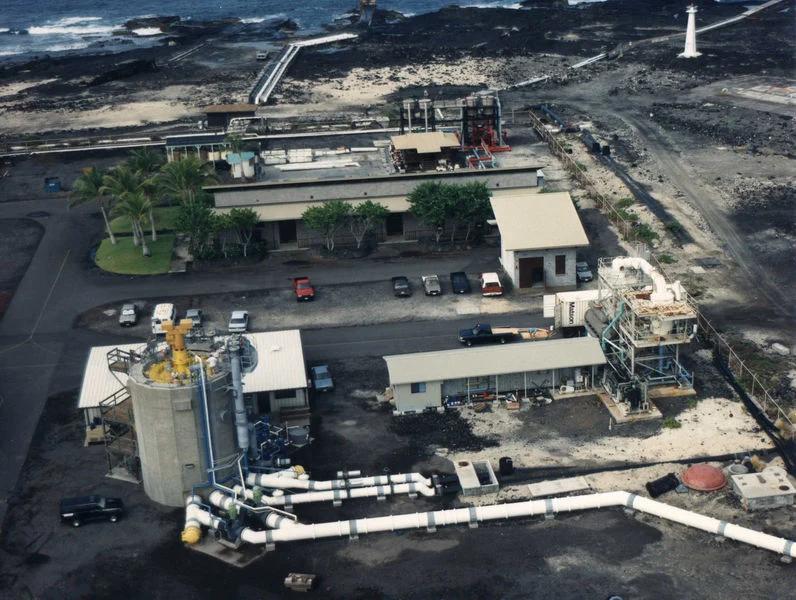
Drogue wants to put AI servers aboard floating vessels powered by the temperature difference between warm tropical seawater and the cold depths. Electricity would be used where it is generated, with computing offering a customer for an ocean resource that has struggled to become a commercial power business.
Washington, D.C.-based Drogue raised $20 million and targets a multi-megawatt shipboard prototype in early 2028, TechCrunch reported. Its founder is Sam Sipe. Toyota Ventures lists the company in its portfolio, and XYZ Venture Capital has publicly announced its partnership with the team.
The technology, ocean thermal energy conversion, or OTEC, already has a working history in Hawaii. Engineers produced net electricity from a barge in 1979, and Makai Ocean Engineering connected a later demonstration system to the grid in 2015. Computing could broaden the market beyond the island customers that have traditionally attracted developers.
An offshore customer could spare a plant the expense of sending its electricity to land and could use ocean water for cooling. Whether those advantages pay for the vessel, deep-water equipment and communications service is the commercial proposition Drogue’s prototype will begin to test.
Power that remains available after sunset
OTEC uses the ocean as a heat engine. In a closed-cycle plant, warm surface water heats a separate fluid with a low boiling point, commonly ammonia. Its vapor drives a turbine connected to a generator. Cold seawater drawn from depth then condenses the vapor back into liquid so the cycle can repeat.
The energy comes from heat flowing from warm surface seawater to cold deep seawater. In the closed-cycle system shown, the circulating fluid is usually ammonia: it becomes vapor, then condenses back into liquid ammonia. Makai’s explanation
The process works like this:
Warm seawater boils the working fluid. Heat passes through metal heat-exchanger walls into the ammonia, producing vapor at the higher operating pressure.
The vapor expands through a turbine. It flows toward the lower-pressure condenser, pushing turbine blades and turning a shaft. This converts part of its thermal energy into mechanical rotation.
The shaft drives a generator. Moving magnets relative to electrical coils produces electricity through electromagnetic induction.
Cold deep seawater condenses the vapor. It absorbs the remaining heat, turning the ammonia back into liquid. The colder condenser helps maintain the lower pressure downstream of the turbine.
A pump returns the liquid to the evaporator. It raises the liquid’s pressure so the cycle can repeat. Some generated electricity powers this pump and the seawater pumps. EIA’s cycle overview
Condensation enables the cycle to continue; the electricity is generated during the vapor’s expansion through the turbine.
NOAA identifies tropical areas with year-round surface-to-depth temperature differences above 20 degrees Celsius as promising locations. The surface ocean retains heat through the night, allowing the same resource to support generation after sunset.
For a server installation, that offers a potential source of evening electricity without first storing the day’s output in batteries. The size of the net supply depends on the water temperatures and the energy needed to keep the plant running.
Hawaii’s Mini-OTEC made that trade-off visible. Makai records 50 kilowatts generated and 40 kilowatts consumed on August 2, 1979, leaving 10 kilowatts of net output. Its barge drew cold water from roughly 2,000 feet below the surface.
The early result established that the cycle could deliver surplus electricity. It also showed how much of the generator’s output could be absorbed by the equipment supporting it.
Makai’s Ocean Energy Research Center at the Natural Energy Laboratory of Hawaii Authority later developed heat exchangers, controls and marine components. Its 2015 grid connection used a 105 kW turbine-generator. The site remains a research and demonstration facility.
That work has also produced a specific maintenance history. Makai describes repairing a deep-water intake after corrosion and continuous motion wore its restraining chain bridles. The company designed the repair and oversaw work completed in 2013. Keeping access to cold water is part of operating the energy system.
Can computing make better use of the plant?
“At Drogue, we believe AI inference belongs at sea,” the company wrote in its public launch post. Inference is the work a trained model does when it processes new inputs. Bringing that work to the power plant would exchange an electricity-export business for a computing service delivered over a communications network.
Hawaii-founded OceanBit offers a related model with a different customer arrangement. Its Demand Response OTEC proposal pairs grid supply with a flexible computing load. When the grid needs more power, computing demand can fall; when local electricity demand falls, computing can absorb more output.
That could help a plant earn revenue during hours when an island grid has less use for its electricity. It also creates a decision for the operator: whether a unit of power is worth more serving a grid customer or running a computing job.
OceanBit’s separate data-center proposal puts power generation and servers on converted vessels, moored and connected to submarine communications infrastructure. It describes an integrated power-and-cooling design and a near-1.0 power usage effectiveness, or PUE. That ratio compares facility electricity with the electricity used by its IT equipment. Its product page supplies no operating measurements for that PUE figure.
Some computing is better suited to flexibility than other work. A 2022 study led by Yujie Cao examined production traces from Alibaba and found scheduling opportunities in periodic batch jobs: work submitted repeatedly that can be completed within a time window. Job dependencies and deadlines constrain how far it can move.
The IEA likewise identifies AI training and some inference as less sensitive to distance from users. Real-time applications impose tighter limits on delay. Training can run far from end users while still needing sustained access to its processors.
Expensive processors also earn revenue only while doing useful work. The IEA’s analysis of flexible computing describes the tension between shifting workloads and keeping accelerators busy.
The cost advantage has to survive the cooling and connection design
Seawater could reduce the equipment and freshwater demand associated with conventional cooling. The U.S. Department of Energy describes how an evaporative system carries server heat through cooling equipment to a tower, where water evaporates to release it. A marine heat exchanger offers another place for that heat to go.
The potential saving varies with the alternative being replaced. In its 2025 assessment, the IEA puts cooling at about 7 percent of electricity consumption in efficient hyperscale facilities and more than 30 percent in less-efficient enterprise sites. An ocean project competing with a modern, efficient campus has a smaller cooling-energy bill to displace.
OTEC could offer data centers a cost advantage if efficient pumping and affordable maintenance leave enough electricity for the servers. Pumping, cleaning heat-transfer surfaces and servicing the offshore equipment would still use energy, money and working time.
Connectivity adds its own infrastructure. OceanBit proposes using existing submarine cable networks; Drogue’s launch post specifies no contracted route or bandwidth. A vessel’s location would need both a suitable thermal resource and a network service capable of carrying its customers’ data.
The International Cable Protection Committee describes cable networks supported by branching systems, diverse routes, specialist repair vessels and maintenance agreements. An offshore computing project would be buying into that engineered service, with its connection and repair arrangements forming part of the operating expense.
What the cost models actually establish
Makai’s FAQ estimates that heat exchangers account for about one-third of the cost of a 100 MW OTEC plant. That is a component estimate for a much larger design than the Hawaiian demonstrator; the undated page supplies no price year or current construction quotation.
Makai and Britain’s Global OTEC announced an agreement in August 2025 to use Makai’s compact thin-foil heat exchangers. Their size and resistance to marine conditions are intended to reduce an important equipment cost.
“TFHX was designed to perform in demanding marine environments where reliability, compactness, and durability are key,” Makai chief executive Greg Rocheleau said.
Academic modeling helps explain why finding a large customer matters. In a study published in 2023, Delft University of Technology researchers Jannis Langer and Kornelis Blok wrote: “For most regions, there is a mismatch between OTEC supply and electricity demand.”
Their modeled plants reached electricity costs below 15 cents per kilowatt-hour in 15 regions at sizes of at least 120 MW gross. The prices are in 2021 U.S. dollars, and the published results use the model’s low-cost assumptions.
The calculation accounts for pumping and transmission to shore in its net electricity supply. It simplifies some operating effects, including deterioration from marine growth on equipment. Its output is a modeled lifetime electricity cost, with no offshore computing service included.
A prototype can establish performance at its own scale. Financing a much larger plant would require confidence that those results carry through to commercial operation.
A cooling customer and a power customer may share the same site
Global OTEC’s September Bahamas announcement explores another way to sell several services from one deep-water system. The UK-based company is leading a feasibility study with the Oceanic Platform of the Canary Islands, commissioned by Expertise France and financed by the European Union.
The assignment includes electricity, reverse-osmosis desalination, district cooling and data-center cooling. It will assess whether a site can support a first installation. Existing internet connections and nearby users of water or cooling could help concentrate the services in one location.
“Our role over the next year is to establish, with real data and engineering, whether a site can carry a first-of-a-kind installation for the Caribbean,” founder Dan Grech said.
There has been progress on offshore hardware, too. On November 2, Global OTEC reported 8,760 hours of sea testing for its structural prototype at PLOCAN off Gran Canaria. The campaign tested a floating structure and vertical intake riser through a year of sea conditions. It supplies evidence about those components’ offshore behavior.
Computing appears in these plans as a dedicated offshore customer, a flexible load alongside a grid, and a user of deep-water cooling. OceanBit proposes both grid-serving and offshore data-center arrangements; its vessel concept shares Drogue’s ambition to put computing beside the power source.
Computing could address the customer mismatch in the Delft study by taking demand to promising ocean sites. A buyer that accepts the location and can keep processors earning through the plant’s operating schedule would give OTEC a revenue source beyond a small island grid. For Drogue, that would make the first vessel a way to establish both a power system and a saleable computing product, building evidence for the larger installations where researchers model lower electricity costs.
Sources
Sources · 22
- https://www.linkedin.com/company/drogue-corporation
- https://techcrunch.com/2026/11/13/this-young-startup-wants-to-power-floating-data-centers-with-the-oceans-heat-and-investors-are-already-on-board/
- https://toyota.ventures/portfolio.html
- https://ca.linkedin.com/company/xyz-venture-capital
- https://pages.plasticodyssey.fund/oceanawakens/
- https://www.eia.gov/energyexplained/hydropower/ocean-thermal-energy-conversion.php
- https://coast.noaa.gov/czm/thermalenergy/
- https://www.makai.com/pipelines/pipelines/
- https://www.makai.com/renewable-energy/otec/
- https://www.oceanbitenergy.com/about
- https://www.oceanbitenergy.com/grid-solution
- https://www.oceanbitenergy.com/data-center-solution
- https://www.sciencedirect.com/science/article/pii/S0306261922009631
- https://www.iea.org/files/de9dea13-b07d-42c5-a398-d1b3ae17d866/EnergyandAI.pdf
- https://www.iea.org/reports/energy-and-ai/energy-demand-from-ai
- https://www.energy.gov/cmei/femp/cooling-water-efficiency-opportunities-federal-data-centers
- https://www.iscpc.org/news/media-enquiries/
- https://www.makai.com/faq/
- https://globalotec.co/global-otec-and-makai-ocean-engineering-sign-mou-for-heat-exchanger-technology/
- https://link.springer.com/article/10.1007/s40722-023-00301-1
- https://globalotec.co/the-bahamas-explores-ocean-thermal-energy-for-data-centres-and-water-supply-as-global-otec-leads-technical-studies/
- https://globalotec.co/offshore-otec-prototype-completes-8760-hours-at-sea-through-record-storm-season/