A 3D Printer That Lets Paste Hold the Shape
Northwestern’s DIAL method combines patterned light with thick inks to build intricate functional materials.
Published November 6, 2026Intelligence / Materials / Smart Materials & Programmable Matter
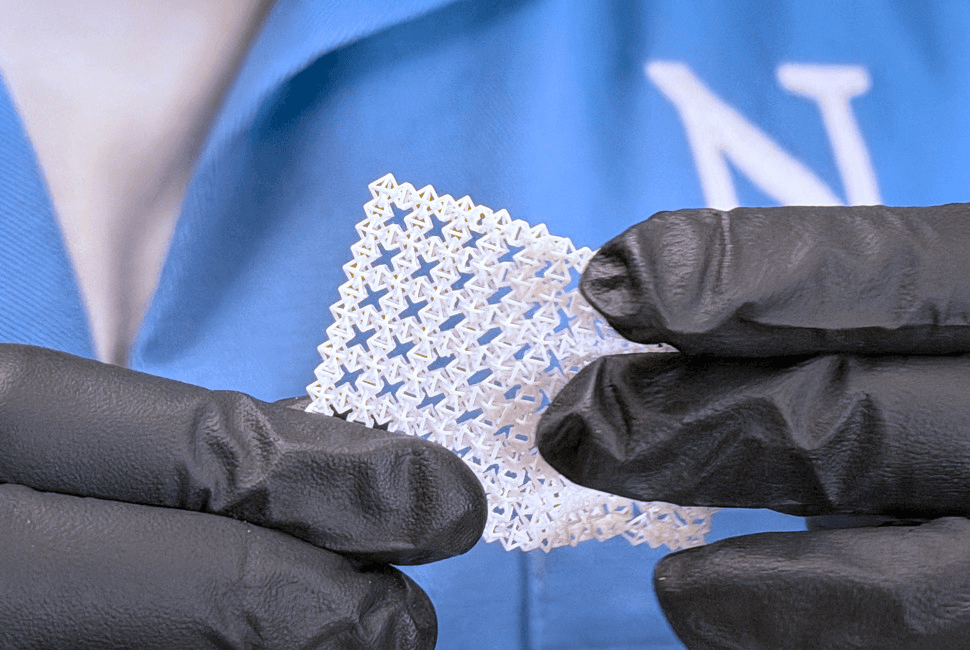
Northwestern engineers have printed a porous structure in 30 minutes that took a conventional extrusion printer 124 minutes, using a paste-based process that also produced lattice walls just 150 micrometers thick. The university announced the work November 4 alongside its publication in Science Advances.
Called direct ink additive lithography, or DIAL, the method spreads ink into sheets and uses projected light to harden selected regions. Repeating the sequence builds a three-dimensional object. Its research target is functional material: substances chosen for electrical, mechanical or biological properties, whose useful ingredients can make them difficult to print.
“DIAL can produce parts that have been challenging if not impossible to make with other 3D printing methods,” senior author Ryan Truby said in Northwestern’s announcement. Mechanical engineering Ph.D. candidate Pranav Kaarthik led the study.
The researchers printed structures from ion-conducting electrolyte material and water-rich hydrogels, as well as designs containing multiple materials. Application-specific testing will assess how the printed forms perform in batteries, tissue-culture tools or robot components.
The ink does two jobs
A blade spreads the deposited paste into a layer about 50 micrometers thick. Patterned light defines the solid features. In the model formulation, silica nanoparticles give the resin a yield stress: it flows under sufficient force but holds its shape afterward. Uncured ink supports the growing object and is washed away at the end.
The paper’s abstract describes model inks with yield stresses in the kilopascal range and comparisons against both digital light processing and direct ink writing. DIAL brings sheet deposition and movable light patterning into one process, allowing the researchers to explore support-free printing, larger areas and several material systems.
The process depends on the ink’s changing behavior. A paste must move when the equipment pushes it, settle into a predictable layer and then resist deformation. Each requirement concerns a different stage of printing. A material that performs well in one stage can still fail in another.
Earlier experiments by Rishav Agrawal and Esther García-Tuñón, published in Soft Matter in 2024, illustrate the problem. In graphite-filled hydrogel inks, changing the particle concentration altered flow, recovery and structural strength. Higher loading reduced recovery and worsened print quality. They argued that the properties must be assessed together rather than reduced to a single measure of viscosity.
The direct ink writing study illustrates a formulation challenge relevant to DIAL: an ingredient added for conductivity or stiffness can also change how a paste spreads and supports a shape. Formulations need to satisfy both the printing process and the finished material’s intended use.
Preparing the process for practical use
The reported printing-time comparison applies to a particular object and test. A production assessment would also count ink preparation, cleaning, material recovery and the proportion of parts that pass inspection. For a complicated internal geometry, removing the surrounding paste without leaving residue is a practical question worth testing.
Light curing imposes another qualification step. A candidate ink has to harden reliably through each layer and bond to the material below it. Each new formulation needs checks of cure depth, dimensional accuracy and performance after washing.
Application tests could include an electrolyte architecture that performs well in an assembled cell, or a hydrogel culture insert that supports the intended biological experiment. DIAL gives researchers a way to make those test pieces. Their performance will help establish the method’s practical value.