LiberAI turns human experience into robot skills
Human recordings and measured hand motion help the model tackle unfamiliar tasks
Published November 6, 2026Intelligence / Robotics / Humanoid Robotics
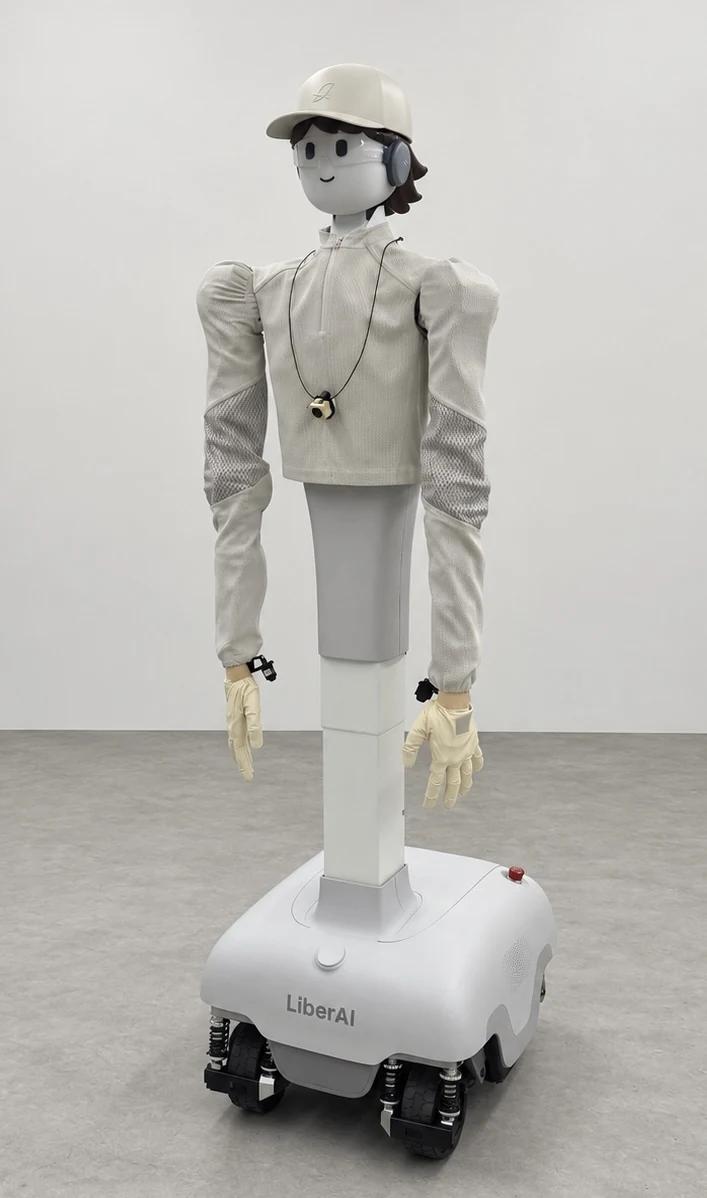
LiberAI has introduced a robot-learning model that can perform some unfamiliar physical jobs without first being shown those particular jobs on a robot. Announced in a company release dated November 4, Liber-0 completed 36% of 600 trials across 60 tasks, a measurable step toward machines that can draw on a broader store of experience. 1
The work addresses an expensive bottleneck in useful robotics. Teaching each new task by repeatedly steering a robot through it demands equipment, operators and time. Researchers want skills learned in one setting to remain useful when the object, room or assignment changes. 3
Liber-0 was pretrained on more than 2.2 million hours of human experience. For the evaluated tasks, it drew on human recordings and earlier robot experience, performing jobs for which it had received no task-specific robot demonstrations. LiberAI calls this task-level “zero-shot” performance. 1
The results show how uneven that transfer remains. Success reached 63.5% for picking up and placing objects, 34% for shorter tasks involving other kinds of manipulation, and 10.5% for challenging multistep tasks. The company chose 60 GPT-6-proposed tasks and ran each ten times. 1
Giving human movement a robot meaning
A video leaves much of an action unstated. A hand may hide the object it grips, and the camera cannot directly reveal the forces at a fingertip. A machine with different joints also needs a different route to the same result. These are central problems in transferring human demonstrations to robots. 4
LiberAI combines ordinary visual experience with recordings from its LiberSense Glove, which measures hand motion alongside synchronized camera views. The model predicts both subsequent images and actions. Information about body geometry and joints helps it adapt movements to the body carrying them out. 2
The hardware is part of the approach. LiberAI’s LEO platform has dexterous hands, articulated wrists and a movable waist. Chest and wrist cameras give it views close to those used during human data collection. Bringing the two perspectives closer makes the learning problem less dependent on translating between radically different bodies and viewpoints. 2
In a separate eight-task experiment, glove recordings combined with one-quarter of the robot demonstration pool scored 75.6 for task progress, versus 72.8 using the full robot pool alone. These task-progress scores credit partially completed work; the 36% headline figure counts completed trials. 2
A growing effort to learn from people
Other researchers have been pursuing the same data problem. Georgia Tech’s EgoMimic combines first-person video and hand tracking with robot demonstrations. Its framework brings human and robot movements into a shared learning process. 4
“The only way to break that cycle is to detach the data collection from the robot itself,” Georgia Tech researcher Simar Kareer said in February 2025, discussing the labor of collecting demonstrations for EgoMimic. His comment predates Liber-0 and describes the wider research motivation. 5
The February 2026 EgoScale preprint extends that direction to dexterous hands, using more than 20,854 hours of human video labeled with actions. Its researchers report that human pretraining improved performance and helped transfer learning across different robot hands. A direct comparison with Liber-0 would require testing both systems on the same tasks and protocols. 6
The next test is dependable work
Liber-0’s reported performance leaves a substantial reliability problem, especially when several actions must succeed in sequence. For someone relying on a robot to complete a chore, the useful measure will include how often it finishes, how it recovers from mistakes and how much supervision it still needs. Independent testing in varied settings would help establish how reliably those skills transfer.
LiberAI identifies touch and force sensing as future work. Those signals could help a robot learn what motion recordings miss during contact with objects. For now, the release provides company-run experiments and demonstrations. It gives researchers another concrete way to study whether everyday human skill can reduce the cost of teaching machines. 2
Sources
1. LiberAI company release November 4 2026
2. LiberAI technical report on Liber-0 2026 accessed November 5
3. Khazatsky and colleagues DROID robot dataset 2024 revised 2025
4. Kareer and colleagues EgoMimic October 31 2024
5. Georgia Tech on learning from human perspectives February 19 2025
6. Zheng and colleagues EgoScale preprint February 18 2026
Sources · 6
- https://ces.einnews.com/pr_news/954166732/liberai-introduces-liber-0-for-zero-shot-robot-manipulation
- https://www.liberai.com/blog/liber0/
- https://arxiv.org/abs/2403.12945
- https://arxiv.org/abs/2410.24221
- https://news.research.gatech.edu/2025/02/19/new-algorithm-teaches-robots-through-human-perspective
- https://arxiv.org/abs/2602.16710