Blue Origin unveils lighter, more powerful Northstar rocket engine
The new booster engine puts 3D printing at the center of a push for faster production. Blue Origin has announced development testing, with flight plans still to come.
Published November 6, 2026Intelligence / Space Development / Advanced Propulsion
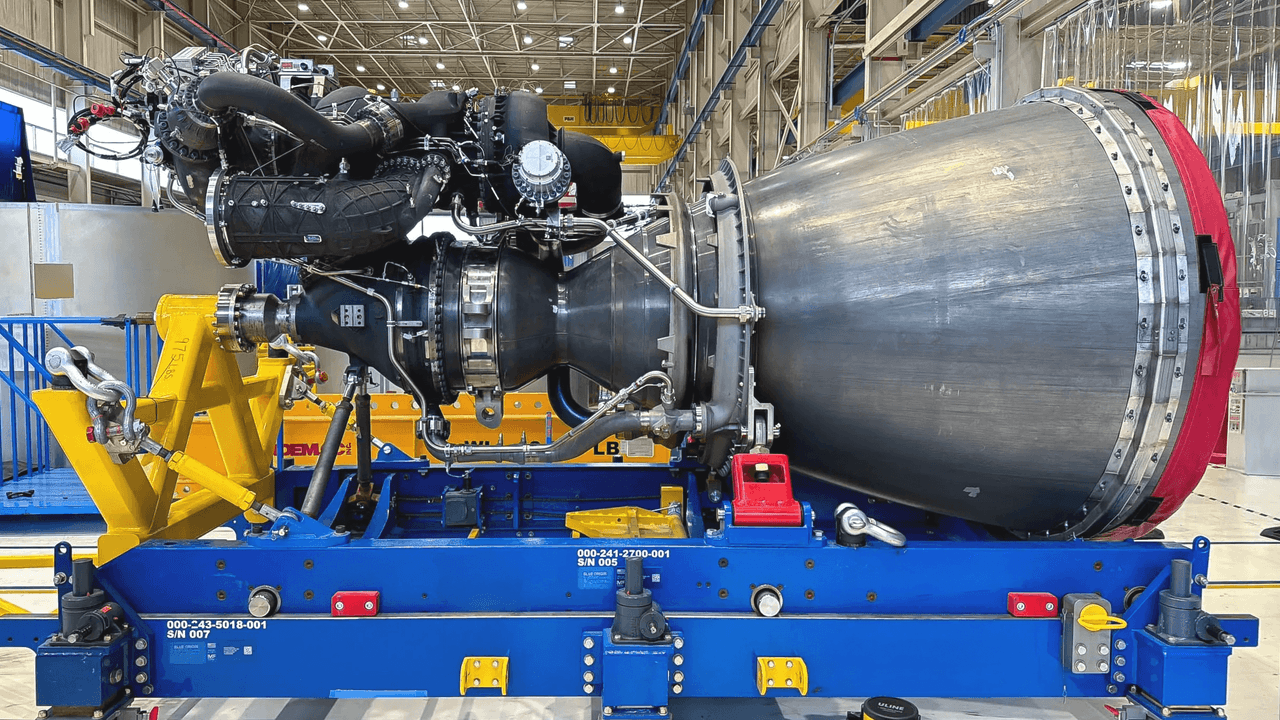
Blue Origin unveiled Northstar on November 5, a reusable rocket engine rated at 715,000 pounds-force of thrust, about 12% above the company's current BE-4 rating. Burning liquid oxygen and liquefied natural gas, the engine adds a second booster design to Blue Origin's propulsion lineup. Blue Origin's announcement
The company reports a 30% reduction in engine mass and half as many parts as BE-4. More than 65% of Northstar's mass is produced using additive manufacturing, according to its engine specifications, which describe combining or eliminating components to simplify the engine.
Blue Origin says the program reached development testing 11 months after approval and can achieve “assembly in less than a day.” The figure covers assembly within a longer manufacturing process. End-to-end production time, flight qualification, a first-flight date and a launch-vehicle assignment remain to be announced.
For rocket builders, the combination of lower weight and fewer components offers two practical advantages: less hardware to lift and fewer individual pieces to produce and join. How much that changes a launch vehicle's performance or cost will depend on the completed propulsion system and its operating record.
More thrust from a lighter engine
Northstar retains the oxygen-rich staged-combustion cycle and single-shaft turbopump architecture used in Blue Origin's earlier propulsion work. The cycle describes how the engine gets its propellants from their tanks into a combustion chamber at very high pressure.
A preburner burns propellant to make hot gas that drives a turbine, which powers the pumps. In an oxygen-rich arrangement, that gas contains excess oxygen. It then enters the main combustion chamber, where combustion is completed before the exhaust expands through the nozzle. A single-shaft layout couples the pumping machinery on a common rotating shaft. NASA's explanation of staged combustion and turbopumps describes the pressure-raising job that makes this machinery essential.
The mass reduction amplifies the reported thrust increase. Dividing 715,000 by 640,000, then allowing for the 30% mass reduction, gives a calculated improvement of approximately 60% in thrust per unit of engine mass. That comparison assumes Blue Origin's thrust and mass figures use the same BE-4 baseline. The company has not supplied an absolute Northstar mass in these announcements.
Propellant efficiency requires another measurement: specific impulse, which relates thrust to the rate at which an engine consumes propellant. NASA's guide to specific impulse explains why engineers use it to compare engines. Blue Origin has yet to publish a Northstar value in its release or engine listing, leaving that part of the performance picture open.
Fewer parts to build and join
Additive manufacturing builds a component by depositing or fusing material in successive layers. For rocket hardware, its appeal includes complex internal passages and the ability to replace an assembly of separate pieces with a more integrated structure. NASA's Long Life Additive Manufacturing Assembly project has explored that approach for combustion chambers and nozzles, including reductions in the number of parts that must be made and assembled.
Finished hardware still needs a controlled production process. In a separate NASA study of printed thruster components, work after printing included heat treatment, surface finishing, inspection, integration and testing. Such work adds to the time needed to turn raw material into an accepted engine. Northstar's detailed production sequence remains unpublished.
In NASA's 2021 account, LLAMA project manager John Fikes said engineers needed to “demonstrate the reliability and successful performance of each step.” That testing is part of qualifying printed flight hardware.
Building a record in service
Blue Origin lists Northstar as throttleable and designed for rapid reuse. Its published specifications do not give a minimum throttle setting or a demonstrated number of reuse cycles. By comparison, the same page specifies BE-4's minimum thrust as 220,000 pounds-force and identifies its existing applications: seven engines on New Glenn's booster and two on United Launch Alliance's Vulcan first stage.
Those operating details matter for a booster that must both launch a heavy vehicle and control its descent. Repeated starts, changing thrust levels and successive heating and cooling cycles place demands on the engine across a mission and between flights. A development test program establishes evidence about those demands; qualification and flight operations add evidence under the conditions for which the hardware is intended.
The announcement arrives during a wider expansion of New Glenn's capabilities. Also on November 5, Blue Origin introduced GS3, a third stage powered by the BE-7 engine for high-energy missions. The company said a government customer's cislunar mission using GS3 is scheduled for 2028.
Blue Origin is also working to restore New Glenn launches after its May hot-fire accident. Reuters reported on November 5 that the next launch had moved to January 2027, citing two people familiar with the matter and a memo from CEO Dave Limp. The immediate task is returning the existing rocket to service while development continues on hardware intended to make future production and operations more efficient.
Sources
Blue Origin Northstar announcement
Blue Origin engine specifications
NASA staged combustion and turbopumps
NASA guide to specific impulse
NASA LLAMA manufacturing research
Sources · 8
- https://www.blueorigin.com/news/introducing-northstar-new-booster-engine
- https://www.blueorigin.com/engines
- https://spinoff.nasa.gov/node/10878
- https://www1.grc.nasa.gov/beginners-guide-to-aeronautics/specific-impulse/
- https://www.nasa.gov/directorates/stmd/game-changing-development-program/long-life-additive-manufacturing-assembly-llama/
- https://ntrs.nasa.gov/citations/20205011825
- https://www.blueorigin.com/news/new-glenn-expands-reach-with-gs3
- https://www.reuters.com/science/blue-origin-delays-new-glenn-rocket-launch-into-january-ft-reports-2026-11-05/