Berkeley researchers teach robots recovery while people demonstrate the task
University of California, Berkeley researchers have proposed a way to make robot demonstrations more useful by introducing small, learned deviations while a person controls the machine.
Published November 6, 2026Intelligence / Robotics / Autonomous Systems
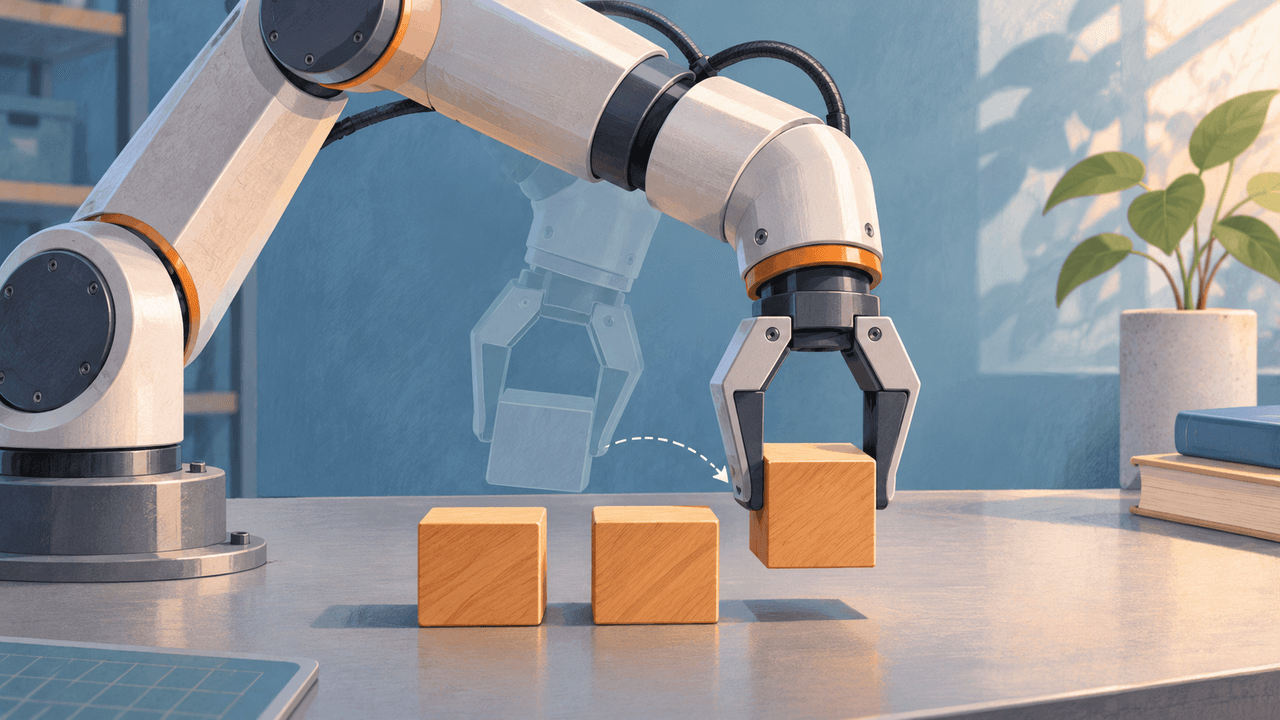
University of California, Berkeley researchers have proposed a way to make robot demonstrations more useful by introducing small, learned deviations while a person controls the machine. Their October 28 preprint, Robotic Data Inoculation, asks a practical training question: how can a dataset include the corrections a robot will need when its own movements drift away from an ideal demonstration? The research paper
Qiyang Li, Zhiyuan Zhou, Charles Xu and Sergey Levine combine continuous human teleoperation with a learned residual policy, a model that adds an adjustment to the operator's command. The person corrects the resulting movement as the task proceeds. The residual model learns alongside data collection with the objective of completing the task successfully. This creates opportunities to record recoveries as part of the demonstration itself. Method and project materials
A successful demonstration shows a robot how to act when objects and movements remain close to the intended path. A recovery example adds information about how to return after a small deviation. In a physical task, an early correction can change the rest of the sequence: a slightly misplaced grip affects how a component approaches its target, and that approach affects the final fit. Coverage of those intermediate situations makes a training dataset more useful.
The Berkeley team tested three precise manipulation tasks with a robot arm: balancing cubes in a T-shaped arrangement, inserting a USB-C cable and removing a keyboard keycap with a tool. It compared learned perturbations with clean human control and random perturbations, then trained policies using imitation learning and offline reinforcement learning. The authors report improved or similar success across the tasks, with the strongest gains over clean demonstrations on cable insertion and cube balancing. Experimental setup and results
There is a history behind this focus on the situations a learner encounters. The DAgger method, introduced in 2011, collected additional expert guidance for states visited by a learned policy. Its central insight was that training examples should reflect the circumstances the policy actually reaches. Data Inoculation brings that concern into shared control during demonstration collection, with the human providing corrections throughout a movement sequence. The original DAgger paper
During data collection, operators show both the intended trajectory and how to recover when the robot departs from it. Learned, state-dependent adjustments offer a way to focus that effort on deviations relevant to the developing policy. For an engineering team evaluating the approach, useful measures would include downstream success, operator time and the number of recoveries captured per collection session.
The real-robot study covered three tasks, with human operators, repeated collection runs and explicit comparison methods. Assessing reliability and safety for factory use would require trials with more object types, additional operators and longer task sequences. Measuring collection effort would also help teams judge the practical benefit.
The idea is attractive because it treats demonstration quality as something engineers can actively improve. A dataset can teach the intended motion and the corrections that keep a task moving toward completion. If the gains carry into larger settings, data collection could become a more deliberate part of robot-system design, with human expertise used to teach the moments that most affect autonomous performance.