OpenAI takes its engineering models into Mazda and Chip Ganassi Racing workflows
OpenAI is extending its work from digital information into the engineering tools used to design physical products. On November 3, the company announced a research collaboration with Mazda and an expanded effort with Chip Ganassi Racing, giving its models two distinct assignments: exploring vehicle designs through simulation and turning scans of existing parts into editable engineering files.
Published November 4, 2026Analysis / Artificial Intelligence / Generative Models
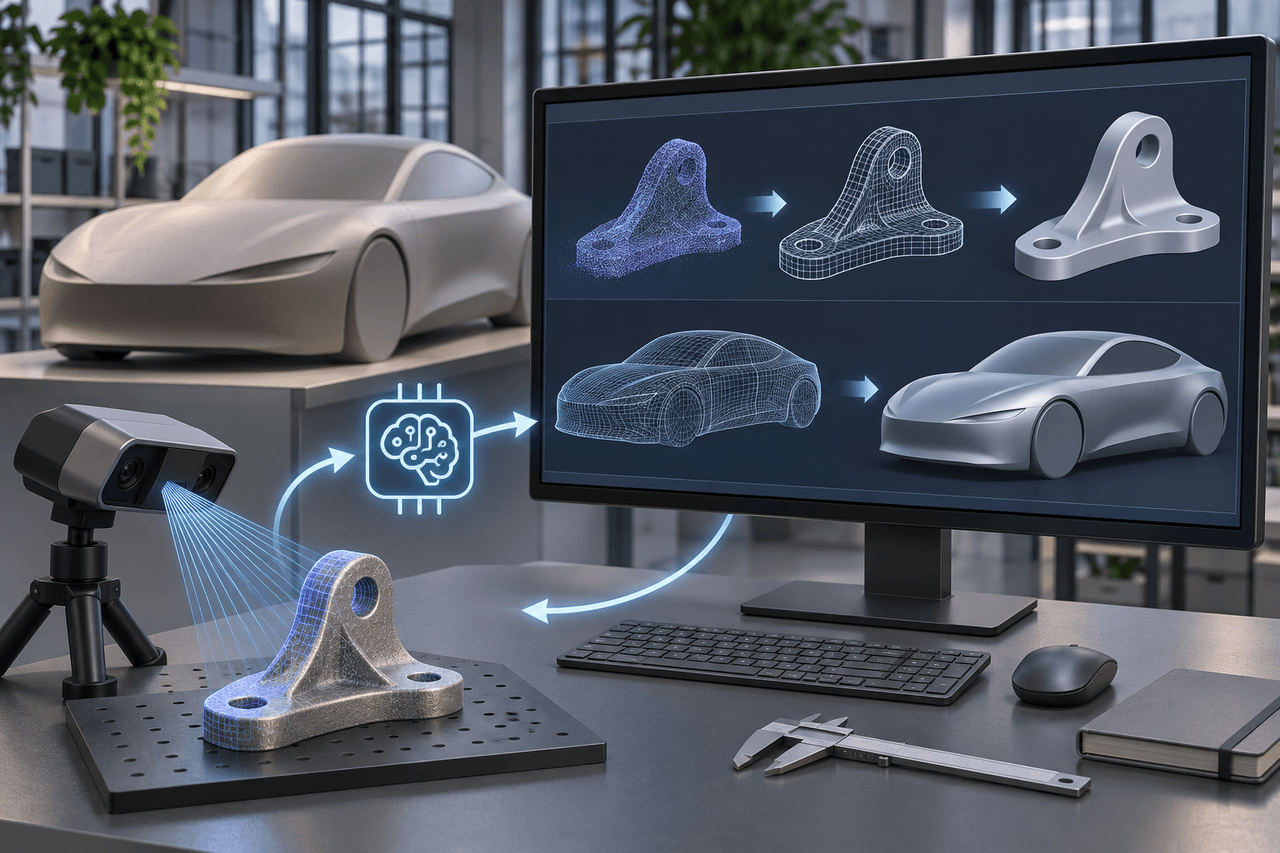
Mazda's aerodynamics and crash-safety engineers are working with OpenAI on airflow and structural simulations that account for performance, styling and cost. At Chip Ganassi Racing, the teams are testing a route from three-dimensional scans to solid computer-aided design models and two-dimensional manufacturing drawings. Engineers at the partner companies review the results for accuracy and practical use. OpenAI's announcement
The choice of work is revealing. A scan describes the surface of an object; an editable design model gives an engineer a way to change its geometry and carry that change into subsequent work. A manufacturing drawing communicates dimensions and requirements to the people making a part. Connecting those forms of information could help a team recover and adapt designs when it has a physical component to study. The practical value would come from preserving the engineering meaning as information moves between tools.
Mazda's assignment examines a related form of iteration. An engineer can alter a shape, run a simulation, assess the result and choose the next variation. Performance is one input to that decision alongside styling, structural behavior, packaging and cost. AI assistance could make it easier to explore alternatives while keeping those requirements visible. A useful measure of success would be the number of engineering decisions a team can resolve with a documented, reviewable chain from design change to result.
The racing collaboration builds on an earlier data-focused relationship. OpenAI's account of that work describes a race car with roughly 200 sensors producing about a billion data points an hour. The new scan-to-design effort moves the collaboration into another stage of the engineering process: creating and revising parts. Data analysis and editable geometry require different kinds of checking, even when both support the same team's performance goals. The earlier Chip Ganassi Racing collaboration
Independent research offers a useful way to assess such demonstrations. An October 17 preprint by Qiang Zou and colleagues evaluated GPT-6 Astra on understanding, generating, editing and evaluating computer-aided designs. It reported successful cases involving complex geometry and identified further work on freeform shapes, parameter dependencies and relationships between assembled parts. The study's emphasis on functionality and editability goes directly to the value these industry workflows are intended to create. The independent CAD assessment
That work also examined iterative refinement, in which an agent attempts to improve its design through successive revisions. It found gains depended on the task, with completion time and correction of critical design errors shaping practical usefulness. For an engineering organization, the appropriate comparison therefore includes total review and correction time. A model-generated design becomes valuable when the effort to produce, inspect and amend it improves the complete workflow. The assessment's findings
OpenAI also described an internal prototype device whose enclosure, electronics and software were developed with its models. Two employees carried out the design exercise in under a week, and a contract manufacturer produced a small prototype batch in under a month. Manufacturing preparation involved several rounds of review and iteration. The example points toward the handoff between a design environment and a real supplier, where tolerances, assembly details and production methods become concrete requirements. The prototype account
OpenAI has not yet published quantified Mazda or Chip Ganassi Racing productivity gains or manufacturing-cost savings from these new projects. The collaborations are research efforts with further results promised in the coming months. Clear evaluation would connect a defined task to time spent, engineering revisions, simulation quality and the quality of the resulting part or design. Keeping those measures together would make the results useful beyond an individual demonstration.
The most consequential shift would be toward assistance that works across the whole design loop: understanding the requirements, making a controlled change, operating the relevant tools and presenting enough evidence for an engineer to judge the outcome. Mazda and Chip Ganassi Racing supply demanding settings for testing that proposition. Their value as collaborators will come from the detailed feedback of engineers who work with the models, simulations and parts every day.