NVIDIA and the race to make computing more efficient with light
NVIDIA’s planned expansion of optical-engine capacity highlights the effort to reduce the energy cost of moving data. The wider photonics race now depends on manufacturing yields, serviceability and evidence from complete computing workloads.
Published October 25, 2026Analysis / Frontier Tech / Experimental Systems
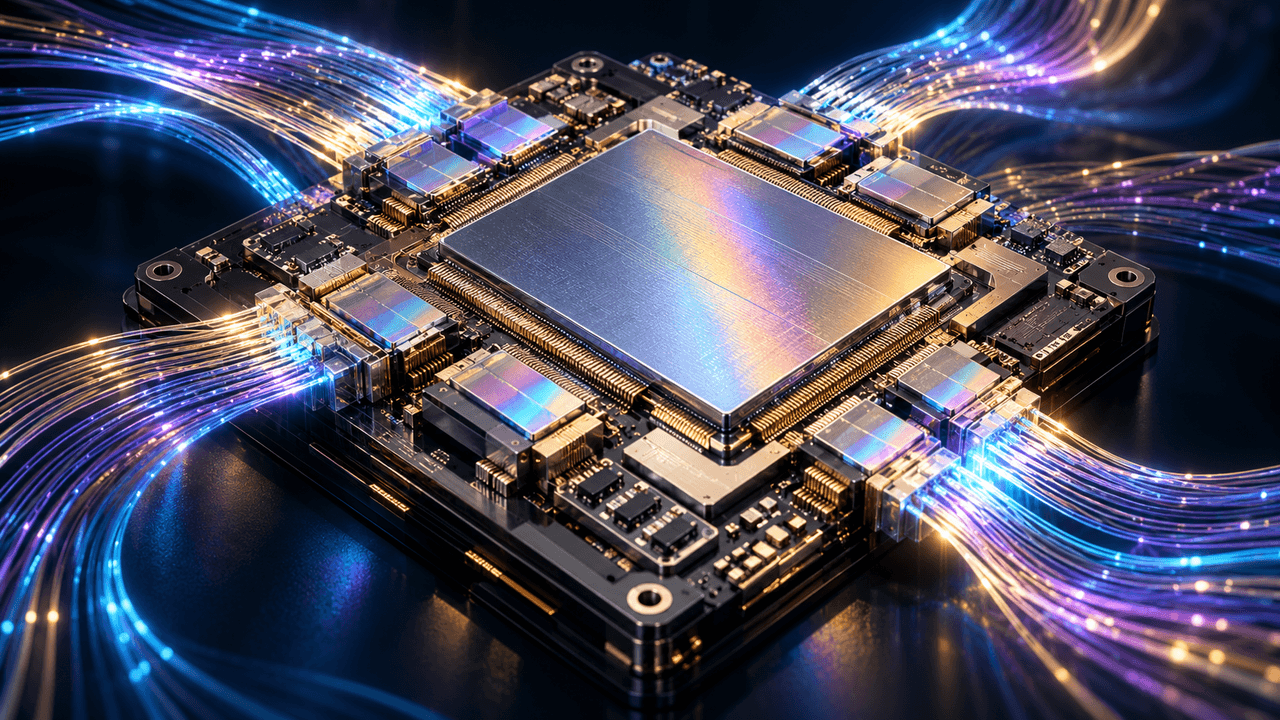
NVIDIA’s plan to expand optical-engine manufacturing with Siliconware Precision Industries, or SPIL, identifies a practical next step for photonics: building enough reliable hardware to matter outside a demonstration. The October 21 announcement targets a fifteenfold increase in SPIL’s Taiwan capacity for optical engines used in co-packaged optics by mid-2027, followed by another doubling by the end of 2028. Those are manufacturing targets, not achieved output or a fifteenfold improvement in computing efficiency. NVIDIA did not disclose the underlying engine volumes, production yields or customer deployment counts.[1]
The distinction matters because the promising part of this announcement is industrial. NVIDIA had already said in June that its Spectrum-X Ethernet Photonics switches were in full production.[2] October’s expansion suggests that supplying optical connectivity at much larger scale is becoming a planning priority. It adds weight to the case that photonics can improve the economics of large computers, without establishing how much electricity any particular customer will save.
That case has become more urgent. The International Energy Agency’s April 2026 outlook projects global data-center electricity consumption rising from 485 terawatt-hours in 2025 to about 950 in 2030. It also identifies tightening electricity, manufacturing and chip constraints, including a high-bandwidth-memory shortage expected to persist through at least the end of 2027.[3] Better connections cannot manufacture missing memory or accelerate a grid permit. They can help operators extract more useful work from the processors and electrical capacity they already have.
Faster processors still need data
A large AI system spends its time moving information as well as calculating. Model data must reach the processor from memory, and processors working on a shared task must exchange intermediate results. Adding arithmetic capacity helps only if the rest of the system can keep it occupied. When communication becomes the limiting step, an expensive accelerator can spend more time waiting rather than finishing useful work.
This produces several different constraints. Memory bandwidth limits how quickly data can feed a processor. Interconnect bandwidth limits communication between processors and systems. Packaging determines how much memory, circuitry and connectivity can fit around a chip. Power delivery and cooling limit how much of that hardware can run at once. Improving one constraint often exposes another; a faster network is useful precisely where communication is holding the application back.
Intel’s optical-interconnect work illustrates the direction of travel. Its 2024 demonstration put an optical input/output chiplet beside a CPU and ran live data through it. Intel described electrical input/output’s limits on bandwidth, reach and energy as the motivation.[4] Optical links could eventually make it easier to connect larger groups of processors, or reach resources farther away, without accepting the same electrical-signaling cost. That is an architectural opportunity, not a guarantee that every application becomes faster.
Moving the light closer to the chip
Fiber already carries data through networks. Co-packaged optics changes where electrical signals become light. In a conventional optical switch, electrical data travels from the main switching chip across the board to removable optical transceivers at the front panel. CPO places optical engines close to the switching chip in the same package, shortening that electrical journey. NVIDIA’s architecture also removes the need for the digital signal-processing retimers used in its pluggable-transceiver comparison.[5]
An optical engine is the hardware that transfers information between electrical and optical signals. The switch still performs electronic networking functions, and the GPUs still perform electronic arithmetic. Putting optics beside a network switch therefore differs from putting optical input/output beside an accelerator. Both differ from a photonic processor that uses light to perform mathematical operations. These distinctions prevent a network announcement from becoming an imaginary announcement of a light-powered replacement for the GPU.
Broadcom supplies a useful example of both the potential and the measurement problem. In October 2025 it reported 65 percent lower optics power than pluggable modules, alongside one million cumulative 400G-equivalent port-device hours without a link flap in Meta’s high-temperature laboratory characterization. A link flap is a brief connectivity interruption; those hours aggregate activity across ports. The result is not a public record of comparable operation across a production fleet. The power reduction concerns optics, not the entire server or data center.[6]
There is also established production evidence for a different use of light. Google’s 2022 Jupiter research described a network redesign combining optical circuit switches with software-defined networking. These switches redirect light between fibers, allowing the network’s connections to change. Google reported five times the speed and capacity alongside a 41 percent reduction in network power across a decade of evolution. The result belongs to a broader architecture, not to CPO alone, and certainly not to optical arithmetic.[7]
The manufacturing problem is becoming central
Lightmatter’s October 12 announcement shows where another part of the race now sits. Working with Flex, it presented a 204.8-terabit-per-second CPO switch tray as a production validation system. A separate tray connecting four accelerators was described as a demonstration. Those labels matter: a design being validated for manufacturing provides more evidence than a concept drawing, but less than a documented volume deployment.[8]
The economics depend on how many completed products pass inspection. A factory can have impressive nominal capacity while producing fewer usable engines than planned. In a tightly integrated package, discovering a defective optical component late can put valuable electronic components and assembly work at risk. The relevant questions include good units shipped per month, the time and cost of testing them, and how failures are handled after installation.
Lightmatter’s March announcement of detachable fiber-array technology addresses this directly. The company described testing optical engines before final integration, compatibility with ASE’s advanced packaging processes and detachable connections that support servicing. These are company claims about a manufacturing approach, not independently disclosed yield results. Their significance is nevertheless concrete: finding defects before combining optics with an expensive chip can reduce the cost of failed assemblies.[9]
Maintenance deserves the same attention as factory yield. In June, cloud operator Lambda described installing an engineering sample of NVIDIA’s Quantum-X Q3450-LD, a different product from Spectrum-X. Its account details liquid-cooling connections, pressure checks and fiber routing. The switch has 18 removable external light-source modules, keeping lasers serviceable even though the rest of the optical path is inside the package. This is useful customer-side installation evidence, not a long-term fleet reliability study.[10]
Greater integration changes which parts can be replaced and how much equipment must be taken out of service. A detachable fiber connection helps, but does not by itself prove that every failed optical engine can be economically repaired. Procurement teams need the actual service procedure, spare-parts strategy and downtime assumptions. Acquisition price alone cannot settle which design delivers the lowest cost per completed job.
NVIDIA’s June description of its production chain makes the integration burden visible: SPIL handles precision packaging, assembly and testing; other partners supply photonic fabrication, laser modules and complete systems. NVIDIA also described validation in its own operating AI facility before customer shipment.[2] The October capacity target is therefore best judged as one part of a coordinated manufacturing expansion. Its success will depend on qualified output and reliable systems, rather than the multiplier alone.
Optical computation has a different hurdle
Using light to calculate is the more ambitious branch of the field. An optical circuit can encode numbers in light and combine signals to perform operations such as matrix multiplication, which underpins much AI processing. But useful computing also needs memory, control, data conversion and software. A fast optical operation is only one stage of an application.
The Leibniz Supercomputing Centre’s April 2026 account of evaluating Q.ANT processors provides a grounded example. LRZ tested two generations of photonic coprocessors and reported promising improvements, while explaining that the cards still exchange data with conventional electronics. Its researchers found efficiency strongest when calculations remained on the optical unit. They also identified precision, software and further development as important work before broader AI-cluster deployment.[11]
A 2025 Nature paper on the PACE photonic accelerator exposes why measurement boundaries matter. The researchers reported 4.21 trillion operations per second per watt excluding lasers, falling to 2.38 when laser power was included. The demonstration concerned particular optimization problems and combined photonic arithmetic with electronic support. It did not establish a general replacement for a GPU.[12]
The buyer’s comparison must be a completed workload at a stated accuracy and response time. It should include the host computer, memory traffic, conversion between electrical and optical signals, laser power and any repeated operations needed to reach the required precision. A component can be excellent at its assigned operation while producing a modest overall benefit if the application spends most of its time elsewhere. Conversely, a well-matched workload that stays on the optical hardware may capture much more of the advantage.
Component efficiency is not a facility electricity forecast
A simple hypothetical shows the scale of the distinction. Suppose a data center draws 100 megawatts, of which 5 megawatts powers the optical subsystem being replaced. If that subsystem’s consumption falls by 60 percent, the direct saving is 3 megawatts. With all other loads unchanged, the facility draws 97 megawatts: a 3 percent reduction, not 60 percent. These are illustrative assumptions, not measurements of NVIDIA, Broadcom or a typical data center. Any cooling benefit would need to be measured separately.
The operational benefit could still be valuable. At a site whose electrical connection cannot grow, a few freed megawatts could support additional computing. A better network might also shorten a communication-heavy job, reducing the hours that the rest of its equipment must run. Neither benefit follows automatically from a lower energy-per-bit figure; both require application-level measurement.
Even genuine efficiency gains need not reduce absolute electricity consumption. If the energy needed for each comparable job falls by 10 percent but the number of jobs rises by 20 percent, total energy increases by 8 percent. Operators may use efficiency to expand output within an existing power limit, or combine it with more capacity. Lower energy per useful result and lower total electricity use are different outcomes.
What the next milestone needs to show
By mid-2027, the useful questions will be whether SPIL has achieved the targeted manufacturing capacity, how much qualified output it produces, and whether customers can deploy and maintain the resulting systems economically. Meaningful performance evidence will compare complete applications under matching conditions and disclose what is included in the power measurement. Reliability evidence should distinguish laboratory qualification from sustained operation in customer facilities.
The broader conclusion is encouraging but specific. Optical networking is already useful, tighter integration is moving through production and manufacturing validation, and photonic arithmetic is being tested on real workloads. The technologies are at different stages and solve different problems. NVIDIA’s SPIL agreement strengthens the manufacturing case for the networking route. Its ultimate value will be measured in reliable computing delivered per watt and per dollar, while memory supply, packaging capacity and electricity infrastructure continue to set limits of their own.
Sources
NVIDIA · NVIDIA and Supply Chain Partners Expand Capacity to Accelerate AI Infrastructure Buildout. October 21 2026.
NVIDIA · NVIDIA Spectrum-X Ethernet Photonics Ramps to Production. June 1 2026.
International Energy Agency · Key Questions on Energy and AI Executive Summary. April 16 2026.
Intel · Intel Demonstrates First Fully Integrated Optical I/O Chiplet. June 26 2024.
NVIDIA · NVIDIA Silicon Photonics. Accessed October 25 2026.
Broadcom · Broadcom Showcases Industry-Leading Quality and Reliability of Co-Packaged Optics. October 1 2025.
Google Research · Jupiter Evolving. SIGCOMM 2022.
Lightmatter · Lightmatter Delivers Open Rack CPO Switch and XPU Scale-Up Server. October 12 2026.
Lightmatter · Lightmatter Unveils vClick Optics. March 11 2026.
Lambda · Unbox One of NVIDIA’s First Co-Packaged Optics Switches With Us. June 1 2026.
Leibniz Supercomputing Centre · LRZ Puts Photonic Computers to Real World Test. April 21 2026.
Hua and colleagues in Nature · An Integrated Large-Scale Photonic Accelerator With Ultralow Latency. April 9 2025.
Sources · 12
- https://nvidianews.nvidia.com/news/nvidia-and-supply-chain-partners-expand-capacity-to-accelerate-ai-infrastructure-buildout
- https://blogs.nvidia.com/blog/nvidia-gtc-taipei-computex-2026-news/
- https://www.iea.org/reports/key-questions-on-energy-and-ai/executive-summary
- https://www.intel.com/content/www/us/en/newsroom/news/intel-unveils-first-integrated-optical-io-chiplet.html
- https://www.nvidia.com/en-us/networking/products/silicon-photonics/
- https://investors.broadcom.com/news-releases/news-release-details/broadcom-showcases-industry-leading-quality-and-reliability-co
- https://research.google/pubs/jupiter-evolving-transforming-googles-datacenter-network-via-optical-circuit-switches-and-software-defined-networking/
- https://lightmatter.com/press-release/lightmatter-delivers-open-rack-cpo-switch-and-xpu-scale-up-server-through-independent-collaborations-with-flex-and-other-industry-partners/
- https://lightmatter.com/press-release/lightmatter-unveils-vclick-optics-industry-first-detachable-fiber-array-unit-for-cpo-advanced-packaging-and-high-volume-production/
- https://lambda.ai/blog/unbox-one-of-nvidias-first-co-packaged-optics-samples-with-lambda
- https://www.lrz.de/en/news/detail/photonic-computers-in-real-world-test
- https://www.nature.com/articles/s41586-025-08786-6