Toyota and Waymo redraw robotaxi supply lines as China faces export pressure
Japan-based production would give Waymo another supplier as Chinese technology companies confront tougher competition for overseas orders and closer scrutiny of market access.
Published October 31, 2026Intelligence / Transportation / Advanced Surface & Marine
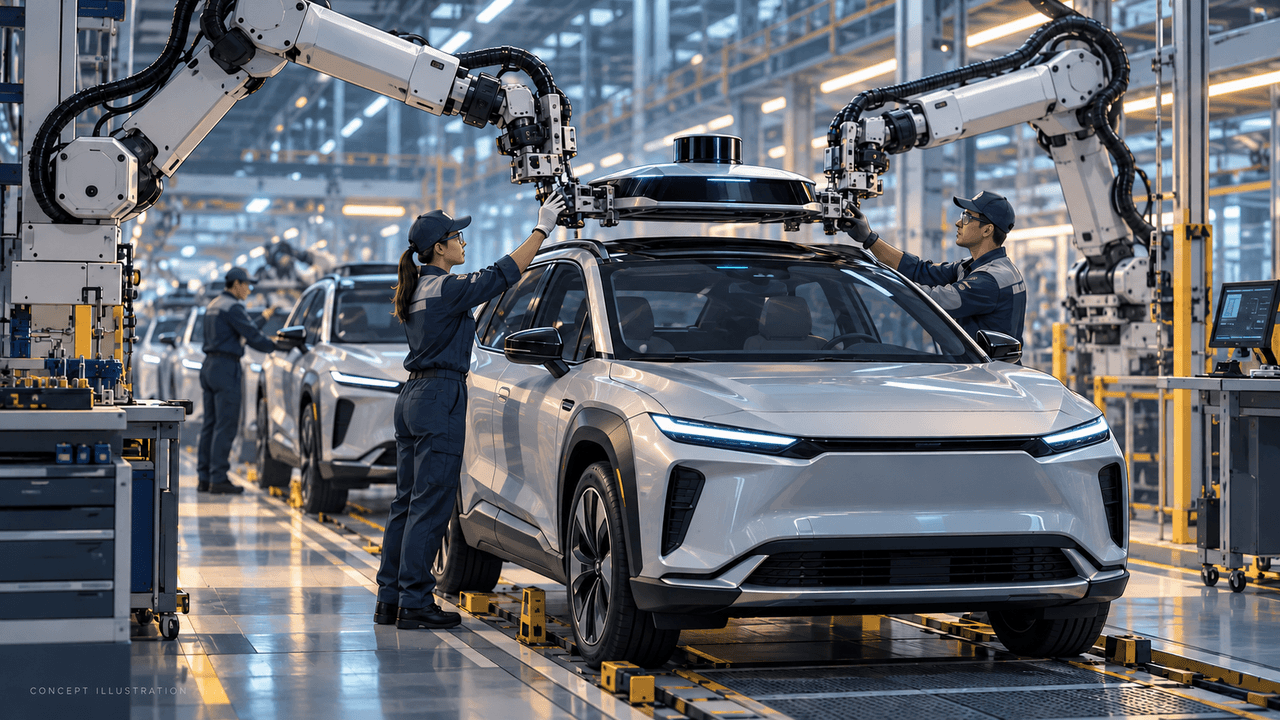
Toyota plans to build Waymo-equipped robotaxis in Japan, bringing vehicle assembly and installation of the autonomous-driving hardware into a single factory. The agreement adds a new manufacturing route for a company whose Chinese-built vehicles have been heading to Arizona to become driverless taxis.
The October 30 announcement identifies Toyota’s Takaoka plant and the electric bZ4X as the next platform. Initial testing and validation in Japan are scheduled for 2027, with deployments in the United Kingdom and other Waymo markets planned for later years. [1]
Toyota’s entry puts another major manufacturer in contention for Waymo’s future fleet orders. For Chinese suppliers, the stakes depend on how quickly the service grows and which vehicles it buys. The agreement arrives during a sharp selloff in Chinese technology shares, as investors reassess how much overseas business those companies can expect.
How China fits into Waymo’s fleet
Zeekr supplies the Chinese-built platform in a fleet that has drawn on several manufacturers. Zeekr’s regulatory filing identifies the Chunxiao factory as a manufacturing site for vehicles supplied to Waymo. The original partnership announcement also describes an international division of work: vehicle development in Gothenburg, Sweden, followed by delivery to the United States for integration of the Waymo Driver. [2,3]
In May 2025, Waymo described its manufacturing partnership with Magna in Mesa, Arizona. The facility was designed to install its autonomous technology in multiple vehicle platforms, including Jaguar I-PACEs and the Zeekr RT. At that stage, a manufactured vehicle platform receives the system that enables Waymo’s driving service. [4]
The Zeekr platform is now called Ojai. [7] Waymo has recently described plans to expand that production route. On October 6, Waymo said production of its silver Ojai vehicles was ramping up in Mesa, with testing underway and rides in San Francisco, Los Angeles and Las Vegas expected in the following weeks. The update came less than a month before the Toyota agreement. [5]
Toyota’s agreement does not announce the cancellation of Zeekr’s program. The agreements point to a company diversifying its vehicle supply as it expands.
A different place for the final assembly work
Takaoka would bring the two main manufacturing stages together. Toyota says it will assemble the base vehicle and integrate Waymo’s autonomous-driving hardware under the same roof. The planned bZ4X includes automatic doors, a power liftgate and extra rear legroom, features intended to make entry, exit and everyday riding easier. [1]
Combining the work could let vehicle engineers and autonomous-system teams coordinate mounting points, installation access, inspection and repair more closely. It could also simplify the handoff between a completed car and an equipped robotaxi. Production results will show whether those changes save time or money.
Mesa offers a different strength: flexibility across vehicle platforms. Waymo’s 2025 factory announcement described plans for an automated assembly line and eventual capacity of tens of thousands of vehicles a year. That figure described full-capacity potential. The company also emphasized validation and commissioning after the driving system is installed. [4]
Hyundai is also preparing to supply Waymo. Its partnership with Waymo calls for IONIQ 5 vehicles assembled in Georgia, with first deliveries planned for the fourth quarter of 2026. Together, the Toyota, Hyundai and Zeekr arrangements illustrate how Waymo can distribute manufacturing across countries while retaining its driving technology as the common element. [6]
Market access enters the investment calculation
Four days before the Toyota announcement, Reuters reported that China’s STAR50 index had fallen 40 percent in less than four months. Optical-component suppliers Zhongji Innolight and Eoptolink were roughly 60 percent below their June and July peaks, partly amid fears of U.S. restrictions on Chinese equipment used in data centers. Reuters also identified high valuations, concerns about AI demand and tax bills as contributing pressures. [8]
The optical-component makers serve a different industry from Zeekr, but their experience exposes a risk shared by exporters: the prospect of losing overseas customers can quickly change what investors think a company is worth. For Waymo’s suppliers, the immediate issue is the allocation of future vehicle orders within an expanding network.
Vehicle suppliers face their own U.S. restrictions. The Commerce Department’s connected-vehicle rule, issued in January 2025, phases in restrictions on certain China- and Russia-linked vehicles and technologies in the United States. Covered software and specified manufacturer restrictions begin with model year 2027; covered connectivity hardware restrictions follow with model year 2030, or January 2029 for components without a model year. The framework includes authorization procedures. A particular vehicle’s treatment depends on its manufacturer, technology and applicable permissions. [9]
Investment policy is evolving separately. On October 22, Treasury proposed changes to its outbound-investment program for certain strategic technologies, including semiconductors and AI. The proposal awaits final implementing regulations. It concerns qualifying investment transactions, while the connected-vehicle regime addresses a different set of products and activities. Together, these policies show why businesses must assess market access alongside engineering and price. [10]
Toyota and Waymo describe their agreement in terms of manufacturing expertise and autonomous-driving technology. The trade and investment rules form the backdrop to that partnership; the companies’ announcement presents a vehicle-development and production plan. [1]
What the change could mean for China
If Toyota or Hyundai wins orders that would otherwise have gone to Zeekr, Chinese vehicle manufacturing captures a smaller share of that spending. If Waymo’s overall fleet grows fast enough, several suppliers could gain orders at once. Both outcomes are plausible; the announced Toyota program supplies a new option, while order allocations will determine the financial consequences.
Competition can also affect margins before it changes total sales. With several qualified platforms, Waymo could gain leverage over prices and delivery terms. Suppliers may respond through productivity improvements, revised bids or additional engineering investment. These are potential commercial pressures; the announced agreements leave their financial terms and future order split open.
For a company raising capital, the calculation extends further. A weaker share price can make a new equity issue more dilutive, while uncertainty about export demand can complicate spending on factories and research. The Reuters-reported selloff shows investors reassessing technology businesses; the financing consequences for an individual supplier depend on its balance sheet, funding needs and customers. [8]
China’s contribution remains substantial within the vehicle program itself. Zeekr supplies an engineered electric platform, with vehicle development drawing on its Swedish engineering operation and production in China. Waymo supplies the autonomous-driving system. That division of expertise helps explain the partnership’s value and the work another supplier must perform to compete. [2,3]
The choice of supplier also determines where specialized integration work happens. Zeekr’s manufacturing route links vehicle production with a separate American installation operation. Toyota proposes combining those stages in Japan. That could influence which factories accumulate specialized production knowledge, service experience and supplier relationships.
For riders and cities, these manufacturing choices matter when they produce a dependable fleet at a sustainable cost. Completed-vehicle prices, production rates, repair times and service reliability will provide the basis for comparison. Toyota’s 2027 validation program is an early test of its approach. The orders that follow will show how much of Waymo’s expansion each partner captures.
Sources · 10
- https://global.toyota/en/newsroom/corporate/44960881.html
- https://www.sec.gov/Archives/edgar/data/1954042/000141057825000390/zk-20241231x20f.htm
- https://zgh.com/media-center/news/2021-12-28/?lang=en
- https://waymo.com/blog/2025/05/scaling-our-fleet-through-us-manufacturing/
- https://waymo.com/blog/shorts/silver-ojai/
- https://www.hyundai.com/worldwide/en/newsroom/detail/0000001260?category=corporate&topic=cp-corporate-information
- https://www.cpuc.ca.gov/-/media/cpuc-website/divisions/consumer-protection-and-enforcement-division/documents/tlab/av-programs/tcp0038152a-waymo-al-0004.pdf
- https://live.euronext.com/en/financial-news/china-ai-bubble-has-already-burst
- https://www.bis.gov/node/22645
- https://home.treasury.gov/news/press-releases/sb0667