A Spin-Wave Junction Remembers Which Way to Send a Signal
The device stores a magnetic routing setting for spin-wave computing. Its potential to reduce energy use depends on the control, readout and other hardware of a complete circuit.
Published October 27, 2026Intelligence / Frontier Tech / Experimental Systems
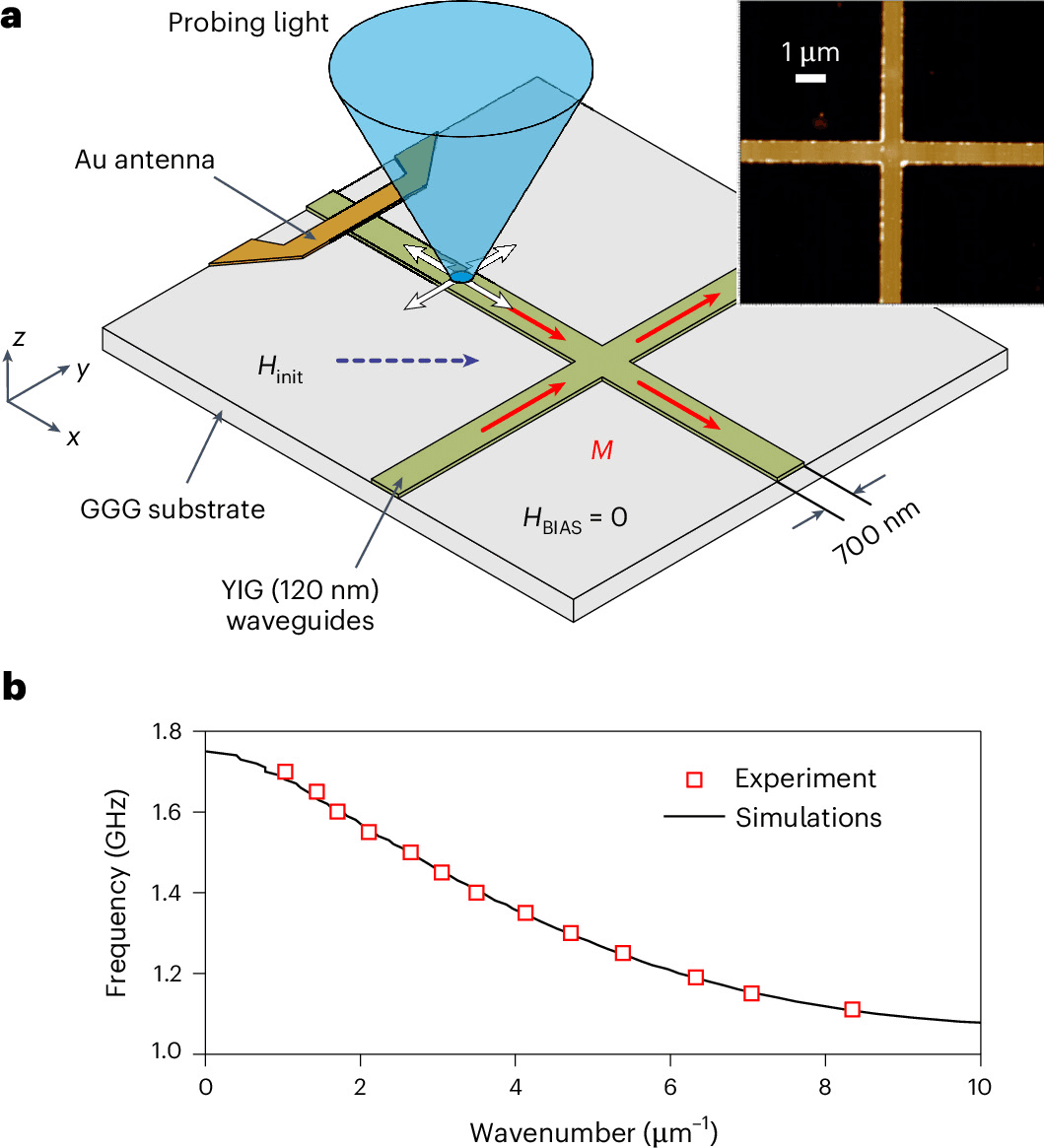
Image: K. O. Nikolaev et al., Nature Materials (2026), Figure 1. CC BY 4.0. Reproduced without changes.
A tiny magnetic junction can remember where to send a signal, giving researchers a building block for programmable connections inside a future computing circuit. In a Nature Materials study published October 22, they routed spin waves through crossing magnetic waveguides after setting the material's magnetization. The work belongs to magnonics, which uses waves in magnetic materials to transmit and process information. The authors envision applications ranging from directing multiple data channels to neuromorphic computing, where networks of interacting elements perform processing inspired by the brain. Their experiment establishes a routing component for that wider effort. [1]
The memory stores the circuit's configuration: which branch a passing signal should take. The waveguide retains a direction of magnetization that determines this choice. Researchers call that state nonvolatile because it persists without a continuously applied holding field. Files on a storage drive and working data in random-access memory (RAM) serve different jobs: holding content a user or program can retrieve. This device retains a setting that directs a magnetic signal path. A useful analogy is a railway junction whose points stay set between trains. The setting directs traffic while the passing signals carry information through the network. [1]
For a person using a future device, the possible benefit would be specialized processing that uses less electricity and produces less heat for a useful task. Retaining a route could reduce the overhead of keeping a circuit configured, while wave-based processing offers a different way to move and manipulate information. Those advantages would have to outweigh the power used to create, detect, control and strengthen the signals. Any eventual gain in battery endurance or sustained performance would depend on that complete energy budget and the workload.
Spin waves are coordinated disturbances in a material's magnetic order. The researchers used yttrium iron garnet (YIG), a magnetic insulator with low losses, to guide them through two strips crossing at a right angle. Earlier experiments had established zero-field wave propagation in YIG nanostructures. The new measured device had 700-nanometer-wide guides in a 120-nanometer-thick film. A brief 100-millitesla field initialized its magnetic state before being removed. A microwave antenna then launched the waves, and optical measurements followed their path with the global bias field at zero. Changing the retained magnetization changed the favored output branch. [1] [3]
Repeated measurements reproduced the routing choice. In the supplementary analysis, fitted wave-amplitude ratios for the favored output arms were about 0.94 and 0.93 in two magnetic configurations. These compare wave amplitude with the incoming signal. The supplement also reports a small difference in phase shift, which the authors attribute to slight geometric imperfections in the sample. For a network made from many junctions, fabrication consistency, reflected power and phase changes influence whether a signal arrives in a form the next element can use. Those details connect a successful laboratory crossing to the demands of a reliable circuit. [2]
Programming a larger network also requires a way to rewrite individual routes. The paper explores that step through simulations combining a global magnetic field with a local field at a chosen crossing. The simulated arrangement switches one waveguide while leaving another's state intact. The authors discuss generating local fields with currents in metal leads, drawing on methods used in magnetic memory. The experimentally demonstrated crossing and the simulated selective writing establish different parts of the proposal: a working routing element and a design for controlling more elaborate networks. Integrated write hardware still needs fabrication and measurement. [1]
The surrounding hardware contributes to the energy bill. In a separate experiment, related researchers used local parametric pumping, an externally supplied microwave drive, to strengthen zero-field spin-wave pulses. A larger circuit may need amplification to compensate for losses. It must also exchange information with electronics, requiring interfaces that turn electrical signals into magnetic waves and recover usable outputs. The routing study's microwave excitation and optical observation provide a laboratory means of launching and seeing waves; a computing implementation needs practical control and readout alongside its magnetic network. Their power, area and reliability belong in any comparison with an electronic circuit performing the same task. [1] [4]
The next computing milestone is a network whose routes can be written, retained and read through repeated operations, with reproducible behavior across fabricated devices. That would let designers assess this approach as a programmable interconnect or signal-processing element in specialized hardware. An end user would benefit if the complete implementation reduced the energy and heat of a task they actually perform. The immediate contribution is the saved magnetic routing setting. Turning it into that user benefit requires the routing junction, its controls and its electronic interfaces to work together within a measured system budget.
Sources
Conceptual illustration
Explore the routing mechanism
A brief initializing field sets a magnetic route. After that field is removed, +45° initialization favors the lower output and −45° favors the upper output. Pausing the wave source leaves the selected state stored.
This is a teaching illustration, not a predictive simulation. Its animation timing and wave pattern are schematic. The experiment used continuous waves; miniaturized networks, selective switching and pulsed routing were simulated.