The interface challenge behind a 260-cycle lithium–CO₂ battery
A closer look at transport, carbonate chemistry and the test conditions behind a laboratory result.
Published October 25, 2026Intelligence / Energy / Advanced Battery Tech
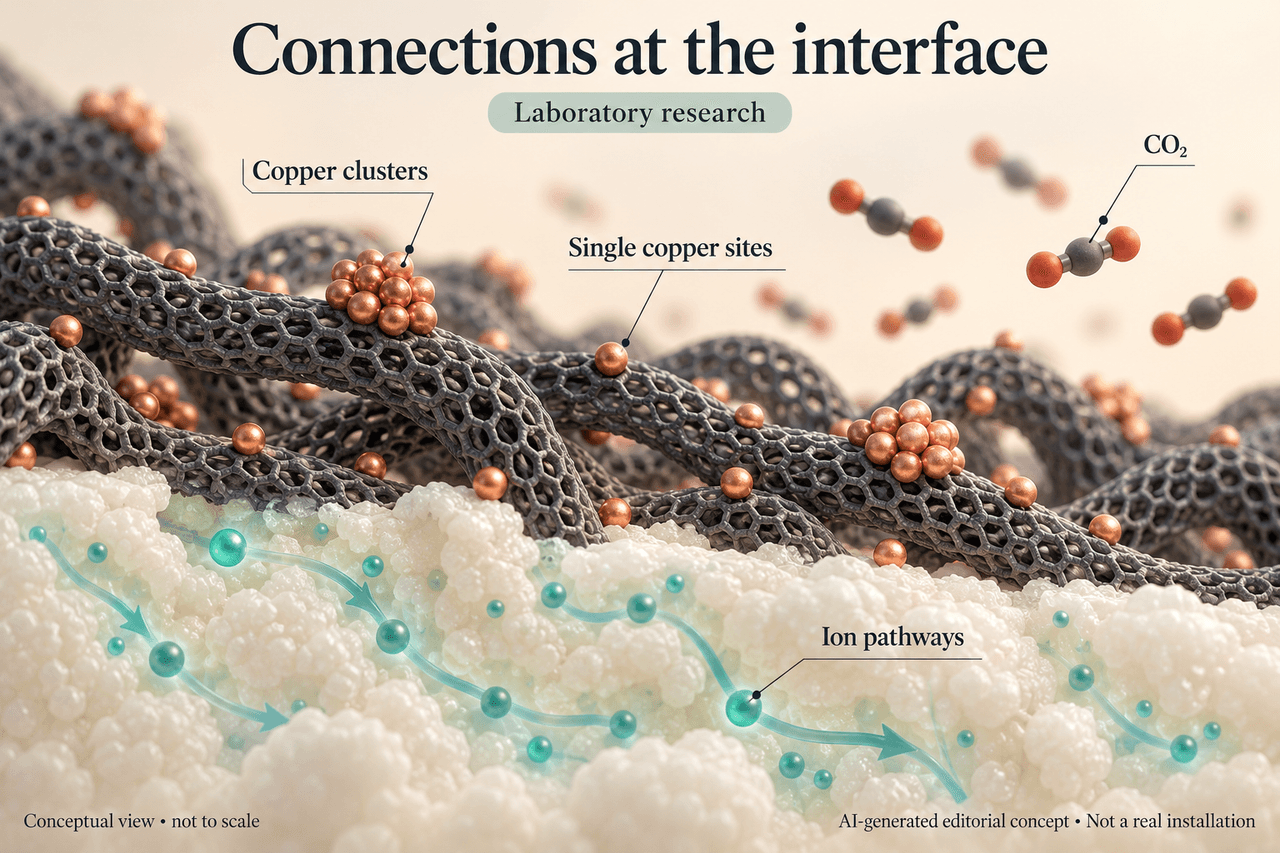
A battery electrode has to keep working after its own reaction products have changed the surface. For lithium–carbon dioxide cells, that is an especially awkward requirement: the material produced during discharge can obstruct the chemistry needed to recharge. Making a capable catalyst is only part of the job. The electrode must keep that catalyst connected to the routes supplying its reactants.
An accepted, peer-reviewed study published October 24 in Nature Communications reports 260 cycles over more than 1,000 hours using copper clusters and individual copper atoms on nitrogen-doped carbon nanotubes. A succinonitrile-based ion-conducting layer and lithium aluminium germanium phosphate solid electrolyte complete the integrated design.
Why the interface becomes the problem
The conventional lithium–CO₂ reaction is commonly written as 4Li + 3CO₂ ⇌ 2Li₂CO₃ + C. Discharge creates lithium carbonate and carbon; charging aims to reverse the transformation. That compact equation hides a physical complication. Carbonate forms on an electrode that must continue exchanging charge and admitting gas. Its location and contact with the catalyst matter alongside its chemical composition.
A 2021 solid-state Li–CO₂ study used ruthenium on carbon nanotubes with a ceramic electrolyte to improve cycling relative to a nanotube-only cathode. Its methods also included a drop of liquid electrolyte. That detail is worth remembering when comparing research described as solid-state: the actual construction and test protocol need checking, not just the label or cycle count.
For an insulating reaction product, simply increasing electrode area cannot guarantee that every new surface remains useful. The engineering requirement is local access: ions, electrons and gas must reach compatible reaction sites. A catalyst stranded outside one of those pathways contributes little, however impressive its activity might be in a different experiment.
Architecture and catalysis have different jobs
There is a useful parallel in 2024 research on solid-state lithium–sulfur cathodes. Researchers combined a porous carbon framework, solid electrolyte and carbon fibres to build connected ion and electron pathways. They also examined structural damage after cycling. Sulfur chemistry differs from CO₂ chemistry, but the architectural lesson transfers: conductivity in a material and useful connectivity throughout an electrode are separate questions.
Our engineering reading is that a gas-reacting cathode adds another constraint. Making ion-conducting contact more extensive must not isolate the places where gas participates. More conductive carbon, more electrolyte or more catalyst is therefore not automatically better. Their arrangement has to support concurrent transport rather than optimize one component in isolation.
The copper study combines these transport and catalytic functions. Its nanotubes carry electrons, while the conformal ion-conducting phase brings lithium ions to the reaction interface. The authors attribute improved carbonate activation to electronic interaction between the two copper-site types.
That catalytic strategy has precedent. A 2022 primary study of ruthenium clusters beside isolated ruthenium sites found that neighbouring sites changed electronic properties and interactions with reaction intermediates. The broader idea is to tune how a surface binds molecules during successive reaction steps. Isolated atoms and clusters need not behave like two independent ingredients simply mixed together. This precedent helps explain the rationale; it does not independently validate the new copper mechanism.
What the cycle number actually establishes
The copper cell was cycled at 500 mA/g with a 1,000 mAh/g capacity limit at 28 ± 1 °C. The abstract reports 78% energy efficiency; the results describe efficiency above 70% during extended cycling. These are not claims of a constant 78% across every cycle. (Paper and supplementary information)
A capacity-limited test asks whether an electrode can repeatedly deliver a specified portion of charge. It should not be read as repeated exhaustive discharge. Nor does a per-gram current specify the demands on a complete battery without knowing precisely which mass was counted. Comparisons need matched capacity limits, loading, temperature and gas conditions before a longer cycle life can be treated as an engineering advantage.
In general, energy efficiency differs from Coulombic efficiency. The first compares electrical energy delivered with electrical energy supplied. The second compares charge out with charge in. Voltage matters to the energy calculation: a cell can return nearly the same quantity of charge while requiring a higher charging voltage than its discharge voltage. Neither metric alone supplies a packaged battery's energy density, power capability or calendar life.
Recharging needs chemical evidence
Earlier experiments show why voltage traces deserve chemical checks. A 2018 study of lithium carbonate oxidation detected highly reactive singlet oxygen in an aprotic electrolyte. A separate 2022 investigation used gas analysis to examine carbonate decomposition and reactions involving the carbon substrate. Those electrolyte-specific findings should not be assumed to occur identically in the new solid-state system. They establish why product identity and unwanted reactions need measurement.
The copper paper itself describes substantial but incomplete removal of carbonate-related species after charging. That qualification matters: continued cycling does not by itself demonstrate perfect chemical reversal.
For JetsonsAge, the next useful evidence would be reproducible operation at greater usable charge per electrode area, with clearly reconciled mass accounting and sustained gas access. Larger cells would also need their electrolyte, lithium, collectors and enclosure included in performance calculations. These are engineering questions for further work, not outcomes established here.
The immediate contribution is a testable interface-design approach. Its value will depend on whether the connections that make a small electrode work can survive more demanding use, while chemical measurements continue to explain what is actually being charged and discharged.