Solid-state batteries face a factory test, not another range promise
Solid Power has begun commissioning its MOBIUS electrolyte line. The next hurdle is turning a promising material into repeatable, qualified production.
Published October 28, 2026Intelligence / Energy / Advanced Battery Tech
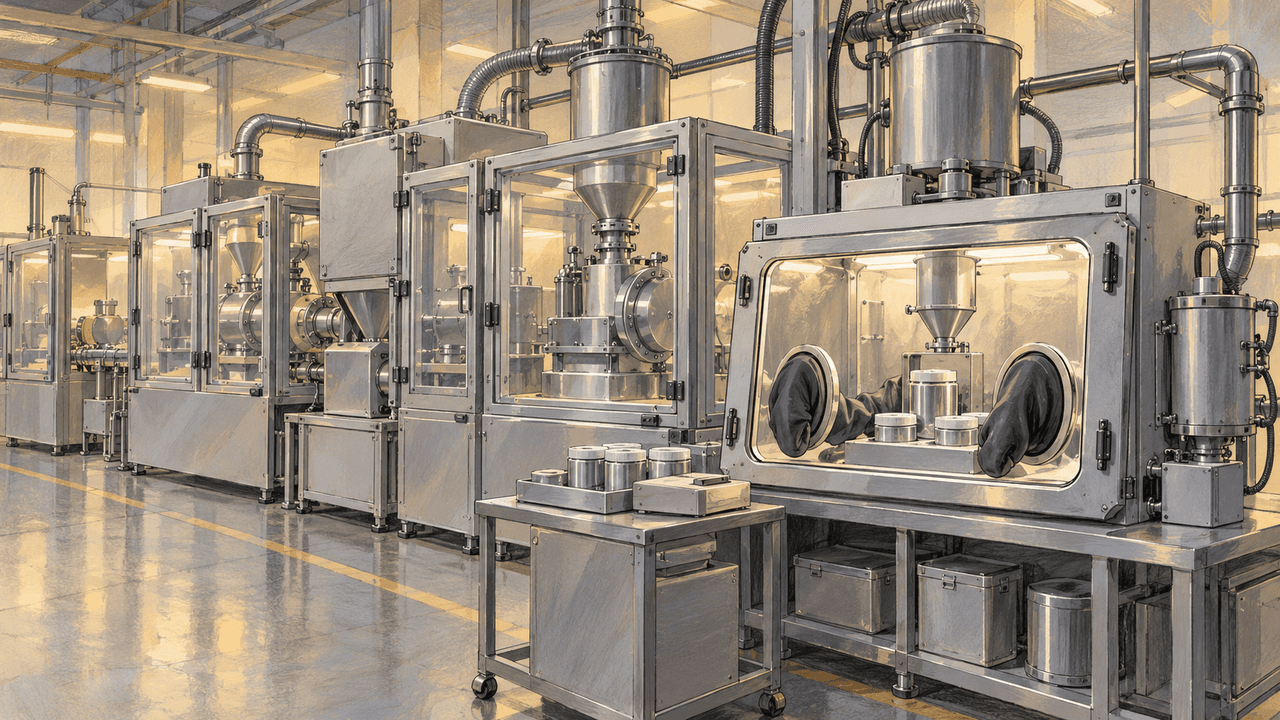
For a battery-material supplier, one successful sample is the beginning of the manufacturing problem. Customers need repeated deliveries with the properties their designs require. A material that performs well in a small test cell still has to emerge consistently from production equipment as volumes grow. That is the factory test now facing Solid Power’s latest electrolyte line.
Solid Power’s latest solid-state battery milestone is happening inside manufacturing equipment in Thornton, Colorado. On October 26, the company said it had begun commissioning MOBIUS, a continuous-production pilot line for sulfide electrolyte, with materials entering the equipment. [B1]
Primary powder-processing equipment has passed site acceptance testing, the company says. Full acceptance testing remains ahead, expected by October’s end, followed by planned fourth-quarter startup. Commissioning is the process of bringing equipment into operation and checking that its installed systems perform as intended. [B1]
MOBIUS is designed to add 45 metric tons of annual capacity, bringing the site’s expected total to about 75. Those figures describe planned capability, not achieved output. Sustained production and yield remain unestablished by this announcement. [B1]
Electrolyte is the material that carries ions inside a battery while electrons travel through the external circuit to do useful work. Rechargeability depends on reversing those movements. Solid-state designs replace the familiar liquid or gel electrolyte with a solid material; Solid Power’s approach uses sulfide chemistry. Making that material is one part of building a working battery, alongside the electrodes that store and release charge and the engineering that brings these parts together. [B2, B3]
A batch process handles a defined quantity as one production lot, then starts another. Continuous manufacturing instead keeps material moving through the process. Solid Power expects tighter control and more consistent output, alongside its existing batch lines. [B1]
Solid Power’s earlier filings describe why it needs a pilot before a larger factory: to learn and optimize production-intent processes before mass production. Its strategy centers on supplying electrolyte and licensing technology to manufacturers, rather than making commercial battery cells itself. The factory challenge therefore reaches directly into the product it intends to sell. [B3]
Its June investor presentation describes a feedback loop between electrolyte development and test cells: the company evaluates how a material behaves inside cells, then uses those findings to improve it. Partners provide another source of feedback. The presentation also separates pilot validation and capacity expansion from the later goal of commercial readiness, including support for partner qualification. Getting more material out of a machine is only useful if customers can use it successfully. [B4]
Yield belongs in that assessment. It asks how much production meets requirements, rather than simply how much passes through the equipment. The annual report identifies volume, uniformity, reliability and manufacturing yield among the broader obstacles to commercializing cells and components. A larger nominal capacity cannot by itself resolve those problems or establish competitive production costs. [B3]
Equipment acceptance and material qualification answer different questions. The first concerns machinery; the second concerns whether the resulting material meets a customer’s requirements. For that reason, the most revealing next results would concern sustained output, consistency against specifications, usable yield and customer qualification. Those measures would show whether the process can move from equipment acceptance to dependable supply. They would also make it possible to judge the economics with something firmer than a capacity target.
MOBIUS puts a necessary industrial question within reach of an operating test. It offers no new evidence yet about how far a finished car will travel, what a commercial battery will cost or when consumers will be able to buy one. Its significance is closer to the factory floor: whether a solid-state ingredient can be made reliably enough for others to build with it.
Sources · 4
- https://www.businesswire.com/news/home/20261026225686/en/Solid-Power-Announces-Significant-Advancement-in-Commercial-Pathway-Commissioning-MOBIUS-Continuous-Electrolyte-Manufacturing-Line
- https://www.energy.gov/science/doe-explainsbatteries
- https://www.sec.gov/Archives/edgar/data/1844862/000110465926041143/tm264075d2_ars.pdf
- https://s202.q4cdn.com/841762012/files/doc_presentations/2026/Jun/12/Investor-Presentation-June-2026.pdf