QuantumScape Plans a 100 MWh Battery Line for AI, Aerospace and Defense
The Muehlbauer partnership sets a path toward a targeted 2028 production start, with equipment engineering underway and key manufacturing details still open.
Published October 24, 2026Intelligence / Energy / Advanced Battery Tech
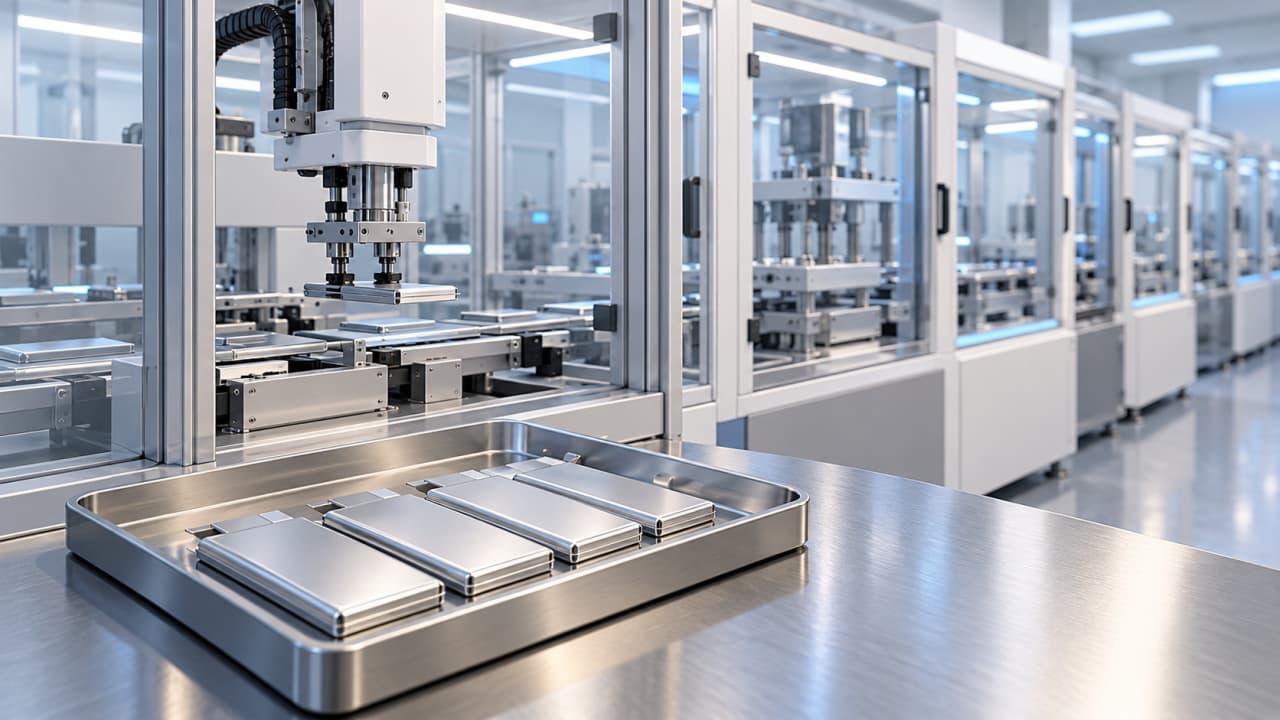
QuantumScape has announced plans for a 100 megawatt-hour battery cell production line, bringing German equipment maker Muehlbauer into its effort to turn solid-state battery technology into larger-scale manufacturing. The October 21 announcement targets cell production in 2028 and markets including AI data centers, aerospace and defense. Its practical significance is a plan to expand the supply of cells beyond today’s pilot operation.
QuantumScape develops rechargeable lithium-metal batteries. In conventional lithium-ion cells, lithium moves into and out of a graphite-based negative electrode, or anode, through liquid electrolyte and a porous separator. QuantumScape’s design uses a solid ceramic separator and dispenses with that graphite host: lithium metal forms at the anode during charging. Removing the host material can free space and weight for storing energy. The ceramic is designed to resist lithium filaments that could short-circuit a cell. “Solid-state” describes this separator; QuantumScape still uses liquid electrolyte on the positive-electrode, or cathode, side.
The capacity figure also needs unpacking. A megawatt-hour measures energy: 100 MWh equals 100,000 kilowatt-hours. For a cell factory, that describes the combined rated storage energy of its output. Manufacturing capacity is commonly expressed per year, but QuantumScape’s release and accompanying shareholder letter do not explicitly define the figure as annual nameplate capacity. Even a confirmed nameplate rating describes designed throughput; actual saleable output depends on operating time and how many cells pass quality checks.
Muehlbauer’s role is to provide cell-assembly equipment. According to the announcement, its engineers evaluated processes at QuantumScape’s Eagle pilot line in San Jose and developed enhancements for higher throughput. That gives the project an equipment partner with a defined task. The new line’s location and final cell format or product mix are not specified in the reviewed disclosures.
The work now disclosed is engineering. Construction and equipment installation, commissioning to bring machinery into operation, and qualification to establish consistent cell quality are further steps. Customer testing can proceed alongside that work, but sustained commercial production requires both a functioning process and products customers accept. QuantumScape describes the proposed line as its first commercial-scale mass production; it has not supplied separate construction, commissioning or qualification dates, or a timetable for reaching full output.
There are measured cell results behind the ambition. QuantumScape’s 2024 QSE-5 B-sample measurements reported 844 watt-hours per liter and 301 watt-hours per kilogram at 25°C, using a five-hour discharge rate. The packaged cell’s volume was measured fully charged under module pressure, excluding its tabbing area; the stated operating-pressure range is below 3.4 atmospheres applied. Its published 12.2-minute charge from 10% to 80% was measured at 45°C. These conditions matter when comparing batteries, and individual-cell results do not establish the performance of a complete customer system.
AI data centers offer a specific use for compact, powerful batteries. Synchronized computing workloads create rapid changes in electricity demand, making storage useful as a buffer, as NVIDIA’s power-architecture work explains. QuantumScape’s October 8 QS PowerBlock announcement introduced a modular reference design for storage inside power racks. Its claims of four times the power density and five times the runtime were benchmarked against Open Compute Project Open Rack V3 specifications using prototype tests and modeled configurations under controlled conditions. Final performance will depend on the customer’s system configuration and operating conditions.
Aerospace puts a premium on energy per kilogram, but translating a cell advantage into flight capability takes system engineering. NASA research on aircraft batteries shows how structure, thermal management and safety requirements reduce the energy density available at pack level. For defense customers, QuantumScape also identifies supply-chain resilience as an attraction, citing its existing US-built cells and efforts to avoid critical dependencies on Chinese suppliers.
Customer testing is already part of the picture. In its third-quarter letter, QuantumScape reports shipping QSE-5 samples to defense, aviation and telecommunications customers. It does not name those recipients or disclose committed purchase volumes for the planned line. The combination suggests a strategy of pursuing several specialized markets while automotive development continues. The next meaningful evidence will be equipment delivered and running, consistent qualified cells, and customer acceptance—milestones that turn a manufacturing plan into a dependable source of batteries.
Sources · 9
- https://ir.quantumscape.com/news-releases/news-release-details/quantumscape-announces-plans-100-mwh-solid-state-battery
- https://www.quantumscape.com/battery-technology/
- https://www.energy.gov/cmei/vehicles/articles/fotw-1271-january-2-2023-electric-vehicle-battery-manufacturing-capacity
- https://ir.quantumscape.com/static-files/d00eb7bb-65ea-4355-99c4-476435c5eea9
- https://www.quantumscape.com/a-first-look-at-the-qse-5-b-sample/
- https://ir.quantumscape.com/static-files/1b960eea-ee9f-453f-8009-cc532676a351
- https://developer.nvidia.com/blog/building-the-800-vdc-ecosystem-for-efficient-scalable-ai-factories/
- https://ir.quantumscape.com/news-releases/news-release-details/quantumscape-announces-qs-powerblock-rack-energy-storage-ai-data
- https://ntrs.nasa.gov/api/citations/20210017488/downloads/Battery_Cell_to_Pack_Scaling_Trends_for_Electric_Aircraft_6_14.pdf