NVIDIA’s DSX POD targets faster AI data-center deployment
A modular reference design promises deployment in as little as 14 days at prepared sites. The full project still depends on site construction, utility connections and commissioning.
Published October 24, 2026Intelligence / Artificial Intelligence / Generative Models
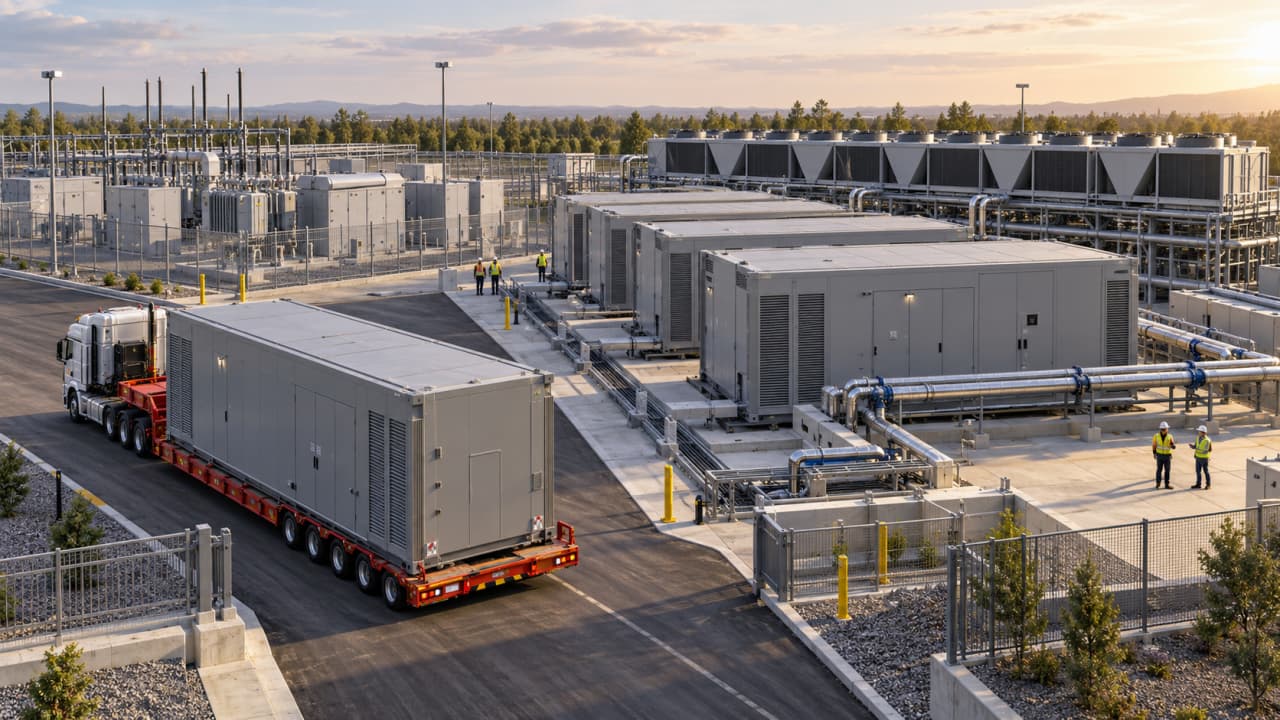
NVIDIA wants AI data centers to arrive with much of their assembly already finished. Its DSX POD announcement, unveiled October 21 at GTC Berlin, describes modular containers integrated and tested before shipment. NVIDIA says deployment at a prepared site could fall from six months to as little as 14 days. The comparison comes from NVIDIA.
An “AI factory” is a data center that trains AI models and runs them to answer requests, a process called inference. It does not manufacture chips or robots. DSX POD is a reference design: a technical blueprint that delivery partners use to build customer systems. Designed around NVIDIA’s Vera Rubin computing platform, it coordinates the equipment and infrastructure needed to operate a large AI installation. NVIDIA’s product page describes a partner-delivered design, with partners responsible for engineering, customization, manufacturing and support.
The change is where much of the difficult installation happens. Partners assemble computing systems, networking, rack-level power and liquid cooling inside prefabricated modular containers. Rack-to-rack cabling, wiring, piping and functional testing take place at the manufacturing facility. The intended advantage is that equipment arrives as an integrated unit, with fewer individual connections left for crews to make around racks at the destination.
Meanwhile, another team can prepare the land, foundations and supporting infrastructure. Factory assembly and site preparation can proceed in parallel, rather than making every installation task wait for the building site. That overlap matters: moving a job indoors does not automatically shorten the whole project, but doing two streams of work at the same time can shorten the path to service—provided they finish when needed.
The 14-day claim belongs to the deployment phase at an already prepared site. NVIDIA’s technical description says work after delivery includes placing containers, connecting them to one another and to external power, cooling and networks, checking for transport damage, validating connections and completing system commissioning. Commissioning means testing the installed system to establish that it works as intended. For cooling, that includes checking the complete connected loop under operating conditions.
This is not a two-week timetable from buying land to running models. Earlier manufacturing, site construction and establishing utility service sit outside the prepared-site claim. Final hookups and commissioning still have to happen. The reviewed materials provide no detailed schedule or customer acceptance record for the 14-day figure. Planners therefore lack the clear start and finish milestones needed to use it as a dependable onsite timetable.
The practical benefits are plausible. A repeatable layout could help crews learn from one unit to the next, while factory testing could expose a wiring or plumbing problem before it becomes a field repair. Dell’s planned implementation brings compute, storage, networking, rack power and liquid cooling into the same containerized offering. For an operator, the economic opportunity is earlier use of expensive equipment. Whether that produces earlier revenue depends on having workloads and customers ready; these announcements provide no project price or measured savings.
The approach also has a defined audience. NVIDIA’s FAQ identifies the initial focus as large new-build, liquid-cooled AI infrastructure. A repeatable container design may suit an operator expanding similar capacity across prepared locations. A constrained existing building may demand a different approach. Transport adds its own engineering obligations: installed racks must survive handling and travel, with appropriate restraints, lifting arrangements and checks after arrival. Factory integration shifts responsibility upstream without removing the destination’s physical requirements.
Power remains a separate constraint. The International Energy Agency reported in April 2026 that transformer and other equipment supply chains had tightened, while planning pressures were delaying grid connections and approvals. A container ready to receive electricity cannot make a utility supply arrive sooner. Likewise, factory-installed liquid-cooling pipes still need a site system that can carry the heat away. The shorter installation window is most useful where those prerequisites are ready on time.
Commercial delivery is still ahead. NVIDIA says its partners plan worldwide DSX POD deliveries in early 2027, and Dell lists that same window for its modular offering. HPE says it will support DSX POD, building on its existing modular data-center expertise. Those are delivery plans, not evidence of completed DSX POD customer deployments. The useful test will be whether partners can repeatedly turn prepared sites into working capacity on the promised schedule, with clear acceptance criteria and a complete account of the work required beforehand.
Sources · 6
- https://nvidianews.nvidia.com/news/nvidia-introduces-dsx-pod-ai-factories-to-accelerate-europes-infrastructure-deployment
- https://www.nvidia.com/en-us/data-center/products/dsx/pod/
- https://developer.nvidia.com/blog/achieve-productive-ai-capacity-faster-and-more-predictably-with-nvidia-dsx-pod/
- https://investors.delltechnologies.com/news-events/press-releases/detail/1659/dell-technologies-advances-enterprise-agentic-ai-from-the-deskside-to-data-center-with-nvidia
- https://www.iea.org/news/data-centre-electricity-use-surged-in-2025-even-with-tightening-bottlenecks-driving-a-scramble-for-solutions
- https://www.businesswire.com/news/home/20261021721099/en/HPE-Teams-With-NVIDIA-to-Advance-Secure-Agentic-AI-Across-Enterprises-and-Industrial-Environments