Tiny Magnets Offer a More Direct Readout of Muscle Movement
A three-person experiment connects implanted magnetic beads to screen control, advancing a sensing approach that could guide future prosthetic limbs.
Published October 31, 2026Intelligence / Frontier Tech / Human Augmentation
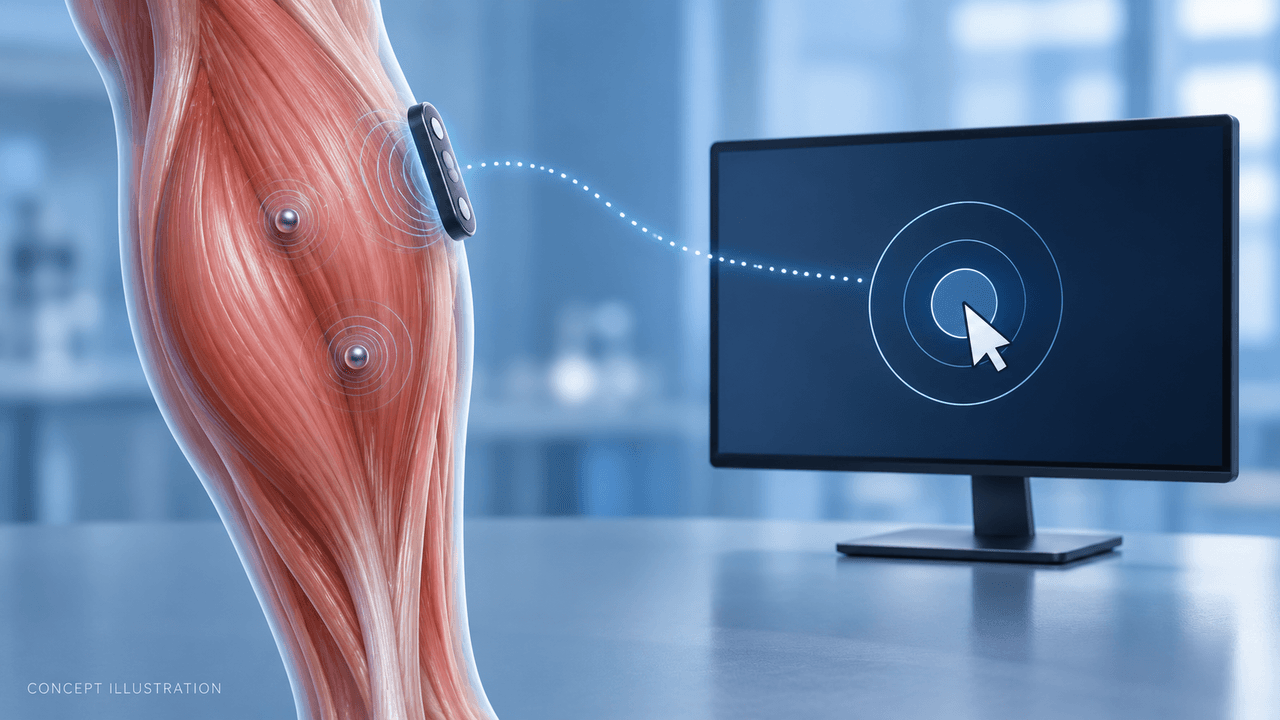
A robotic limb needs a reliable answer to a deceptively difficult question: how does its wearer want it to move? Recording electrical activity can show a muscle’s activation. Measuring the muscle’s movement provides another part of the picture.
MIT researchers have extended a magnetic sensing method to three people with below-knee amputations. In the experiment reported October 29, participants used muscle signals to move a cursor toward targets on a screen. The task tested control through long-term implanted magnets; walking with a robotic prosthesis remains a subsequent stage of evaluation. [1]
The method, called magnetomicrometry, places pairs of tiny magnets inside a muscle. External sensors track their changing separation as the muscle shortens or stretches. That gives a direct measurement of length and movement speed, which can become an input to a prosthetic controller. MIT’s earlier animal work, published in 2021, established the sensing approach before the present human study. [2]
The new participants had an agonist-antagonist myoneural interface, a surgical arrangement that reconnects opposing muscles so they continue to interact. Researchers compared magnetic sensing with electrical recordings from both implanted electrodes and skin electrodes. MIT reports that the magnetic approach produced more accurate and stable control in the virtual task. The team is conducting a larger study involving control of prosthetic limbs. [1]
For readers following assistive robotics, the advance lies in the interface between a person and a machine. A powerful motor and sophisticated control software can only act on the information they receive. Tracking mechanical movement offers a different kind of signal from tracking electrical activation.
The next results to watch are practical ones: reliable movement while wearing a prosthesis, performance across more users, and the long-term demands of an implanted system. The cursor experiment provides a controlled comparison on the path toward those harder tests.
Sources
1. MIT human-study report, October29