A tiny carbon ribbon carries current like a metal
Five- and seven-sided atomic rings give researchers a new route toward precisely built carbon wiring.
Published October 31, 2026Intelligence / Materials / Nanomaterials & Graphene
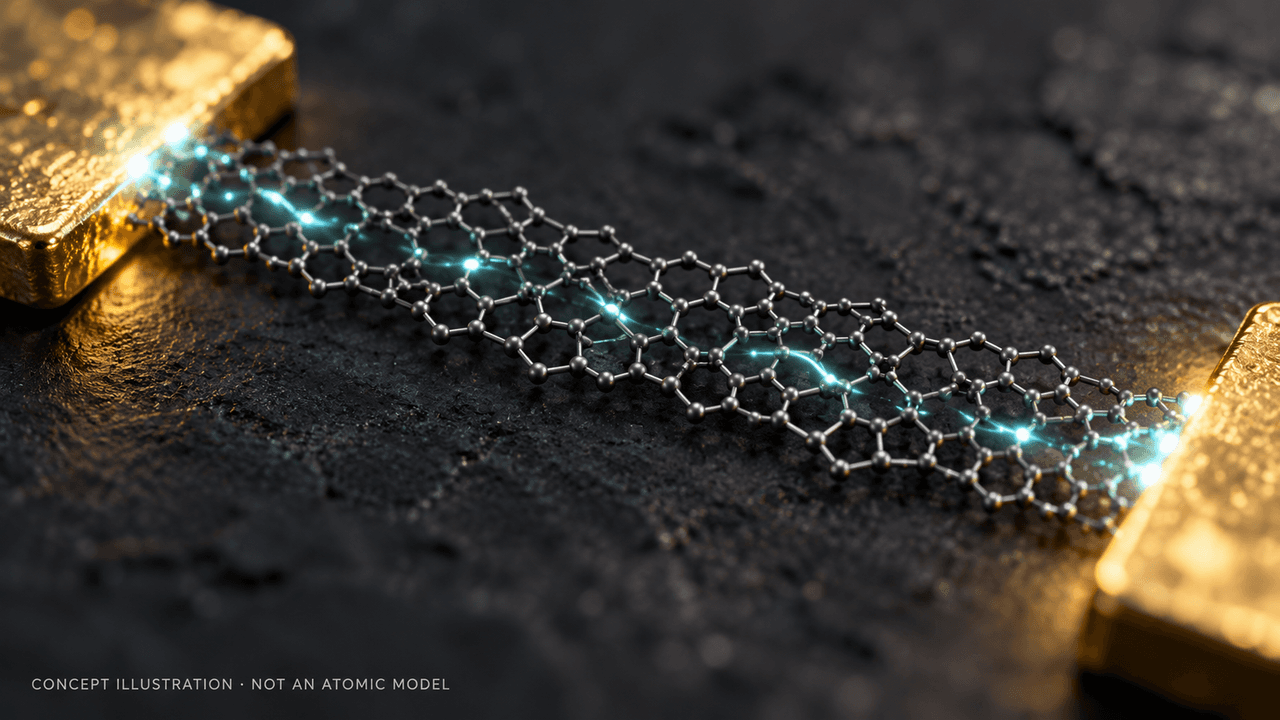
Carbon electronics will need tiny conducting connections alongside components that switch current. Researchers have made a narrow candidate: a flat ribbon of carbon atoms arranged in five- and seven-membered rings. One version behaves as a metal. The study appeared in Nature on October 28. Nature study
The challenge began with chemistry. The team needed chains of paired five-membered rings, but the intended molecular starting point was too reactive. They instead joined more stable molecules containing eight-membered rings on a silver surface. Heating rearranged those rings into the required chains. Further heating fused neighboring chains sideways, creating seven-membered rings between them. USTC research release
The resulting ribbon was about 0.9 nanometers wide. To test it, researchers used a microscope tip to contact and lift one end, making a short current path between the tip and the silver surface. At low temperature, conductance stayed almost unchanged over several nanometers of lifting. That supports efficient electron transport over the short distance measured. USTC research release
Atomic arrangement proved decisive. Two ribbon structures shared the same central chain of seven-membered rings, but the orientation of the neighboring chains differed. CPHN 1 was metallic and approached one conductance quantum, a benchmark for a highly transmitting quantum channel. CPHN 2 was a narrow-bandgap semiconductor. Nature study
This laboratory synthesis and transport demonstration gives researchers another structure to study for future carbon wiring. The authors identify further synthetic optimization as necessary for device integration. Nature study