Why Helium’s Critical-Material Status Matters for Chipmaking
DOE has designated helium a critical material. Reliable chipmaking supply still depends on purification, distribution and recovery, not deposits alone.
Published October 25, 2026Intelligence / Frontier Tech / Experimental Systems
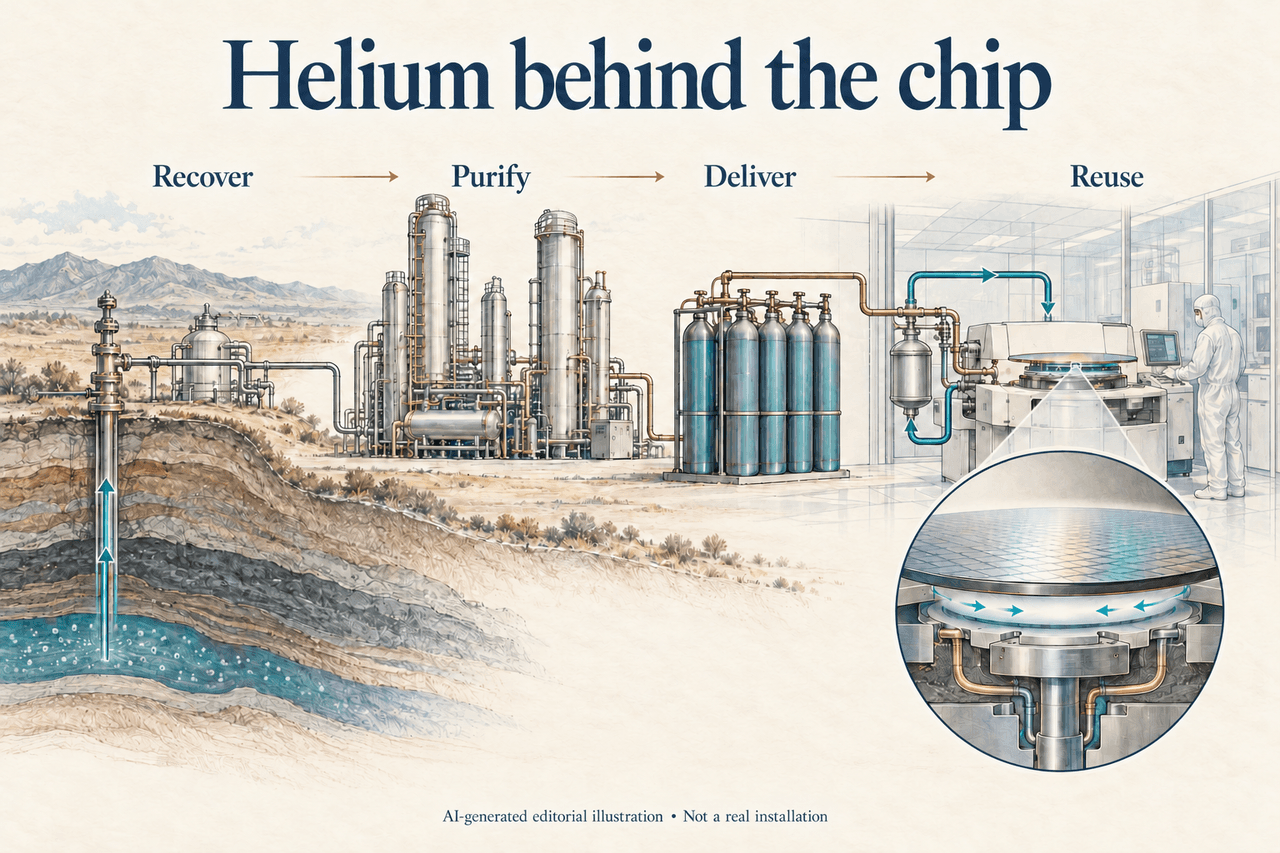
America has helium underground. Semiconductor resilience depends on turning it into purified, deliverable gas and keeping more of it in circulation.
The Department of Energy’s October 23 announcement of helium’s critical-material designation puts an overlooked manufacturing input beside the chips it helps produce. DOE says helium is essential to semiconductor production and that limited refining capacity and lengthy permitting timelines constrain domestic supply despite substantial helium-rich resources. The practical question is how quickly those resources can become dependable industrial deliveries. DOE’s announcement
What Washington actually changed
The action adds helium to DOE’s Critical Material List under Section 7002(a)(2) of the Energy Act of 2020. That framework covers nonfuel materials the energy secretary determines face high supply-disruption risk and perform an essential function in energy technologies. It is distinct from the Interior Department’s critical-minerals designation process through the U.S. Geological Survey. DOE’s definitions
The posted notice, signed October 21, explains the addition and its semiconductor rationale. It identifies no funding award, spending amount, new plant or construction schedule. Readers should therefore separate the policy designation from subsequent decisions about financing and physical capacity. Project-level financing still requires separate evidence.
Why a chip factory needs helium
One important job happens underneath the wafer. EPFL’s microfabrication facility describes helium confined in the narrow space between a wafer and its electrostatic chuck during plasma etching. The gas conducts accumulated heat into the tool below. Clean wafer backsides and effective confinement matter because local imperfections can disrupt thermal stability. Helium helps control a manufacturing condition that must remain consistent while intricate structures are etched. EPFL’s process guidance
Its usefulness combines heat transfer with chemical inertness. Helium can move heat without behaving like a reactive process chemical. Air Liquide also includes helium among the ultra-high-purity carrier gases supplied to semiconductor manufacturers, alongside equipment for distribution, purification and online purity control. The requirement extends beyond obtaining a cylinder: the gas must arrive and remain suitable for the process. Helium’s properties; semiconductor gas systems
Substitution depends on the application. Oxford Instruments lists either helium or argon as backside gas for heat transfer in its ion-beam-etching technology. That example cautions against saying helium is irreplaceable everywhere, even as DOE identifies critical applications without viable alternatives. Oxford Instruments’ specifications
Consumption figures also need care. USGS combines semiconductors with controlled atmospheres and fiber optics in a category representing 17 percent of U.S. helium use in 2025. That percentage cannot be assigned to chipmaking alone. The policy concern is a manufacturing dependency, not evidence that semiconductor factories consume most of the country’s helium. USGS’s end-use breakdown
Deposits are only the first stage
USGS’s 2026 commodity summary estimates 8.49 billion cubic meters of recoverable helium in identified U.S. natural-gas reservoirs, excluding storage. It also reports that the United States remained a net exporter in 2025. Those figures argue against treating the designation as proof that America has run out. Geological resources and annual availability answer different questions. USGS’s helium summary
The production chain has several distinct steps. Linde Engineering describes recovering crude helium from natural gas through cryogenic processing, often alongside nitrogen removal, then purifying it using pressure-swing adsorption. Its systems can produce helium above 99.999 percent purity and liquefy it for storage. Plant configurations depend on feed-gas composition and helium concentration. A promising reservoir still needs processing equipment suited to what comes out of the well. Linde’s processing description
Delivery introduces another layer of infrastructure. Linde describes liquid-helium shipments in specialized, highly insulated containers, with distribution facilities repackaging supplies into dewars, tube trailers and cylinders. Additional extraction therefore has to connect with purification, storage and transport capacity. A discovery announcement alone says little about when a particular fab can receive qualified gas. Linde’s supply network
The kind of gas field matters, too. USGS has warned that a shift toward shale gas, which lacks recoverable helium quantities, could weaken supply. More natural-gas production does not necessarily yield proportionally more helium. Supply planning has to identify suitable feedstocks and the facilities capable of recovering their helium. USGS’s supply-risk explanation
Recovery belongs in the capacity discussion
More fresh production is only one route to resilience. USGS reports that large-volume helium applications in the United States seldom recycled their gas in 2025, although closed-loop systems were becoming more common. That leaves recovery as a practical area to examine, without assuming every exhaust stream is equally suitable. USGS’s recycling assessment
Recovery requires equipment and quality control of its own. Linde Kryotechnik describes collection, compression, drying and high-pressure storage before recovered helium returns to a liquefier. Moisture and inadequate pressure can prevent direct reuse. For semiconductor operations, the relevant engineering question is how much usable gas a recovery system can return while maintaining the required purity, rather than simply how much exhaust it captures. Recovery-system requirements
Keep the cryogenic story precise
Wafer heat-transfer gas should be distinguished from helium’s cryogenic roles. NIST lists helium-4’s normal boiling point at about 4.2 kelvin. At still lower temperatures, dilution refrigeration uses a mixture of helium-3 and helium-4, as equipment manufacturer Bluefors explains. These isotopes should not be treated as interchangeable when discussing quantum-computing supply. NIST’s helium-4 data; Bluefors’ dilution-refrigeration explanation
The next evidence to watch
JetsonsAge assessment: The designation gives helium a clearer place in energy-supply policy. Its industrial significance will be demonstrated through commissioned processing equipment, reliable deliveries and recovery systems that work at the required purity. For chip manufacturing, the useful measures are deliverable volume, process quality and continuity of service. Deposit estimates establish potential; an operating supply chain determines how much of that potential reaches the factory.
Sources · 14
- https://www.energy.gov/articles/energy-department-designates-helium-critical-material-strengthen-american-manufacturing
- https://www.energy.gov/cmm/what-are-critical-minerals-and-materials
- https://www.energy.gov/sites/default/files/2026-10/fed-register-notice-helium.pdf
- https://www.epfl.ch/research/facilities/cmi/tips_and_tricks/
- https://encyclopedia.airliquide.com/helium
- https://electronics.airliquide.com/who-we-are/our-markets/semiconductors-0
- https://plasma.oxinst.com/technologies/ion-beam-etching
- https://pubs.usgs.gov/periodicals/mcs2026/mcs2026-helium.pdf
- https://www.linde-engineering.com/products-and-services/process-plants/natural-gas-processing/helium-recovery-and-liquefaction-plants
- https://www.linde-gas.com/products-and-services/gases/helium
- https://www.usgs.gov/news/national-news-release/usgs-seeks-public-comment-helium-supply-risk
- https://www.linde-kryotechnik.ch/products/helium-recovery-systems
- https://www.nist.gov/pml/sensor-science/fluid-metrology/database-thermophysical-properties-gases-used-semiconductor-9
- https://ldsl-system.bluefors.com/dilution-unit