Hanwha’s 151-MWh cargo-ship concept puts charging on the port’s agenda
Hanwha reports concept approval for a 1,700-TEU electric vessel. Its prospects depend on fitting energy replenishment, battery handling and paying cargo into a working regional service.
Published October 24, 2026Intelligence / Transportation / Advanced Surface & Marine
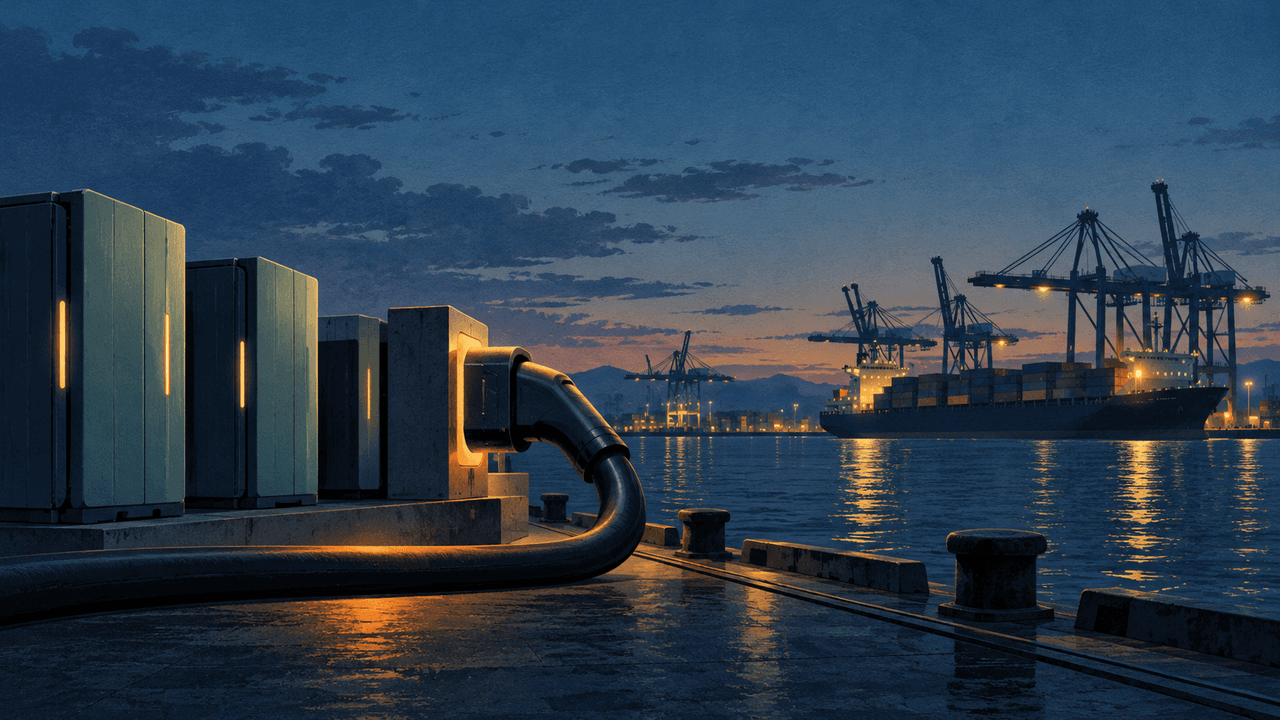
A regional container ship has two jobs at the dock: exchange cargo and prepare for the next passage. Put its propulsion energy in batteries, and those jobs become closely connected. The ship needs enough charge to leave on time, while the terminal needs the electrical supply, equipment and space to provide it.
Hanwha Power has moved a design built around that relationship through an early technical review. In an October 23 announcement, the company said the American Bureau of Shipping, or ABS, had granted approval in principle for a fully electric, 1,700-TEU container-ship concept with approximately 151 megawatt-hours of battery storage. The certificate ceremony took place the previous day in Bergen, Norway.
The proposal targets short-sea and regional transport, using containerized batteries and port charging. Hanwha says the format supports flexible replacement and familiar container handling. The attraction is a vessel whose propulsion, energy supply and maintenance can be planned around a recurring pattern of port calls.
Two capacities, two different questions
The ship’s cargo rating uses TEU, short for twenty-foot equivalent unit. It is a standard measure based on a 20-foot shipping container; a 40-foot container counts as two. A 1,700-TEU design therefore describes its container-carrying scale. The cargo that can earn revenue on a particular voyage also depends on loading and weight limits.
The 151-MWh figure describes stored electrical energy. As Pacific Northwest National Laboratory explains, megawatt-hours measure an energy store, while megawatts measure how quickly energy enters or leaves it. A battery’s energy capacity helps determine how much work it can do between charges. Its charging power helps determine how long replenishment takes.
Turning that headline capacity into a voyage requires more information: propulsion demand at the intended speed, the electricity used by other equipment, the permitted battery operating window and a reserve for the passage. Turning it into a port call requires the arrival charge and the power actually delivered to the batteries. Those are the figures that will make Hanwha’s design assessable as a transport service. The announcement provides a concept and a storage scale; a specified route and operating plan are the next useful evidence.
What the approval establishes
ABS is a classification society that reviews ships and marine equipment against technical requirements. Its description of approval in principle places the milestone within concept engineering and risk assessment. The review assesses whether a proposed design meets the intent of applicable rules and standards, subject to conditions. An approval road map identifies the later work and submissions needed for final class approval.
That gives a developer a structured route forward and gives potential project partners an outside technical assessment of feasibility. Hanwha’s announced milestone belongs to this design-development stage. Detailed engineering, construction, commissioning and sea trials would establish how a completed vessel performs. The company’s specific approval road map has yet to be made available in the material reviewed for this report.
The port becomes part of the propulsion system
For an electric ship, a dependable berth is also an energy connection. The amount of electricity needed between voyages must fit the hours available alongside. That places terminal operations and the local grid inside the vessel’s commercial case.
The Mærsk Mc-Kinney Møller Center for Zero Carbon Shipping examined this relationship in its 2024 pre-feasibility study of battery-powered cargo vessels. Its case studies show how route choices, port productivity and charging opportunities affect battery sizing. Larger energy requirements can call for dedicated high-power infrastructure, bringing questions about electricity availability, berth allocation and cost.
The distinction between shore power and voyage charging matters here. A terminal can supply a ship’s equipment while it is berthed, yet propulsion batteries add another energy demand. ABS’s hybrid-electric requirements explicitly address arrangements that charge batteries while also supplying the ship’s electrical consumers. A useful operating demonstration would put both demands on the clock alongside cargo work.
Containerized batteries offer another operational possibility: exchanging depleted units for charged ones. The Møller Center’s study explains that swapping can separate battery charging from the ship’s time in port and use existing container cranes and vehicles. It also requires additional battery inventory ashore. Hanwha’s reference to flexible replacement establishes a design feature; an operational swapping service would require its own plan for handling, charging and spare units.
Making room for energy and cargo
Putting batteries in a familiar container format simplifies the handling concept. The design must still accommodate their mass, supporting structure, access and protective equipment alongside freight. The Møller Center’s work treats battery arrangement and cargo capacity as a connected engineering problem. For Hanwha’s proposal, the informative drawing will show where the energy containers sit and how the stated cargo capacity works with them installed.
ABS’s December 2025 lithium-ion battery requirements illustrate the integration work if that chemistry is selected. Their containerized-system provisions cover dedicated locations, ventilation, gas detection, emergency disconnection, structural support and handling. Stacking generally requires an alternative arrangement accepted through detailed review and risk assessment. Battery containers have to function as managed electrical equipment throughout storage, lifting and operation at sea.
Hanwha describes the intended operation as having no direct carbon emissions. The wider climate result will depend on the electricity used for charging and the production and replacement of the batteries. A route-level assessment can connect those factors to the amount of cargo moved, giving operators a meaningful comparison with existing service.
The design’s value is that it brings a substantial battery system into a recognizable cargo-transport proposal and advances that proposal through concept review. Its next persuasive milestone would combine the ship and its shore facilities: a declared payload, a repeatable passage, an energy reserve and a measured port turnaround. That is the evidence that can turn a promising battery capacity into a dependable regional shipping service.
Sources · 8
- https://www.hanwha.com/newsroom/news/press-releases/hanwha-power-receives-abs-approval-in-principle-for-1700-teu-battery-powered-container-ship-design.do
- https://www.ups.com/us/en/supplychain/resources/glossary-term/teu-container
- https://gridpiq.pnnl.gov/v2-beta/doc/technologies/es/es-energy-power/
- https://ww2.eagle.org/content/dam/eagle/innovation-and-technology/technology-cutsheets/AIP-Novel-Concept-Cutsheet.pdf
- https://www.zerocarbonshipping.com/files/battery-powered-vessels-pre-feasibility-study.pdf
- https://ww2.eagle.org/content/dam/eagle/rules-and-guides/current/conventional_ocean_service/319-requirements-for-hybrid-electric-power-systems-for-marine-and-offshore-applications-2024/319-hybrid-electric-power-systems-reqts-Apr24.pdf
- https://ww2.eagle.org/content/dam/eagle/rules-and-guides/current/other/275-requirements-for-use-of-lithium-ion-batteries-in-the-marine-and-offshore-industries-2025/275-lithium-ion-batteries-reqts-dec25.pdf
- https://www.nature.com/articles/s41560-024-01655-y