GXO Expands Digit Deal as Humanoid Robots Face the Test of Repeat Business
Two more sites are planned for early 2027, extending a commercial relationship built around repetitive tote handling.
Published October 27, 2026Intelligence / Robotics / Humanoid Robotics
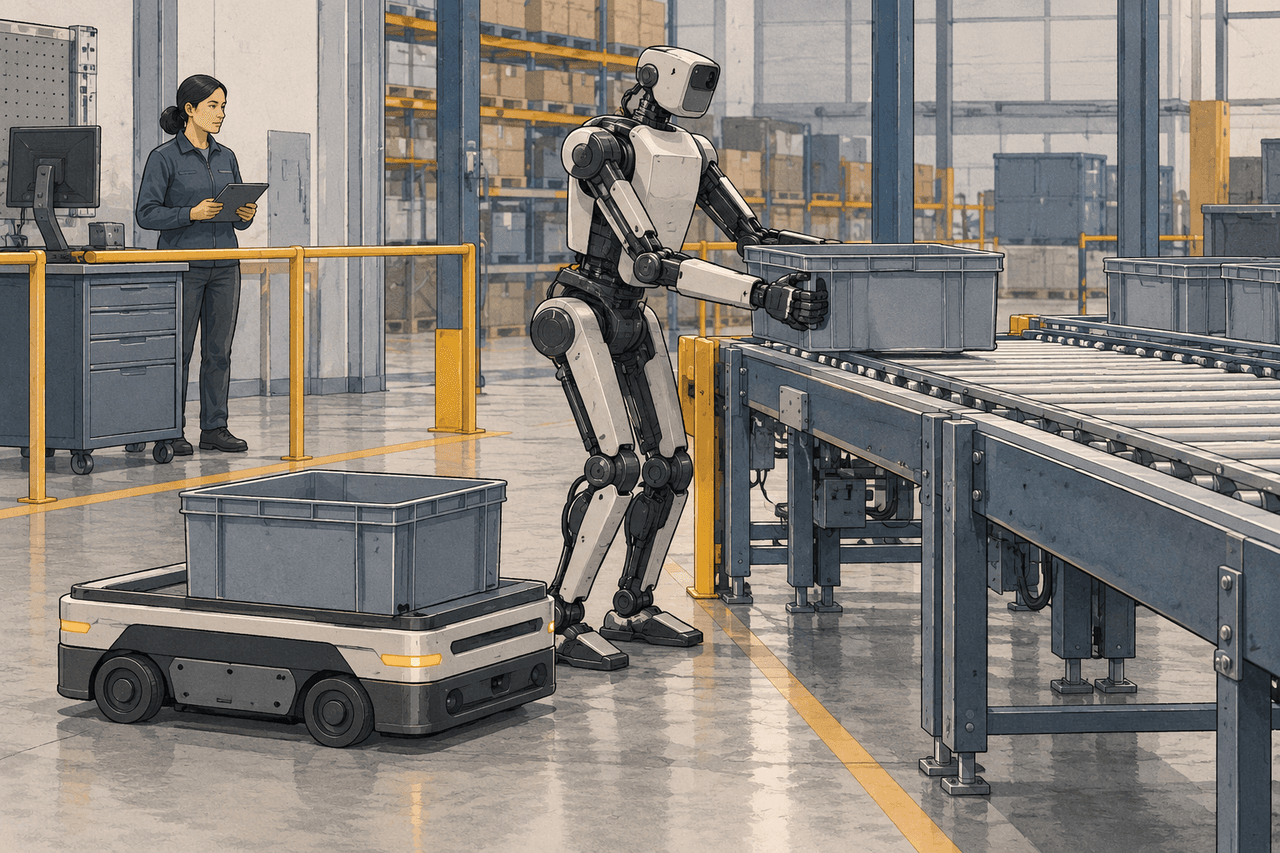
GXO Logistics is planning to put Agility Robotics' Digit humanoids to work at two more American sites, extending a customer relationship that has already moved from a pilot to commercial operations. The October 26 agreement covers e-commerce fulfillment in Statesville, North Carolina, and Lebanon, Tennessee. Deployment is expected to begin in early 2027. For a field crowded with demonstrations, a customer returning for additional locations offers a more useful signal of demand. [1]
The work remains specific. GXO's June 2024 multi-year robots-as-a-service agreement placed Digit in a fulfillment operation for SPANX, transferring totes from mobile robots to conveyors. Agility Arc coordinated the equipment. This kind of handoff gives a humanoid a defined role between systems already doing useful work. Its value depends on completing that step at the rate and consistency the surrounding operation needs, with predictable recovery when the handoff fails. [2]
The companies say Digit has moved more than 100,000 totes at the Flowery Branch, Georgia, facility. They separately report more than 65,000 hours of operation across Agility's commercial operations and customer programs. The tote total describes accumulated work at one location; the hours describe a broader set of activity. Assessing productivity would also require the number of robots, scheduled operating time, successful cycles and interruptions for the same measured period. [1]
Human support is part of that system. Agility describes on-site service, online support and real-time monitoring, alongside software that connects Digit with warehouse automation and management systems. Those capabilities can help a customer introduce unfamiliar equipment without building every support function internally. They also belong in the cost of the service. The expansion announcement leaves the staffing, intervention frequency and contractual price undisclosed, so the public evidence supports customer interest more firmly than a quantified return on investment. [3] [1]
Utilization will determine how much work the hardware can absorb. A robot available for a shift can still spend time waiting for totes, charging, recovering from an exception or pausing while another machine is cleared. Conversely, a narrowly assigned robot could be valuable if it reliably removes a bottleneck. The useful comparison is the cost of completed handoffs within a functioning warehouse, including the people and equipment that keep those handoffs moving.
A service contract can make that comparison easier to purchase, because a customer buys access to a supported capability over time. The terms determine who carries the risk of downtime and what level of performance earns payment. Publicly reported figures for uptime, human interventions and cost per successful transfer would help explain why expansion makes sense. GXO's decision suggests that it sees additional uses worth pursuing; the evidence for how broadly those uses can scale will come from the new operations. [2]
The next deployments also carry a hardware transition. The companies expect to start with Digit 4 and migrate to Digit 5 when it becomes commercially available. That gives the early-2027 rollout two practical milestones: beginning work at the additional sites and demonstrating continuity as the equipment changes. Repeat business is an important step toward a durable robotics service. Sustained performance across different facilities would make the case stronger, especially if the companies publish the support and operating data behind it. [1]