A $237 million grid funding call takes aim at the parts holding up new power
Better transformer cores, specialized windings and refurbished equipment could help American factories shorten a queue that stretches from utility substations to new data centers.
Published October 31, 2026Intelligence / Energy / Grid Technology
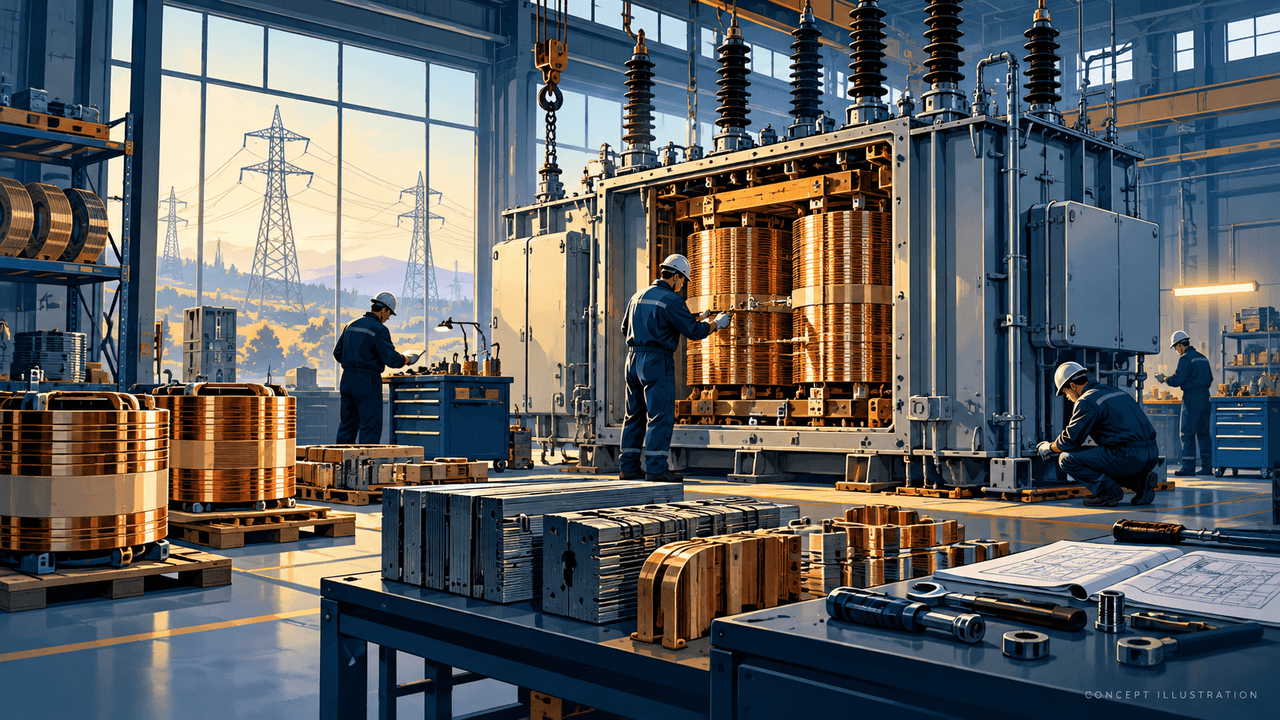
Steel, windings and insulated connectors can determine how soon a transformer leaves the factory. A delay in any one of them can hold up a utility replacing aging equipment or a developer waiting for an electrical connection.
The U.S. Department of Energy is directing a new $237 million funding opportunity at that manufacturing problem. Announced October 30, Grid Supply Chain Alternatives to Lead Energy Dominance, or Grid SCALED, offers support for returning used equipment to service and bringing domestic materials and components into production. [1]
Applicants will need working technology and credible plans involving suppliers and customers. The program is aimed at manufacturing demonstrations rather than early-stage laboratory research, with the goal of turning established capabilities into equipment utilities can order and install.
The components behind the bottleneck
Transformers change voltage as electricity moves between power plants, transmission networks and local distribution lines. Inside them, metal windings carry current around magnetic cores. Insulation separates energized parts, while bushings allow electrical conductors to pass safely through grounded housings. Each has its own materials, manufacturing methods and qualification requirements.
DOE’s supply-chain analysis traces the industry through electrical steel, specialized copper wire, insulating materials and other components before reaching final assembly. A transformer plant’s expansion depends partly on whether those suppliers can deliver more parts reliably. [2]
Grid SCALED divides the response between two funding tracks. One provides $50 million for refurbishment and reuse, with proposed federal awards ranging from $2.5 million to $15 million. The other provides $187 million for alternative materials and components, with awards ranging from $1 million to $25 million. DOE will select projects through the competitions before the funded work proceeds. [1]
Better materials with a route into factories
Transformer cores are among the targets. The notice specifically identifies electrical steel and cores among the components of interest. Higher-performance grades and established amorphous-metal designs can reduce losses in the core while providing manufacturers with additional sourcing options. DOE’s transformer engineering analysis treats core materials, conductor materials and core-and-coil configuration as separate ways to improve efficiency. [3]
To turn a material advantage into domestic production, a proposal would need to identify the metal’s source, the core-making process and the manufacturer that will use it, with testing to support its expected service life. Manufacturing complexity and purchase price remain part of that calculation.
The coils inside transformers offer another opportunity. The notice names continuously transposed conductors, specialized assemblies of insulated conductor strands used in transformer windings, along with other copper windings. A domestic supplier able to expand qualified production could remove a constraint farther along the assembly line. [1]
More advanced conductors are also attracting attention. In an October 26 overview, DOE highlighted Pacific Northwest National Laboratory’s copper–graphene and aluminum–graphene composites, reporting conductivity gains of 5–7% over the pure metals commonly used today. Higher conductivity offers possibilities for carrying electricity with lower resistive losses or changing the amount of metal a design requires. [4,5]
A project involving those composites would still have to meet the competition’s readiness requirements. For the materials track, DOE requires technology readiness level 6 or higher, demonstrated performance and lifetime characteristics, and a credible path into production. Applicants must also secure commitments from upstream suppliers. [1]
Ceramic bushings, insulation and chemical precursors for grid equipment or battery-storage systems are additional named priorities. Some successful projects could involve a new domestic source for an established component, rather than a dramatic change in the equipment’s design. The funding notice accepts both innovative alternatives and established technologies supplied through new domestic sources. [1]
Giving existing equipment another working life
The refurbishment track addresses a different source of capacity: equipment already removed from the grid. It requires technology readiness level 8 or higher, setting a higher maturity threshold than the materials track. [1]
Transformers, circuit breakers, switchgear and other retired or damaged hardware can contain serviceable assemblies and valuable metals. DOE seeks programs that recover, repair and recertify equipment for utility inventories, as well as processes that return copper, aluminum and electrical steel to grid supply chains. [1]
Projects could combine improved inspection, repair equipment and electrical testing to make that work more consistent. A utility purchasing a refurbished transformer needs confidence in its insulation, electrical performance and remaining useful life. DOE’s October 26 overview identifies uneven refurbishment standards, limited testing equipment and poorly documented processes as obstacles to wider adoption. [4]
Funding can help establish the machinery and procedures a refurbishment business needs to supply utilities reliably. Applicants must quantify how quickly equipment returns to inventory, how procurement times change and how costs compare with buying replacements. Those measurements will determine whether a promising recovery process produces a meaningful supply benefit.
Private commitments will shape the results
Applicants must contribute at least half of total project costs from nonfederal sources. At the minimum share, a $10 million federal contribution would support a $20 million project, with the balance supplied by the recipient and its partners. Domestic businesses, universities, nonprofits, governments and tribes can participate under the notice’s eligibility rules; foreign participation and work abroad generally require DOE waivers. [1]
For the materials track, an initial phase establishes the manufacturing plan, supplier relationships and first-customer commitments. A DOE review then determines whether the project advances into factory implementation and production scale-up. The program asks applicants to show throughput, yield, domestic sourcing and delivery improvements alongside technical performance. [1]
Required concept papers are due November 20, 2026, at 5 p.m. Eastern, followed by full applications on February 8, 2027, at the same time. [1]
Delivery schedules and equipment inventories will show whether the spending has eased the shortages. Better materials and faster refurbishment become useful grid capacity when utilities receive qualified equipment and put it into service.
Sources · 5
- https://files.simpler.grants.gov/opportunities/f5ae758f-11a7-4897-81c2-553821ff2270/attachments/5174c9c4-ffa0-460e-9c51-ffaeeca5dd15/FundOpp_DE-FOA-0003641.pdf
- https://www.energy.gov/sites/default/files/2022-02/Electric%20Grid%20Supply%20Chain%20Report%20-%20Final.pdf
- https://www.energy.gov/sites/default/files/2024-04/dt_ecs_fr.pdf
- https://www.energy.gov/oe/articles/innovative-solutions-grid-equipment-shortages
- https://www.pnnl.gov/available-technologies/ultra-conductors