A thousand-hour carbon conversion test brings industrial durability into focus
A Toronto-led team reports a durable catalyst for turning captured carbon dioxide into a chemical feedstock. Factories will also need higher output and competitive energy costs.
Published October 31, 2026Intelligence / Materials / Carbon-Negative & Biomaterials
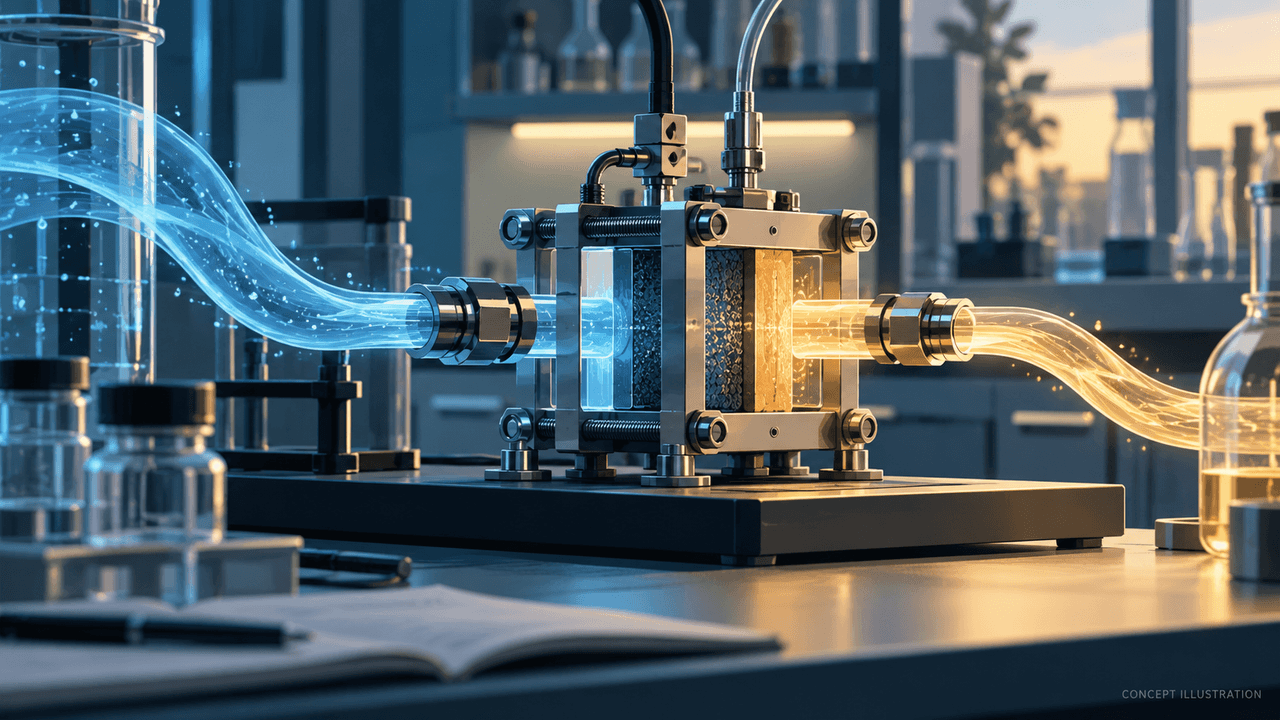
For more than 1,000 hours, almost six weeks, a University of Toronto-led team kept a laboratory system running as it converted captured carbon dioxide into carbon monoxide, a feedstock for chemical manufacturing.
Published October 30 in Nature Energy, the laboratory study reports operation at 50 milliamps per square centimeter and 2.9 volts, with approximately 80 percent carbon-monoxide Faradaic efficiency and 39 percent energy efficiency. [1]
Research centered in Toronto with an international team
Collaborators include researchers in Australia, Taiwan, Japan and Britain, alongside Shell in Amsterdam. Shell supported the work; microscopy took place at McMaster University in Canada. [1]
The catalyst uses covalently linked cobalt-containing molecules supported on carbon nanotubes. The researchers attribute its durability to early cobalt loss that creates vacancies and stabilizes the remaining structure. [1]
The long run addresses a familiar problem in catalyst development: strong performance in a brief experiment can fade during sustained operation. Following the material as it changes helps researchers design for the intervals between a factory’s maintenance shutdowns.
Turning an emissions stream into a manufacturing input
The process belongs to a field called reactive capture. Instead of treating carbon capture and electrochemical conversion as separate operations, it uses a capture solution as part of the conversion system. Earlier research from the Toronto group describes the opportunity: conventional routes first recover concentrated CO2 from the capture liquid, then feed it into a conversion device. Integrating those stages could simplify the processing chain and reduce the energy associated with releasing CO2. [2,3]
Electricity drives the conversion. Carbon monoxide is the useful output in the new experiment. Combined with hydrogen, it forms synthesis gas, a starting mixture for making fuels and chemicals. Capturing carbon supplies a raw material; producing the desired final product requires further chemistry, energy and equipment. [4]
Evonik’s 2026 reporting gives that market a concrete shape. It describes carbon monoxide as a feedstock for products ranging from fragrances and lubricants to pharmaceutical intermediates and polymers, with current production drawing on natural gas. Its Power2ValueChemicals project tests the production chain from CO2 electrolysis, targeting valeric acid methyl ester, a fragrance ingredient. Such processes could supply existing chemical factories with a different source of carbon. [7]
An industrial operator would start with the available carbon stream and the customer’s requirements. The concentration and purity of the incoming CO2, the gas mixture needed downstream and the electricity consumed per unit of product all shape the design. Using a chemical plant’s existing streams poses different challenges from collecting dilute carbon dioxide in air.
Industry is already testing several routes
Mitsubishi Heavy Industries reported a demonstration in Nagasaki, Japan, in February 2026 that connects CO2 conversion with liquid-fuel production. Its route uses solid-oxide electrolysis to process carbon dioxide and steam into synthesis gas, followed by Fischer–Tropsch synthesis, which converts that gas mixture into liquid hydrocarbons. The company presented the work as a demonstration of an integrated production chain. [4]
In the Nagasaki demonstration, carbon monoxide is an intermediate between captured carbon and liquid fuel. The process uses solid-oxide equipment, a different engineering route from the catalyst-based capture-and-conversion system studied in Toronto.
Another example comes from Evonik and Siemens Energy’s Rheticus pilot in Marl, Germany. Their 2020 announcement described a system combining electrolysis with fermentation. Electrolysis supplied carbon monoxide and hydrogen, and microorganisms converted the gases into specialty chemicals. The pilot linked electrical conversion with a biological production step. [5]
The projects serve different product markets and use different equipment, from solid-oxide electrolysis to fermentation. Toronto’s result addresses a particular problem within that wider effort: keeping a reactive-capture catalyst productive over time.
How the new result compares
Earlier Toronto research published in Nature Communications in 2025 reported approximately 94 percent carbon-monoxide Faradaic efficiency at 100 milliamps per square centimeter, with 42 percent energy efficiency, using a nickel-based catalyst system. A 2024 study reported approximately 64 percent Faradaic efficiency at 50 milliamps per square centimeter and 31 percent energy efficiency; it also described a seven-day experiment using air as the carbon source. [2,3]
The October 2026 paper advances the operating lifetime of its integrated system. Different catalysts, capture conditions and experimental designs make the studies evidence of several routes under development. A fair engineering comparison would hold the feed, equipment and operating conditions consistent, then measure how performance changes over time.
Faradaic efficiency describes how much electrical charge makes the desired product. Energy efficiency asks how efficiently electrical energy supports the conversion. Current density describes electrical throughput over an electrode area. Each answers a different question, so an attractive percentage becomes more useful when considered alongside operating voltage, production rate and life span.
The commercial test is the whole process
Longer catalyst life could reduce replacement work and downtime. Higher output per electrode area could reduce the amount of equipment needed for a given production target. Electricity price, product separation, capture-liquid management, maintenance and downstream processing would all contribute to the eventual bill. The balance among those costs will decide whether an integrated route is competitive for a particular industrial site.
Scaling also requires repeatable performance across larger equipment. A plant would need evidence for operation with realistic impurities, stable product quality and reliable recovery after interruptions. Carbon accounting adds another requirement: the source of electricity, capture energy and eventual use of the product determine the overall emissions outcome. Carbon placed in a fuel returns to the atmosphere when that fuel is burned; its climate value depends on the full production-and-use cycle. [6]
The extended test gives engineers a longer operating record to build on. The next stage would combine that durability with higher sustained output, a complete energy balance and a costed production chain. For a chemical manufacturer, the decisive number will be the cost of a reliable supply of usable product.
Sources · 7
- https://www.nature.com/articles/s41560-026-02159-7
- https://www.nature.com/articles/s41467-025-65331-9
- https://www.nature.com/articles/s41467-024-51908-3
- https://www.mhi.com/news/26021301.html
- https://press.siemens.com/global/en/pressrelease/climate-friendly-industry-using-carbon-dioxide-and-hydrogen-raw-materials-sustainable
- https://www.iea.org/fuels-and-technologies/carbon-capture-utilisation-and-storage/
- https://c4-chemicals.evonik.com/en/attachment/401950?rev=c9346238a5e645995d1df3d66b1c8333