Cadence Wants Engineering Tools to Teach AI How to Design Chips
Its Maestro model portfolio puts specialized AI inside a feedback loop with design software. The question is how much of engineering that loop can reliably capture.
Published October 28, 2026Intelligence / Artificial Intelligence / Generative Models
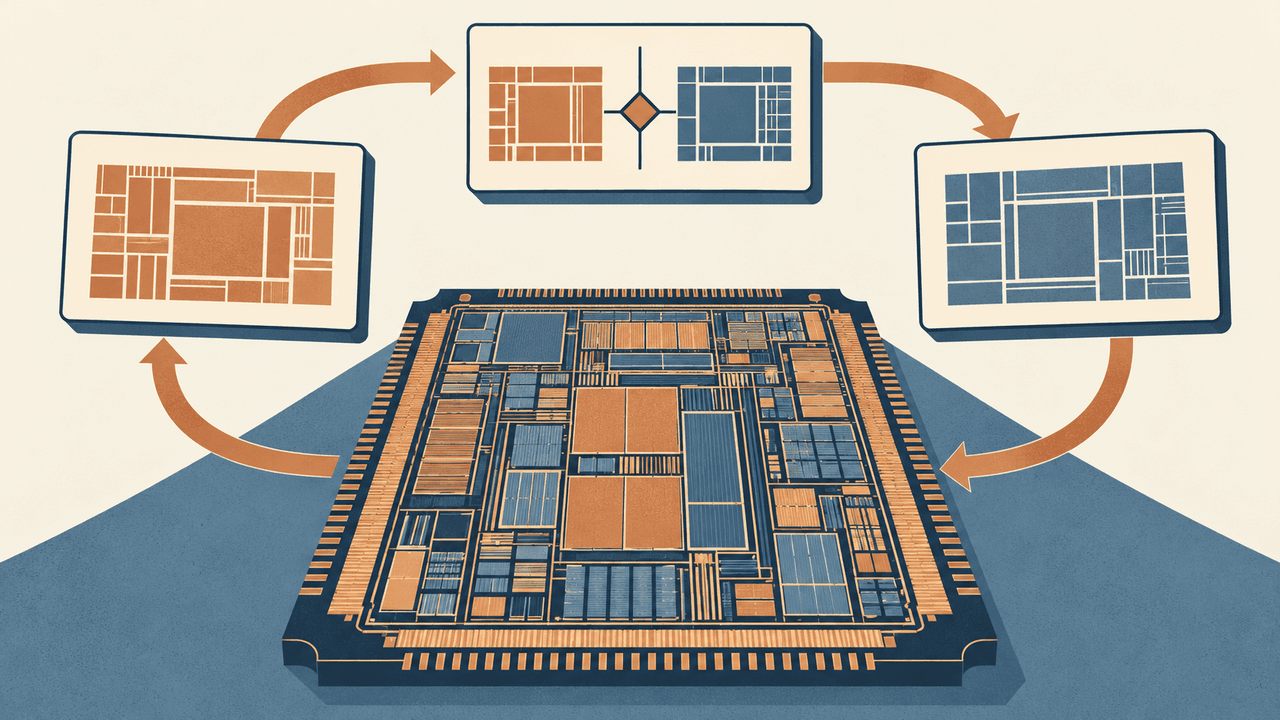
Chip designers work against several limits at once. Their circuitry must perform the right computation, fit within its allotted area and operate within power and timing constraints. An apparently promising change can improve one measure while creating trouble elsewhere. For AI to help with this work, its proposals need to survive the same engineering checks as any other design. [C2]
Cadence is building its latest AI offering around that feedback. On October 26, the company introduced Maestro, a portfolio of specialized models for chip and system design. It says the models will work with its AI agents and electronic and system design automation tools, using engineering evaluations to guide reinforcement learning: training that rewards actions for producing better results. The first models are offered to selected early-access customers in the fourth quarter of 2026. [C1]
The proposed workflow starts with an objective. An agent breaks it into tasks, draws on specialized and general-purpose models, operates engineering tools and evaluates the results. Cadence says feedback from calculation tools that follow fixed mathematical rules will measure outputs against specified objectives and constraints. [C1]
A useful way to understand the idea is to separate proposing from measuring. An AI might suggest a revision intended to reduce power use. Engineering software can then evaluate the revised design under stated conditions. The result gives the next iteration something more concrete than the model’s own assertion that its answer is better. The strength of that process depends on what is measured, which conditions are modeled and whether the original requirements are complete.
Cadence’s September expansion of ChipStack illustrates the type of work involved. Its announced RTL-generation agent creates and revises register-transfer-level descriptions, the code that specifies how digital logic moves and processes data. The company described connecting that work to checks of functionality, power, performance and area, with Honda R&D evaluating the technology for automotive chips. That earlier announcement provides context for Maestro’s intended environment, not an independent demonstration of the new models. [C2]
Deployment is another part of the pitch. Cadence says customers can run the environment in its cloud, public clouds or their own infrastructure. It also describes work with NVIDIA on OpenShell integration for agent security. [C1]
NVIDIA’s technical documentation explains the security idea as controls outside the agent itself. A sandbox is a restricted workspace for running the agent. A policy engine governs access to files, networks and processes; a privacy router controls where model requests go. Those mechanisms address what an agent may access or do. They serve a different purpose from determining whether the circuit it proposes is correct. [C3]
The announcement does not supply enough benchmark detail to establish a general productivity advantage. Customer comparisons would need to account for tool runtime, human review, failed attempts and the scope of the task, rather than treating reduced language-model output as equivalent to a faster finished design. Early access should begin to expose those practical tradeoffs.
Maestro’s significance is the attempt to make domain software part of how engineering AI learns, not merely a destination for its output. A solver can give an agent a firm answer to a defined question. It cannot establish that every necessary question has been asked. The prospect is a more capable design assistant whose proposals are repeatedly tested, with engineers still responsible for requirements and the decisions that the tests do not settle.