Aurora’s Driverless Trucks Still Need a Human Supply Chain
Aurora’s driverless mileage is growing. Its next test is whether service networks, manufacturing and logistics can deliver lower total freight costs.
Published October 25, 2026Intelligence / Transportation / Modular Logistics
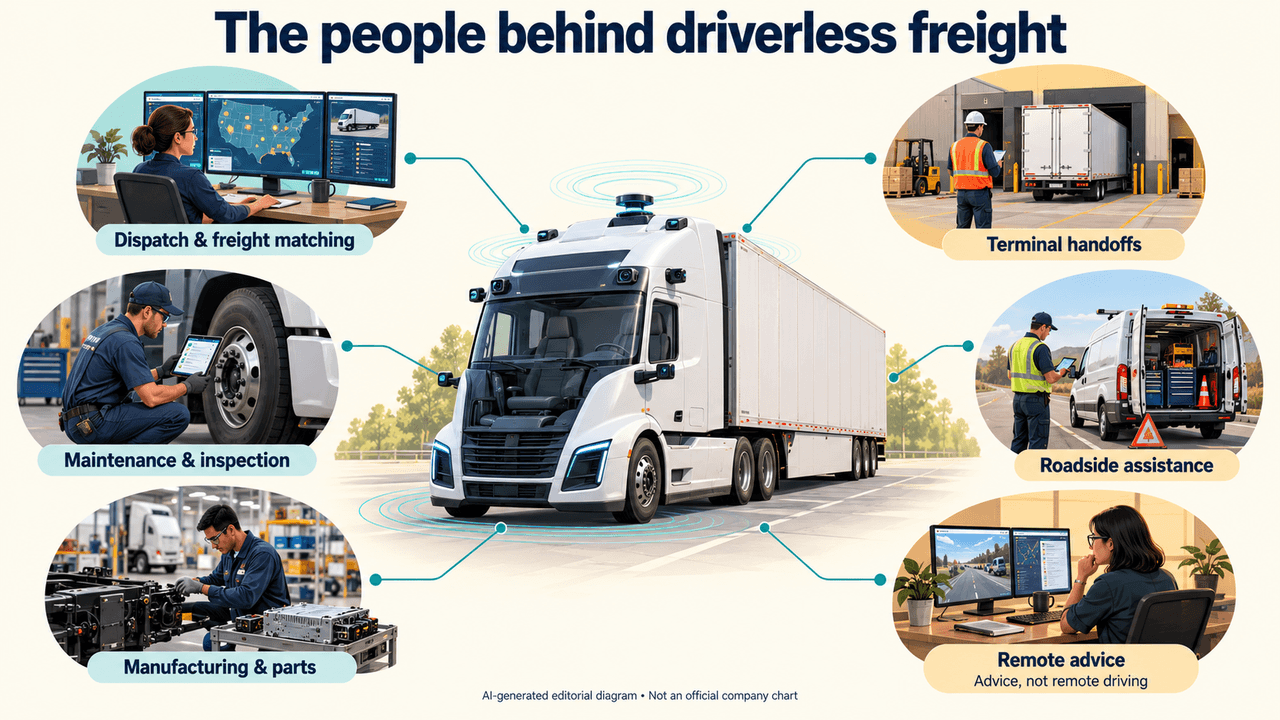
The next test for autonomous freight is whether maintenance, manufacturing and logistics networks can turn an empty driver’s seat into cheaper deliveries.
Driverless freight’s hardest work happens outside the driver’s seat. Aurora says it has surpassed 500,000 driverless miles since commercial launch. That is an important operating milestone. It leaves a different question unanswered: how much does the entire operation cost to move a paying load?
The mileage figure appeared at Aurora’s September 23, 2026 investor day and was repeated in CEO Chris Urmson’s October 8 update. Its 200-truck figure is a year-end deployment target, while more than 30,000 trucks in 2030 is a longer-term ambition. Neither number describes the fleet already operating today.
What the person in the back seat actually does
Aurora’s July 22 explanation of its second-generation launch is unusually useful. The International LT-based trucks operate with nobody behind the wheel. Some trips carry a roadside-assistance employee in a rear seat to collect feedback and provide support. Aurora explicitly says that person neither drives nor supervises the driving.
Calling that employee a safety driver would misrepresent the disclosed role. Calling the operation labor-free would also miss the point. In July, Aurora said it was developing partnerships with conventional roadside-service providers, expected to begin later in 2026. That was a service-network plan, not evidence that every trip had already dispensed with onboard support.
Remote assistance is another distinct function. Aurora’s published explanation says specialists can supply advice, but cannot remotely control the vehicle. The driving system decides whether a suggested action is safe. A command-center employee therefore should not be casually described as someone steering the truck over the internet.
The economic opportunity is to share support across a fleet. A regional responder serving many trucks could cost less per shipment than assigning a person to every journey. Whether that works depends on callout frequency, travel distance and repair time. Those are operating variables to measure, not savings established by the empty seat.
A tire failure becomes a network problem
A truck that drives itself still needs fueling, inspections, tires, repairs and coordinated trailer handoffs. Sensors and computing hardware add their own maintenance requirements. The question is how efficiently those jobs fit around revenue-producing trips.
Aurora’s 2025 annual report describes its continuing Ryder collaboration as an on-site maintenance pilot. It also anticipates partners handling financing, facilities, parts replacement and other services under its future Driver as a Service model. These are substantive pieces of the operating design, not administrative details.
Consider a hypothetical breakdown between terminals. The relevant expense includes the technician, replacement part and recovery vehicle if needed. It also includes the truck’s idle time, the missed delivery appointment and any replacement capacity required to protect the shipment. A wider route map can make those problems harder if repair coverage expands more slowly than freight operations.
The same logic applies at the terminal. Overnight driving delivers little scheduling benefit if the receiving dock cannot unload until morning. Faster highway movement becomes useful capacity only when dispatch, warehouse hours and trailer availability keep up.
The denominator is paying freight
The American Transportation Research Institute’s 2026 operating-cost update puts conventional trucking’s average 2025 cost at $2.336 per mile. That is industry context, not an autonomous-truck cost estimate or proof of Aurora’s savings.
For a fleet comparing alternatives, a useful test is total attributable operating cost divided by loaded miles, alongside revenue and service quality. The numerator must include truck ownership or leasing, financing, fuel, autonomy fees, insurance, maintenance, terminal work and human support. Accounting must avoid double-counting items bundled into a service contract.
Empty return trips matter because they consume fuel, tires and equipment life without carrying a paying load. Higher annual mileage can spread fixed costs over more work, but it can also accelerate component replacement. Running more miles is valuable only when the freight mix and revenue justify them.
Aurora reports that trucks serving McLane, Werner and other customers are averaging an annualized rate above 225,000 miles. Annualized utilization is not a completed year of results, a loaded-mile count or a disclosed all-in profit margin. Insurance premiums, deductibles and responsibility for losses also belong in the comparison; removing the driver does not by itself establish a cheaper insurance bill.
Manufacturing capacity must become serviceable capacity
Supply is becoming more industrial. Aurora’s July results said Roush had begun manufacturing its new fleet and was expected to reach a 1,000-truck annual production run rate in October. That is a targeted rate, not 1,000 delivered vehicles. The same release placed Volvo Autonomous Solutions’ planned driverless start in the first quarter of 2027.
AUMOVIO’s hardware partnership covers components, integration and service, with a mileage-based commercial arrangement. Paying by the mile can redistribute upfront hardware expense and maintenance obligations. It does not eliminate the underlying cost; the contracts determine who bears it.
This is where autonomous freight becomes a logistics business. The trucks need repeatable production, replaceable components, repair coverage and enough well-matched freight to keep them earning. Useful next disclosures would include loaded versus empty miles, support labor per truck, roadside incidents, repair downtime and comparable lane-level costs.
Aurora has demonstrated commercial driverless operation. The larger economic case still depends on the people and infrastructure surrounding it. The decisive achievement will be moving freight reliably at a lower total cost, not merely moving the human out of the driver’s seat.
Sources · 8
- https://ir.aurora.tech/news-events/press-releases/detail/152/aurora-outlines-2030-vision-to-scale-to-30000-driverless-trucks-at-analyst-and-investor-day
- https://aurora.tech/newsroom/driving-the-inflection
- https://aurora.tech/newsroom/your-questions-about-our-latest-driverless-launch-answered
- https://aurora.tech/newsroom/answering-more-of-your-questions-about-aurora-and-autonomous-vehicles
- https://ir.aurora.tech/sec-filings/all-sec-filings/content/0001828108-26-000016/aur-20251231.htm
- https://truckingresearch.org/about-atri/atri-research/operational-costs-of-trucking/
- https://ir.aurora.tech/news-events/press-releases/detail/147/aurora-announces-second-quarter-2026-results
- https://www.aumovio.com/en/solutions/driver-assistance/automated-assisted-driving/autonomous-trucking-solutions.html