Antares clears a design gate toward its first electricity-producing reactor
The company reports DOE agreement on Mark-1’s safety framework. Antares aims to bring the reactor, heat-transfer hardware and generator together in a 2027 test campaign lasting several months.
Published October 24, 2026Intelligence / Energy / Next-Gen Nuclear
A reactor becomes useful to a military base or a remote industrial site when it can turn heat into dependable electricity. That requires a chain of equipment: fuel that sustains a controlled reaction, a system that carries the heat away, machinery that converts it into power, and controls that keep everything working together.
Antares is preparing to test that chain. In an October 23 announcement, the California company said the Department of Energy had approved the Nuclear Safety Design Agreement for Mark-1, its planned electricity-producing reactor. The agreement establishes the requirements and safety-analysis approach for the project. Antares is targeting several months of full-power electrical operation at Idaho National Laboratory in 2027.
That puts Mark-1 at an early, consequential stage of its authorization process. Engineers and reviewers have a common framework for the evidence the project must produce. Detailed safety approvals, readiness checks and startup authorization follow as the design becomes an assembled plant.
From a chain reaction to a power system
Antares develops compact reactors for defense and space applications, aiming to supply power where access to dependable energy is difficult. Its R1 design combines a graphite core containing coated fuel particles, sodium heat pipes and a nitrogen-based generator system. A small reactor’s attraction in such settings is concentrated, sustained energy at the place it is needed. Its usefulness depends on the complete installation: power delivery, maintenance, security and the people required to operate it.
The company already has a nuclear experiment behind it. DOE confirmed that Mark-0 achieved zero-power fueled criticality at INL on June 4, 2026. Criticality describes a self-sustaining chain reaction: enough neutrons from one generation of fissions cause the next generation to continue. A low-power experiment gives engineers evidence about reactor behavior before they undertake the sustained heat production needed for electricity.
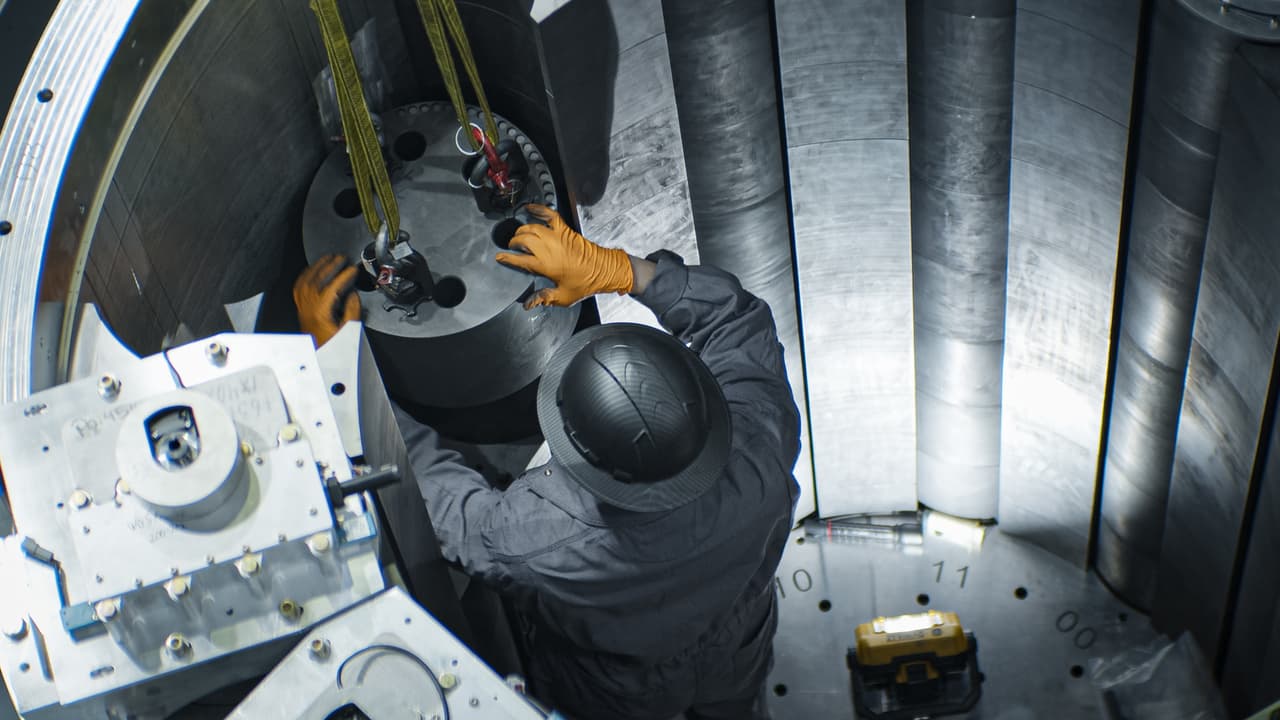
Mark-1 extends that work into power generation. Antares says it will reuse Mark-0’s full-scale core, TRISO fuel and test facility while integrating its nitrogen closed-Brayton power-conversion system. The company intends the operating data to support defense deliveries beginning in 2028, including Fort Bragg. Those dates describe its development schedule; the tests will supply the evidence for the next stage.
How the heat becomes electricity
TRISO is the name for a type of nuclear fuel built from tiny coated particles. Each contains a uranium-bearing center surrounded by protective carbon and ceramic layers. DOE’s fuel explainer describes particles about the size of poppy seeds, with coatings intended to retain radioactive products formed during fission. In Antares’ design, the particles sit within a graphite core.
The next job is moving the heat. Antares specifies sodium heat pipes for that purpose. The company describes these as a passive heat-transfer system, carrying energy from the core to a heat exchanger. Here “passive” refers to that part of the heat-transfer arrangement; the overall plant also includes rotating machinery, electrical equipment and controls.
The generator uses a closed Brayton cycle. In ordinary terms, a gas circulates around a sealed loop: compression raises its pressure, reactor heat raises its temperature, and expansion through a turbine turns a shaft connected to a generator. The gas then sheds heat and returns through the cycle. Antares uses nitrogen as the circulating gas. A recuperator recovers some heat within the loop to improve efficiency.
That basic conversion method has a substantial research history. A NASA Glenn presentation from April 2026 describes earlier closed-Brayton hardware, including nitrogen-based test systems, and the work involved in testing turbines, compressors, alternators and heat exchangers together. For Mark-1, the question is how Antares’ particular equipment performs when coupled to its reactor over an extended campaign.
Months of operation would let the team measure how temperatures settle, how power output holds up and how components behave together. Useful published results would include net electricity delivered after the plant’s own power needs, operating hours, interruptions, component condition and performance during changes in demand. Those are the measurements that connect a working experiment to a customer’s need for reliable power.
What the agreement clears
DOE’s Authorization Pathway for Nuclear Facilities, published as DOE-STD-1271-2025, places the Nuclear Safety Design Agreement in the initial agreement phase. It covers the project’s design requirements, analysis methods, regulatory interactions and key safety decisions. It also sets expectations for the later safety documents.
The pathway then moves through preliminary and final design. A Preliminary Documented Safety Analysis develops the proposed safety case; the final Documented Safety Analysis and Technical Safety Requirements establish the basis and limits for operation. Operating procedures and training must be completed. DOE’s readiness review checks the facility, equipment, procedures, staff preparation and implementation of safety programs before startup approval. Initial testing proceeds under an approved plan and a joint test group.
That sequence explains why agreeing on the framework matters. The safety case has to follow the hardware as it is designed, built and commissioned. Finding disagreements early can reduce redesign and avoid discovering at startup that an essential piece of evidence is missing.
DOE and INL’s May 2026 industry briefing adds a practical lesson from the wider program: safety documents are only part of preparation for operation. Training, quality assurance, emergency management, security, environmental requirements and operating practices also have to be implemented. The briefing describes these as recurring execution demands across projects, rather than findings specific to Antares.
The public confirmation of Mark-1’s October approval currently comes from Antares; the underlying agreement and a separate DOE or INL confirmation were unavailable in the sources reviewed for this report. DOE’s published framework does establish what this stage means and what follows it.
Mark-0 supplied evidence from a controlled nuclear reaction. Mark-1 is being developed to add sustained heat-to-electricity performance. The next meaningful advance will be an authorized test plant producing measured, repeatable power, with enough operating detail to judge how close that system is to serving a customer.
Sources · 7
- https://www.businesswire.com/news/home/20261023509758/en/Antares-Clears-First-DOE-Authorization-Gate-for-Mark-1-Its-Electricity-Producing-Reactor
- https://antaresindustries.com/
- https://www.energy.gov/articles/department-energy-celebrates-first-advanced-reactor-criticality
- https://www.energy.gov/ne/articles/triso-particles-most-robust-nuclear-fuel-earth
- https://ntrs.nasa.gov/api/citations/20260003386/downloads/Rodriguez_Pr_ClosedBrayton_NETS2026_20260003386.pdf
- https://id.energy.gov/Home/DownloadDocument/5633
- https://nric.inl.gov/content/uploads/34/2026/06/Launch-Pad-Industry-Day-Presentations.pdf