AI Begins Designing the Folded Genome, One DNA Edit at a Time
Akita Semifreddo works backward from a desired contact map to candidate DNA sequences, offering a new way to investigate the rules of genome architecture.
Published October 28, 2026Intelligence / Frontier Tech / Synthetic Biology
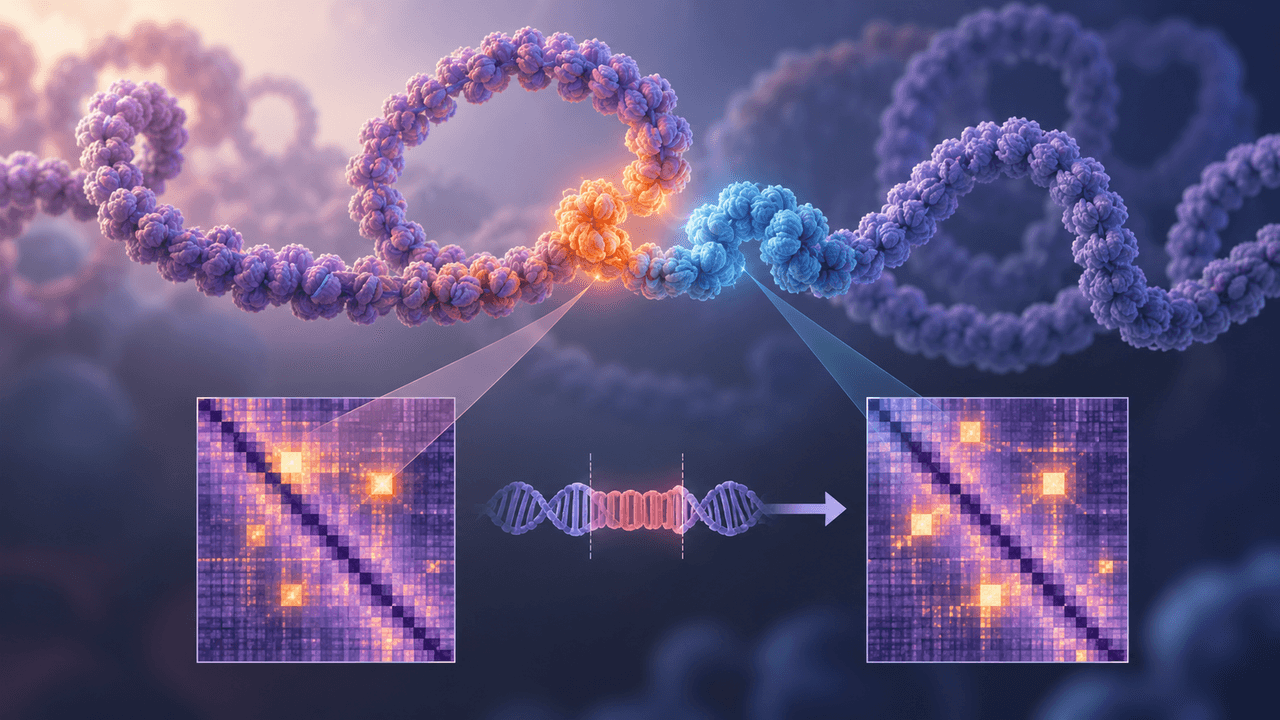
The genome has an architecture as well as an alphabet. A regulatory switch may sit far from a gene along a chromosome, yet come close enough to influence its activity when the DNA folds inside a cell. Those three-dimensional encounters help determine which switches can communicate with which genes. Reading the sequence alone leaves part of that relationship out of view. [A2]
Researchers have now built a system that approaches this problem in reverse: specify a folding pattern, then search for DNA edits predicted to produce it. Akita Semifreddo, described October 26 in Genome Biology by Paulina N. Smaruj, David R. Kelley and Geoffrey Fudenberg, combines the AkitaV2 genome-folding model with the Ledidi sequence optimizer. Its designs remain computational candidates, not laboratory-demonstrated changes to living cells. [A1]
This is the folding of chromosomes, rather than the protein-folding problem made famous by AlphaFold. The relevant picture is a contact map: a grid recording how frequently pairs of genomic regions meet. A bright spot can mark unusually frequent contact between two locations; an insulated region can reveal a neighborhood whose DNA interacts more within itself than across its borders. The original Akita research showed how a neural network could learn to predict such maps from DNA sequence. [A2]
Prediction supplies a way to score a proposed sequence. Ledidi supplies the search strategy. Its general approach balances two competing goals: bring the model’s output closer to the requested result, and avoid changing more DNA letters than necessary. Rather than testing every possible sequence, it uses information from the model to guide successive edits. The penalty for extra changes helps keep designs interpretable: a small set of substitutions is easier to investigate than an extensively rewritten stretch of DNA. For example, a researcher could ask for stronger separation between two neighboring regions while permitting changes only in a short stretch between them. [A3, A1]
The new system makes that search cheaper through its “half-frozen” architecture. It saves intermediate calculations for sequence regions left unchanged and recomputes the affected portions. Crucially, later layers responsible for long-range relationships still run again. A local edit can therefore change the predicted map beyond its immediate neighborhood. The authors use this approach to design boundaries between domains, concentrated contact spots called dots, and elongated contact patterns called flames. [A1]
The supplementary results show both promise and resistance. A second model, AlphaGenome, generally supported the designed boundaries and flames, while agreement on localized dot scores was weaker. More ambitious attempts exposed limits: fountain-shaped patterns failed cross-model checks, and a requested difference between boundaries in two cell types was not corroborated by AlphaGenome. A system can satisfy the predictor it is optimizing against without producing a result that another predictor recognizes. [A4]
Other supplementary analyses offer clues to the sequence grammar behind these patterns. Designed dot anchors commonly acquired oppositely oriented binding motifs: short DNA patterns recognized by CTCF, a protein associated with genome organization. Repeated searches could also find different motif arrangements that produced similar boundary strengths. The search was uncovering multiple candidate routes to a structural outcome, rather than a single mandatory DNA recipe. [A4]
For researchers, the immediate value is a sharper experimental question. A candidate sequence makes a concrete proposal about which letters matter and what changing them should do. Agreement between computer models can help prioritize that proposal; a cell must still supply the biological answer. If the designs hold up experimentally, this approach could turn increasingly accurate genome predictions into a more systematic way to investigate gene regulation.