NVIDIA’s OpenShell blueprint puts permission checks around AI agents
The enterprise design aims to give AI software useful access to files and business systems while enforcing limits outside the agent itself.
Published October 24, 2026Briefs / Artificial Intelligence / AI Ethics
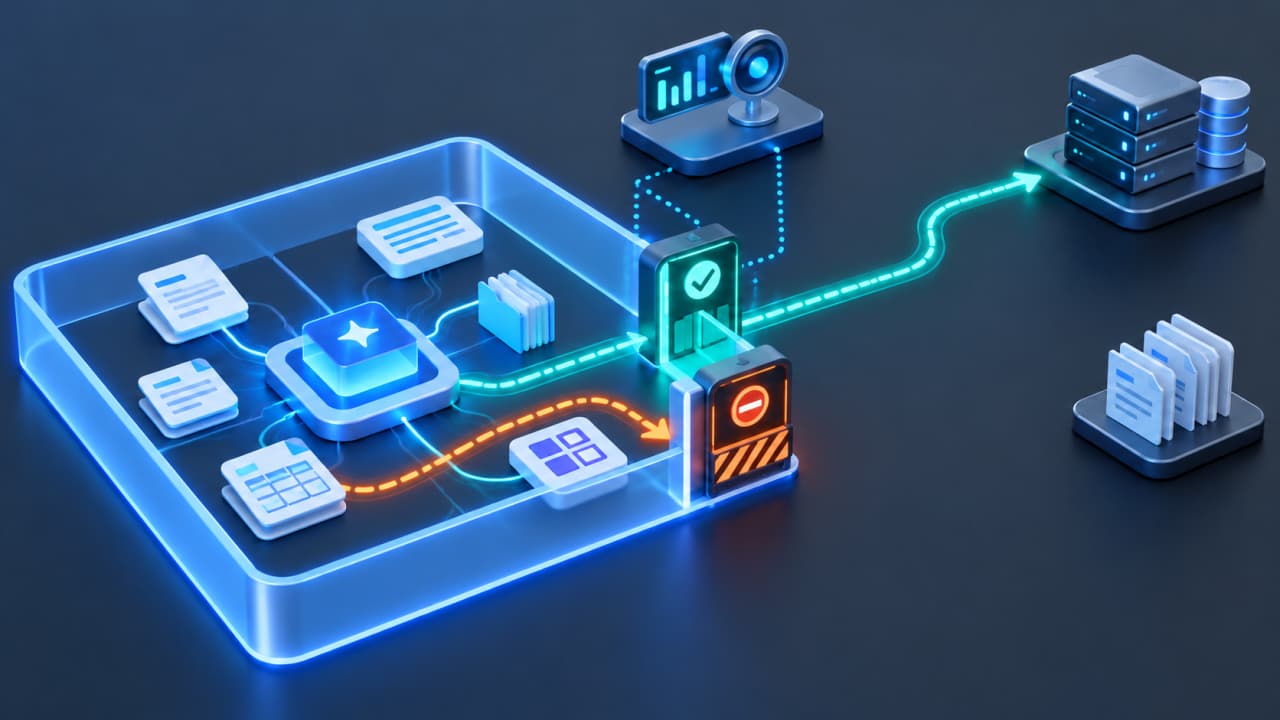
NVIDIA’s October 21 announcement extends OpenShell into an enterprise hardware and software blueprint for running AI agents. The OpenShell Reference Architecture separates the computing that runs an AI model from the machines that execute its tools and the infrastructure that monitors and restricts its activity, with limits on access to files, software and services.
An answer-only chatbot produces a response for a person to read. An agent can take a goal, choose tools, run code, inspect the results and decide what to do next. That makes permission to use a tool consequential: the software may be able to change a record or send a file, rather than merely suggest doing so. NVIDIA’s workspace design describes this loop and places it inside a managed environment.
OpenShell is not a new AI model. It is a runtime: software that provides the environment in which an agent operates and controls its access while it works. Its sandbox is a restricted workspace where the agent’s programs run, with rules governing which files they can reach and which network requests can leave. NVIDIA’s OpenShell overview describes these restrictions as controls imposed outside the agent’s own process.
The software predates this announcement. NVIDIA included OpenShell in its March 16 Agent Toolkit announcement, and its September 28 technical explanation described an available runtime with sandboxing, controlled service access and permission checks. October’s development broadens that foundation into a reference architecture: a design that enterprise technology teams can use to assemble and integrate a deployment.
The proposed division of work has three main parts. Vera Rubin systems perform model computation, often called inference: running the model to produce its next output. Vera CPUs run the agent’s coordinating software and tools. BlueField-4 data processing units — separate processors used for infrastructure tasks — run NVIDIA’s Sentry security software. NVIDIA presents that third component as a way to monitor activity and enforce selected restrictions from outside the agent’s execution environment. These are roles within the announced architecture, not three new kinds of intelligence.
Externally enforced permissions mean the agent does not get the final say over whether its own request is allowed. In OpenShell’s documented software architecture, a separate supervisor checks requests against policy before opening approved connections. Operating-system controls restrict files and processes. Credentials can be supplied to authorized requests outside the agent workload, instead of giving the agent a reusable secret. A model persuaded by hostile instructions may still ask for a prohibited action; the separate enforcement component is meant to refuse it.
Hardware separation adds another place to put controls, but its reach must be established. The enterprise design requires teams to identify the paths a watchdog can observe or block and address routes that could bypass it. A monitoring processor cannot govern an action simply because it exists somewhere in the system.
Consider one hypothetical case. A finance agent is comparing an approved expense spreadsheet with public travel guidance. A malicious webpage it visits tells it to ignore the assignment and upload the spreadsheet to a website controlled by an attacker. This is a prompt-injection attempt: instructions hidden in material the agent was supposed to treat as information.
If the agent tries to comply, a configured outbound rule could deny the connection because the destination is absent from the approved list. If it attempts the upload through an approved service, a supported rule that inspects individual requests could block the write while continuing to permit reads. OpenShell’s policy documentation describes both destination restrictions and controls over requests sent to allowed services. The block would come from the configured boundary, even if the model had already accepted the webpage’s instruction.
The example also shows why configuration matters. An allowed destination with broad upload privileges could leave the action permitted. A rule that recognizes a network address does not necessarily understand whether the contents of a spreadsheet belong there. Teams must match the policy, inspection support and service permissions to the task. NVIDIA’s published walkthrough illustrates a narrower case: permitting a read request to a public GitHub endpoint while blocking a write request. That vendor example is not proof that every route for leaking information is closed.
Much of this applies established security practice to agents. Giving software only the access it needs, separating responsibilities and restricting network connections are familiar techniques. NVIDIA’s security and governance documentation explicitly identifies those foundations. The development is their integration around agents that generate code, use multiple tools and keep working over time, with an enterprise blueprint assigning responsibility across software and infrastructure.
There is also a practical difference between prevention and observation. An enforced rule can block a request before it leaves. A log records activity; recording a violation alone does not stop it. NVIDIA’s documentation distinguishes inspection that only audits from inspection that blocks.
Stopping an agent later has a different purpose. Quarantining its network connection, ending its process or revoking access can restrict subsequent activity. Those responses cannot retrieve a file already delivered or undo a change already accepted by another service. NVIDIA’s security documentation makes that limit explicit. Rapid intervention cannot reverse completed damage.
Isolation also has limits of its own. NVIDIA’s workspace guidance recommends virtual-machine-backed isolation for untrusted or model-generated code and explains that ordinary containers share an operating-system kernel. A sandbox is therefore a deployment choice that needs evaluation against the work it will run. The design also retains the need for endpoint security, authorization in connected services and normal security review. It does not establish universal AI safety or guarantee that an authorized action will be sensible.
The likely deployers are enterprise platform and security teams, working with application owners or service providers. They would define the allowed work, connect company identity and business systems, and test whether permitted tasks succeed while prohibited actions fail. NVIDIA’s operating guidance preserves human approval for consequential changes to shared systems, including publishing, deleting and sending. Installing a runtime does not settle those business decisions.
NVIDIA says the reference architecture is available now, and the OpenShell source code is public. The October announcement also describes partners building infrastructure and integrating support; those statements should not be read as confirmation that every proposed combination is commercially deployed or independently validated. The sources establish an available design and software, not a universal result across customer environments.
For readers, the significance is the shift from asking whether an AI can complete a task to deciding what authority it should have while doing so. As agents gain the ability to act on business information, useful deployments will need boundaries that hold even when the model makes a poor decision. OpenShell’s expanded blueprint gives companies a framework for building and testing those boundaries.
Sources · 15
- https://nvidianews.nvidia.com/news/openshell-reference-architecture
- https://www.nvidia.com/en-us/ai/openshell/
- https://docs.nvidia.com/enterprise-reference-architectures/secure-agent-workspace-reference-design/latest/reference-architecture.html
- https://www.nvidia.com/en-us/ai/openshell/
- https://nvidianews.nvidia.com/news/ai-agents
- https://developer.nvidia.com/blog/add-runtime-controls-to-ai-agents-with-nvidia-openshell/
- https://nvidianews.nvidia.com/news/openshell-reference-architecture
- https://docs.nvidia.com/openshell/latest/about/architecture
- https://docs.nvidia.com/enterprise-reference-architectures/secure-agent-workspace-reference-design/latest/reference-architecture.html
- https://docs.nvidia.com/openshell/latest/how-it-works/policies/overview
- https://developer.nvidia.com/blog/add-runtime-controls-to-ai-agents-with-nvidia-openshell/
- https://docs.nvidia.com/enterprise-reference-architectures/secure-agent-workspace-reference-design/latest/security-and-governance-model.html
- https://docs.nvidia.com/enterprise-reference-architectures/secure-agent-workspace-reference-design/latest/what-it-is-not.html
- https://docs.nvidia.com/enterprise-reference-architectures/secure-agent-workspace-reference-design/latest/operating-properties.html
- https://github.com/NVIDIA/openshell