Google’s Willow chip learns to grow a cleaner quantum building block
A technique called magic-state cultivation has reached real hardware. The next challenge is keeping that improvement as the machinery grows.
Published October 18, 2026Analysis / Frontier Tech / Experimental Systems
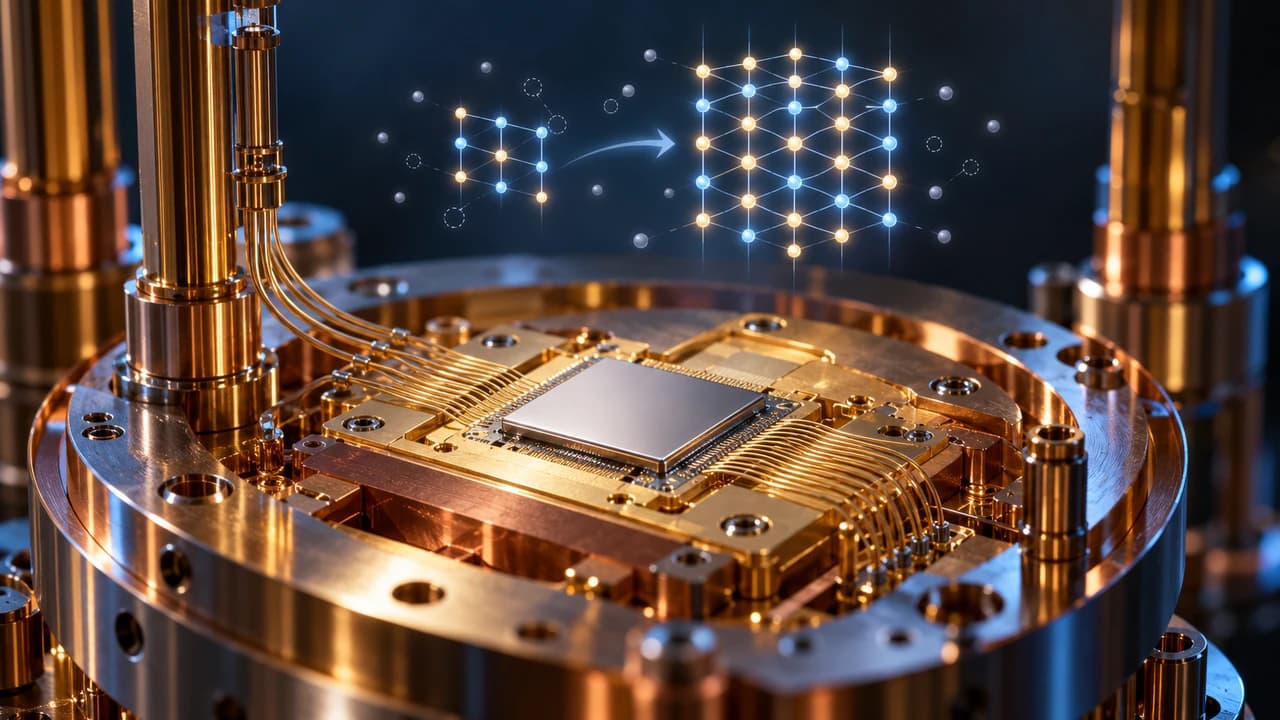
A quantum computer has to manufacture some of the ingredients it needs to calculate. Google has now demonstrated a way to make one of those ingredients much cleaner on its Willow processor: a specially prepared quantum state that helps unlock a broader range of operations.
In its October 15 announcement, Google reported roughly 40 times less error in cultivated states than in uncultivated ones, with T-state logical fidelity reaching 99.99%. Fidelity describes how closely a prepared quantum state matches the intended state. Those figures concern a particular building block, rather than every calculation the chip performs. Google links the research to a paper in Science. Google’s announcement · Science paper
Video: Watch the Google video included in the announcement.
First, give fragile information some protection
A qubit is the quantum counterpart of a computer’s bit. Keeping quantum information intact is difficult: interactions with the surrounding world and imperfect operations introduce errors. Quantum error correction spreads information across a group of physical qubits, creating a protected “logical qubit.” Other qubits help check for signs that something has gone wrong.
Google’s earlier Willow work demonstrated a crucial condition for this approach: with sufficiently reliable hardware, making an error-correcting group larger can make its logical information more reliable. Adding hardware otherwise adds more opportunities for mistakes. In that 2024 experiment, increasing the surface-code array from 3-by-3 to 5-by-5 to 7-by-7 data qubits reduced the encoded error rate by about a factor of two at each step. A surface code is a scheme for organizing those qubits and checks on a grid. Google’s error-correction explainer
That gives the new result its setting. Protected information also needs a practical toolkit for doing calculations.
The “magic” is a missing operation
Quantum gates are the elementary operations that make up a quantum program. Some fit relatively comfortably into error-correcting schemes; others are expensive. T gates belong to the difficult category, called non-Clifford operations. A prepared T-state supplies a resource for implementing one.
The conventional approach, magic-state distillation, processes imperfect states into cleaner ones using costly logical operations. Cultivation takes a different route: start small, check the state carefully and progressively enlarge its protection. At the early stages, an attempt that triggers an error flag is discarded and retried. The design trades failed attempts against the cost of running a much larger preparation process.
Craig Gidney, Noah Shutty and Cody Jones developed the cultivation proposal in 2024. Their simulations suggested approximately tenfold lower resource use than earlier approaches under specified noise assumptions. The unit was “qubit-rounds”: roughly, how many qubits are occupied multiplied by how long they are occupied. That forecast concerns resource cost; it is separate from the experimental 40-fold error improvement. Original cultivation research
Read the small print beside 99.99%
The experimental preprint reports an error upper bound of 0.0001 with an uncertainty of 0.0001. Its injection-only comparison measured about 0.0044. The headline improvement is therefore approximate, and 99.99% should not be read as an exact, guaranteed success rate.
About 8% of attempts survived the full experimental selection, including additional checks used to measure the state. That is not an independently established production yield for a finished magic-state factory.
Measuring such small errors was itself a challenge. The researchers developed “kickback tomography,” using further cultivation steps to assess the prepared state. The preprint first appeared in December 2025; October’s announcement marks the Science publication rather than the first public appearance of the research. Experimental preprint
Google also describes an engineering surprise: ordinary characterization gave misleading results when slowly varying laboratory noise undermined its assumptions. The team changed both its controls and its measurement approach. Google’s account
Getting the ingredient into the machine
The team demonstrated transfer from a small color code into a larger, surface-code-compatible encoding. But the preprint describes this transfer as a proof of principle: storage errors in the larger code limited its quality. The headline fidelity does not establish equally clean states delivered through the entire transfer process. Experimental transfer results
The next test is an engineering one: can this preparation process supply states reliably, preserve their quality and feed a working calculation at a useful rate? A cleaner ingredient is a concrete advance. Turning it into dependable computing means making the surrounding production line work, too.
Sources · 7
- https://blog.google/innovation-and-ai/models-and-research/quantum-computing/magic-state-cultivation-quantum-computing/
- https://www.science.org/doi/10.1126/science.aee7961
- https://www.youtube.com/watch?v=XtTr87pij54
- https://research.google/blog/making-quantum-error-correction-work/
- https://arxiv.org/abs/2409.17595
- https://arxiv.org/abs/2512.13908
- https://arxiv.org/html/2512.13908v1#S3