Google and SpaceX are taking different routes to AI in orbit
Google has received an AI response from its experimental satellite. SpaceX proposes large computing spacecraft. Turning either approach into an alternative to terrestrial data centers will require more than abundant sunlight.
Published October 31, 2026Analysis / Space Development / Base Development
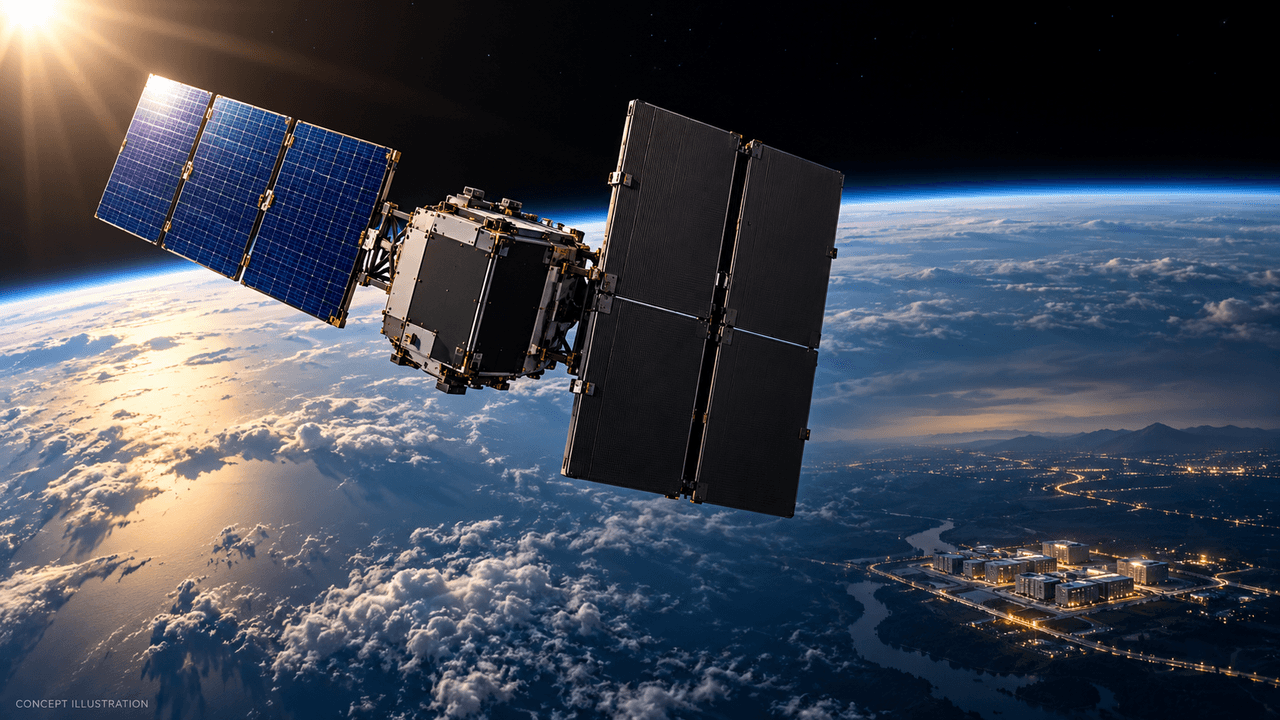
Google’s first orbital AI response was a poem. The larger question is whether sending the computer into space can eventually make the answer cheaper.
On October 30, Google said its Project Suncatcher prototype had run an onboard Gemma 4 model during the week and returned a response through a ground station. The team had already powered up the computing hardware and begun early machine-learning tests. Thermal and radiation testing will follow. This is a useful demonstration of a data-center-class TPU operating in orbit, not evidence that a commercial orbital data center can run reliably or economically. Google’s October 30 report
SpaceX is pursuing the same broad opportunity with a different design emphasis: large, solar-powered computing satellites connected to its Starlink network. Its launch business could also become an important supplier to competitors. Google’s prototype, built with Planet, reached orbit on SpaceX’s Transporter-18 mission on October 1. The two companies are therefore prospective competitors in computing and already participants in the same supply chain. Google’s launch confirmation
For readers watching the next generation of infrastructure, the significance is clear. Orbital computing could add a new way to expand capacity where terrestrial electricity and grid connections are scarce. But the current evidence does not establish lower costs, and moving equipment above the atmosphere replaces familiar engineering problems with expensive new ones.
Two architectures with different priorities
Google’s proposed system resembles a data center distributed across a tightly coordinated formation. Satellites carrying TPUs would exchange information over short, exceptionally fast laser links. Its published research overview models an illustrative 81-satellite group within a one-kilometer radius at an average altitude of 650 kilometers. That is a modeled configuration, not a constellation in service.
Short distances matter because the accelerators must exchange large amounts of data to cooperate efficiently. Google describes a requirement for links carrying tens of terabits per second and reports a laboratory demonstration of 800 gigabits per second in each direction using one transceiver pair. Neither figure is a demonstrated orbital network. Google Research architecture overview
Google’s next announced step is a two-satellite test in 2027. Its September briefing says future spacecraft would carry dozens of TPUs, while the planned pair would test the laser interconnections needed for clustered computing. Google’s mission briefing
SpaceX’s current Starmind design page instead emphasizes localized computing aboard individual AI1 satellites. It lists a 75-meter wingspan, 30-meter deployed height and compute payload power of up to 250 kilowatts peak or 175 kilowatts average. The proposed spacecraft accept processors from different vendors and use laser connections to exchange data through Starlink. SpaceX says its planned Bastrop factory could begin producing thousands of AI satellites as soon as late 2027. These are company design specifications and intentions, not measured fleet performance. SpaceX’s AI1 design
The practical distinction is between making many spacecraft behave like one tightly connected machine and putting substantial computing capacity on each spacecraft. Localized processing could suit jobs that can be divided into largely independent pieces. Closely coupled training places tougher demands on communication. That is an architectural inference, not a claim that either company has ruled out particular workloads.
Sunlight helps but does not remove the energy problem
The attraction is continuous access to a source of power that does not need a local utility connection. Carefully selected sun-synchronous orbits can keep spacecraft in sunlight for much of their operation. Sun-synchronous does not automatically mean eclipse-free: the precise orbit, season and orientation still matter.
The energy must also be collected and converted. Solar irradiance near Earth is about 1,361 watts per square meter before conversion losses. As an illustrative calculation, panels converting 30 percent of that sunlight would produce about 408 watts per square meter under ideal illumination. Supplying one megawatt would therefore require roughly 2,450 square meters of active cells, before allowing for spacecraft overhead, degradation, shadows, wiring losses or reserves. This is a physics-based scale illustration, not either company’s array specification. NASA’s solar measurement explanation
That power is used in space. These proposals do not require beaming bulk electricity down to Earth; they return data. Their potential benefit is avoiding some terrestrial computing load, not supplying electricity to homes or factories.
That also means environmental claims need a full comparison. Solar-powered operation does not erase manufacturing, launches, replacements or reentry effects. Neither architecture has established a verified lifecycle advantage in the evidence reviewed here.
Vacuum is not a free air conditioner
A computer in space still turns almost all of its electrical input into heat. There is no outside air to carry that heat away. It must move through the spacecraft and leave through radiation. NASA’s thermal-control guidance describes the resulting trade-offs in radiator area, coatings, heat pipes and active fluid systems. NASA thermal-control guidance
The scale is revealing. Using the Stefan–Boltzmann law, a radiator with an assumed emissivity of 0.9 at 300 kelvin, about 27°C, emits approximately 413 watts per square meter toward an ideal cold background. At 350 kelvin, about 77°C, that rises to approximately 766 watts. Rejecting one megawatt would require approximately 2,420 or 1,310 square meters of emitting surface respectively, before incoming sunlight, Earth’s radiation, imperfect geometry and engineering margins. Count emitting surfaces, not necessarily the footprint of a two-sided panel. NASA radiation law and constant
Hotter radiators reduce area but require a thermal path and electronics operating limits that support those temperatures. Large surfaces also need to survive packaging, launch and deployment. A design may reduce cooling electricity while increasing mass, manufacturing cost and vulnerability. Those outcomes can coexist.
What would make the economics work
Google’s June 2026 preprint is unusually helpful about the limits of its cost comparison. It examines whether lower launch prices could make the annualized launch expense associated with generating a kilowatt in orbit comparable to terrestrial electricity spending. A favorable satellite proxy produces about $810 per kilowatt per year at a hypothetical launch price of $200 per kilogram. The paper’s terrestrial comparison is roughly $570–$3,000 per kilowatt per year.
This is not a complete cost per unit of computing. The authors explicitly exclude infrastructure and chip costs and say a strict comparison needs more precise spacecraft costs. Their possible mid-2030s launch-price trajectory depends on ambitious reuse and deployment assumptions. It is neither a present quotation nor proof of a business case. Inspected June 17 preprint version
A separate illustrative budget makes the issue tangible. Assume one megawatt of IT load, a five-year operating life, 20 kilograms of launched hardware per kilowatt, and no financing costs. Twenty thousand kilograms must reach orbit. At an assumed $200 per kilogram, launch alone costs $4 million, or $800,000 a year. At $2,000 per kilogram it costs $40 million, or $8 million a year.
Compare that with an illustrative terrestrial facility buying electricity at 10 cents per kilowatt-hour and operating at a power usage effectiveness of 1.2. Its one-megawatt IT load would require about $1.05 million of electricity annually. These are chosen assumptions, not quotes for either project. The orbital example excludes spacecraft manufacture, chips, ground links, operations, replacement, financing and failures. The terrestrial example excludes construction, chips and other operating costs. It is a sensitivity check, not a declaration of a winner.
Mass, lifetime and launch price multiply. Double the mass or halve the useful lifetime and the annualized launch burden doubles. Improved AI chips can also make hardware economically obsolete before it physically fails. A satellite that survives five years may not remain competitive for five years.
For another reality check, SpaceX’s publicly advertised smallsat rideshare service lists $350,000 for 50 kilograms to sun-synchronous orbit and $7,000 per additional kilogram. That retail service is not a suitable quotation for a future bulk constellation, but it shows why a hypothetical low-cost Starship future must not be presented as today’s readily purchasable launch economics. SpaceX rideshare pricing
How much computing would change the picture
The International Energy Agency’s updated 2026 outlook projects about 950 terawatt-hours of annual data-center electricity consumption in 2030. One gigawatt running continuously represents 8.76 terawatt-hours a year, less than one percent of that total. Ten gigawatts would be substantial, but creating that much dependable orbital infrastructure is a vastly different undertaking from running a model on a prototype. Electrical capacity also does not translate directly into identical useful computing across different chips and workloads. IEA’s updated outlook
Using SpaceX’s proposed 175-kilowatt average compute-payload rating, one gigawatt of compute-payload power would require about 5,715 AI1 satellites, before allowances for unavailable units and spare capacity. That is a calculated scale illustration, not a deployment forecast.
Even a modest global share could matter in a region with constrained power. Conversely, new orbital capacity might serve additional AI demand rather than replace an existing data center. Reduced grid demand is a counterfactual that has to be demonstrated, not an automatic consequence of a launch.
Near-term terrestrial construction cannot sensibly assume that these experimental systems will arrive on schedule. The strongest initial case is additional capacity for carefully chosen workloads, with Earth-based fallback, rather than wholesale migration of the cloud.
The risks have a common failure problem
Space weather can upset electronics and change the atmosphere through which low-orbit satellites travel. NASA documents how atmospheric expansion during a 2022 geomagnetic storm contributed to the loss of 38 newly launched Starlink satellites. That event involved vulnerable low deployment orbits; it is not a failure-rate estimate for future computing spacecraft. It demonstrates why the operating environment matters. NASA account
Fault correction, shielding, restart capability and spare capacity can help. They also consume resources. Operators must measure completed useful work after errors, recovery and outages, rather than report only peak chip performance.
Debris adds a different constraint. ESA’s September 2026 environment report says congestion and fragmentation are worsening despite improvements in some disposal practices. Constellations need reliable tracking, collision avoidance and end-of-life disposal. Larger radiator and solar surfaces complicate the design trade-off. A closely coordinated cluster also needs safe behavior when a member loses control. ESA environment report
Hostilities can target more than the spacecraft. Ground facilities, command systems and communications links remain part of the service. U.S. Space Force assessments describe cyber, electronic and physical counterspace threats; these are government threat assessments, not a prediction that a specific commercial system will be attacked. Space Force assessment
Distributed satellites can reduce dependence on a single machine. But a shared software defect, severe environmental event, disrupted ground network or loss of launch access can affect many machines together. Resilience must be tested across the entire service, including recovery on Earth.
The milestones that would change the verdict
The next persuasive result is sustained, useful computing: measured throughput, power, thermal behavior and error recovery over time. After that come demonstrated inter-satellite networking, repeatable manufacture, reliable deployment and a cost comparison that includes replacement and ground infrastructure.
Google’s response from orbit advances the first step. SpaceX’s design provides a concrete proposal for scaling individual spacecraft. Neither currently supplies public evidence sufficient to promise cheaper computing at commercial scale.
Orbital data centers could become meaningful infrastructure. Their best argument today is that abundant sunlight and a new deployment route might relieve constraints on growth. Their biggest unresolved question is whether the hardware needed to exploit those advantages costs more than the terrestrial infrastructure it avoids.
Illustrative scenario explorer
Explore the orbital computing assumptions
Compare alternative locations for the same installed IT power. Useful output is normalized to hypothetical Earth reference units; it is not measured computing capacity. Launch and electricity estimates omit different costs, so they cannot establish a total-cost winner.
The neutral defaults and optional losses are illustrative, not measured fleet performance. The IEA electricity benchmark measures energy, not global computing share. Workload notes are information only.
Sources · 14
- https://blog.google/innovation-and-ai/models-and-research/google-research/project-suncatcher-satellite-response/
- https://blog.google/innovation-and-ai/models-and-research/google-research/project-suncatcher-prototype/
- https://research.google/blog/exploring-a-space-based-scalable-ai-infrastructure-system-design/
- https://blog.google/innovation-and-ai/models-and-research/google-research/google-project-suncatcher-facts/
- https://new.spacex.com/spacexai/starmind
- https://science.nasa.gov/science-research/science-enabling-technology/novel-nasa-instruments-help-scientists-study-earth-bound-solar-radiation/
- https://www.nasa.gov/smallsat-institute/sst-soa/thermal-control/
- https://science.nasa.gov/universe/glossary/
- https://arxiv.org/html/2511.19468v2
- https://new.spacex.com/rideshare
- https://www.iea.org/reports/key-questions-on-energy-and-ai/executive-summary
- https://svs.gsfc.nasa.gov/hyperwall/index/data/a000000/a005100/a005193/cap5193.txt.html
- https://www.esa.int/Space_Safety/Space_Debris/ESA_Space_Environment_Report_2026
- https://www.spaceforce.mil/News/Article-Display/Article/4589119/s4s-commander-at-space-symposium-space-as-a-warfighting-domain-has-been-establi/