Genie 4 makes AI worlds more convincing. Can robots trust them?
Google DeepMind’s new world model adds sound and more natural movement to interactive scenes. Its promise for robotics depends on whether simulated experience can teach reliable behavior outside the screen.
Published October 28, 2026Analysis / Artificial Intelligence / Generative Models
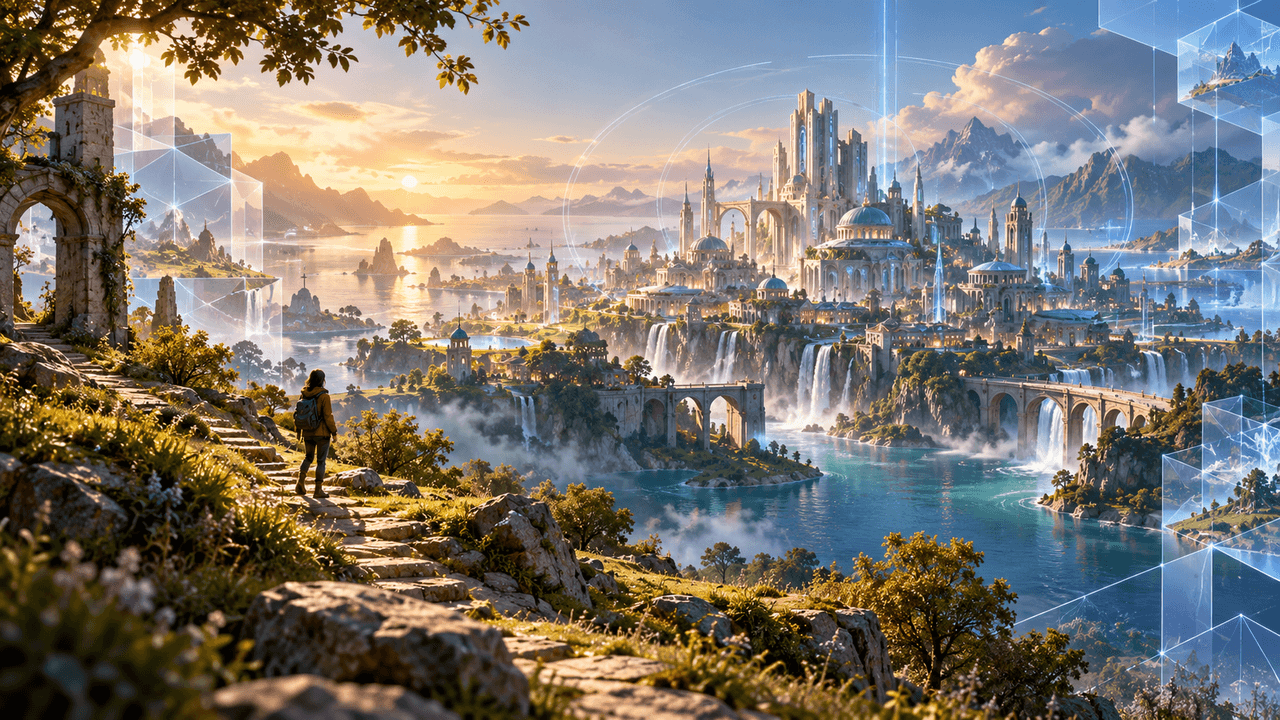
Google DeepMind says Genie 4 can generate sound and dialogue alongside interactive scenes, with more natural human movement. The October 27 announcement introduced a research preview for trusted testers, with wider access described as forthcoming. The creative attraction is the ability to explore a scene while changing what happens inside it. These are company-reported capabilities, not results from a hands-on test conducted for this analysis. 1
The same flexibility makes these artificial intelligence (AI) worlds interesting as possible tools for robotics. A machine could encounter many situations before it operates around people and fragile objects. But simulated experience earns its value only when the relationships it teaches survive outside the screen. Looking natural is one part of that relationship; responding correctly to an action is another.
A world that responds
A conventional video has an already determined sequence. An interactive world must respond when someone turns, moves or changes the situation. Google’s description of Genie 3 explains the basic approach: it generates successive frames from a world description and the user’s actions. The system has to preserve enough of what came before for later views to make sense. 2
That is a demanding kind of continuity. If someone walks around a table, its far side should belong to the same table. A door should remain where it was when the viewer looks away and returns. For a person exploring an imagined world, such consistency makes the experience coherent. For a robot learning to navigate, it determines whether remembering a route is a sensible strategy.
Live text steering is an extension of this interaction, rather than an invention unique to the new release. Genie 3 already allowed users to alter weather and introduce objects or characters while exploring. Its announcement also described a virtual agent pursuing goals through navigation actions. Those demonstrations concerned an agent operating inside generated environments; they did not establish successful transfer to physical robots. 2
Genie 4 brings a closer partnership with Gemini models. Google describes Gemini organizing the scene and guiding its progression while Genie produces what is seen and heard. This combines a plan for what should happen with the continuing generation of the experience. 3
There is immediate creative value in that arrangement. Consider a filmmaker deciding whether an actor should enter before or after a sound is heard. An explorable draft could make the timing easier to judge than a written description alone. A game designer could compare how an encounter feels from different viewpoints. These are illustrative uses: their value is in helping people choose and communicate an idea, without requiring the scene to predict a physical experiment. Coherent staging and easy revision can be the useful result.
Why a convincing scene is not yet a robot test
Engineering simulation asks more specific questions. A physics engine such as MuJoCo represents connected bodies and their interactions, including contact and friction. Its models supply a framework for calculating how a mechanism responds to forces and controls. The calculation still depends on the model and its assumptions; the presence of equations does not by itself make every prediction accurate. 4
Take a hypothetical robot placing a mug on a shelf. A generated scene might show the hand closing around the handle, the mug rising and the cup landing neatly in place. An engineer needs to know whether a particular grip holds as the arm accelerates, and what happens if the mug touches the shelf too soon. Those answers depend on quantities such as weight and friction. A successful-looking lift cannot, by itself, reveal whether those properties and the motor response were represented correctly.
Google’s Apollo example needs to be read at that level of specificity. The release describes Google’s Gemini 4 Argon model breaking a checkers task into instructions, supplied as text captions for Genie 4 to render a scene featuring Apptronik’s humanoid. That demonstrates a route for directing an unfolding scenario. It does not report a physical Apollo learning the task from Genie and then passing a real-world test. 1
There are several possible steps between those outcomes. A system could generate examples that help another model recognize objects. It could provide situations for practicing navigation. It could evaluate a controller, the software that chooses a robot’s next movement. Each use needs its own evidence. Success at interpreting a picture does not establish accurate manipulation, and a successful virtual task does not identify what a robot learned from it.
Research on simulated evaluation shows how that evidence can be assembled. The SIMPLER project compares robot controllers in simulation with their performance on corresponding physical tasks. Its authors identify mismatches in appearance and control as obstacles, then test whether their simulated environments preserve meaningful differences in real performance. The relevant result is agreement across paired evaluations, rather than realism judged by eye. This is separate research, not a validation of Genie 4. 5
This also explains why some visual improvement could be useful. A controller that reads camera images can behave differently when lighting, textures or the appearance of an object changes. Reducing those differences may make an artificial environment a better training or testing tool. The improvement must still be measured against the task that matters, because a more attractive scene can leave errors in contact or motion untouched.
Keeping the promise measurable
Google’s current limitations describe short sessions lasting a few minutes, details and objects that can drift, imperfect representations of real locations, and difficulty with complex interactions among multiple agents. These constrain different uses in different ways. 3
An object that changes after leaving view undermines a task requiring the robot to remember where it was placed. A location that merely resembles a real building cannot establish whether a robot fits through its actual doorway. Short sessions make it harder to investigate failures that emerge after long sequences. These are consequences of the disclosed limits, not observed failures in an independent Genie trial.
Reproducibility is equally practical. If an engineer changes a controller and the robot improves, the comparison should isolate that change. The same starting situation, task and scoring rule need to remain available, or variation must be measured over enough repeated cases. Otherwise, an easier generated scene could be mistaken for a better controller. A useful simulation record identifies the conditions under which its conclusions hold.
Genie 4’s opportunity is to make the creation and exploration of scenarios much easier. That could broaden the ideas people test and the situations AI systems encounter. Its robotics value will become clearer when developers connect those scenarios to repeatable tasks and measured physical outcomes. The decisive result for the mug would be a robot placing it reliably on the real shelf, with evidence showing what the simulated practice contributed.