Fervo Puts Geothermal's Industrial Production Model to the Test
Cape Station's first commercial block and Google's future 396 MW purchase agreement shift the geothermal debate toward repeatable construction, sustained net output and the cost of dependable electricity.
Published October 25, 2026Analysis / Energy / Next-Gen Renewables
Fervo Energy has reached the point where its next-generation geothermal model can be tested against a construction schedule and an electricity meter.
The company says the first power block at its Cape Station development in Beaver County, Utah, reached contractual commercial operation on September 30, 2026. It reported 33 megawatts of net production and began earning revenue under its power purchase agreement. Two more blocks in the roughly 100 MW first phase were still being commissioned when Fervo announced the milestone on October 1. Their contractual operating dates were expected by January 1, 2027. Fervo's commercial-operation announcement establishes a meaningful, but bounded, achievement.
The important question is whether this becomes a repeatable way to produce dependable clean electricity at a lower cost. A successful first plant supplies evidence. A series of plants that become cheaper to build and reliable to operate would change the choices available to utilities, industry and communities.
A customer for the next phase
Google has already made a large commitment to that next step. A 396 MW power purchase agreement announced September 1 supports Cape Station expansion expected online in 2028, with electricity intended for a potential Utah data center. Google also received an option for approximately 600 MW more by June 2030. The data center remains subject to engineering, approvals and commercial conditions.
The agreement gives the expansion a substantial prospective customer. Its announcement does not disclose an electricity price, however, so readers cannot use it to establish what Google will pay per megawatt-hour or what a similar project would cost an ordinary utility.
Engineering the underground reservoir
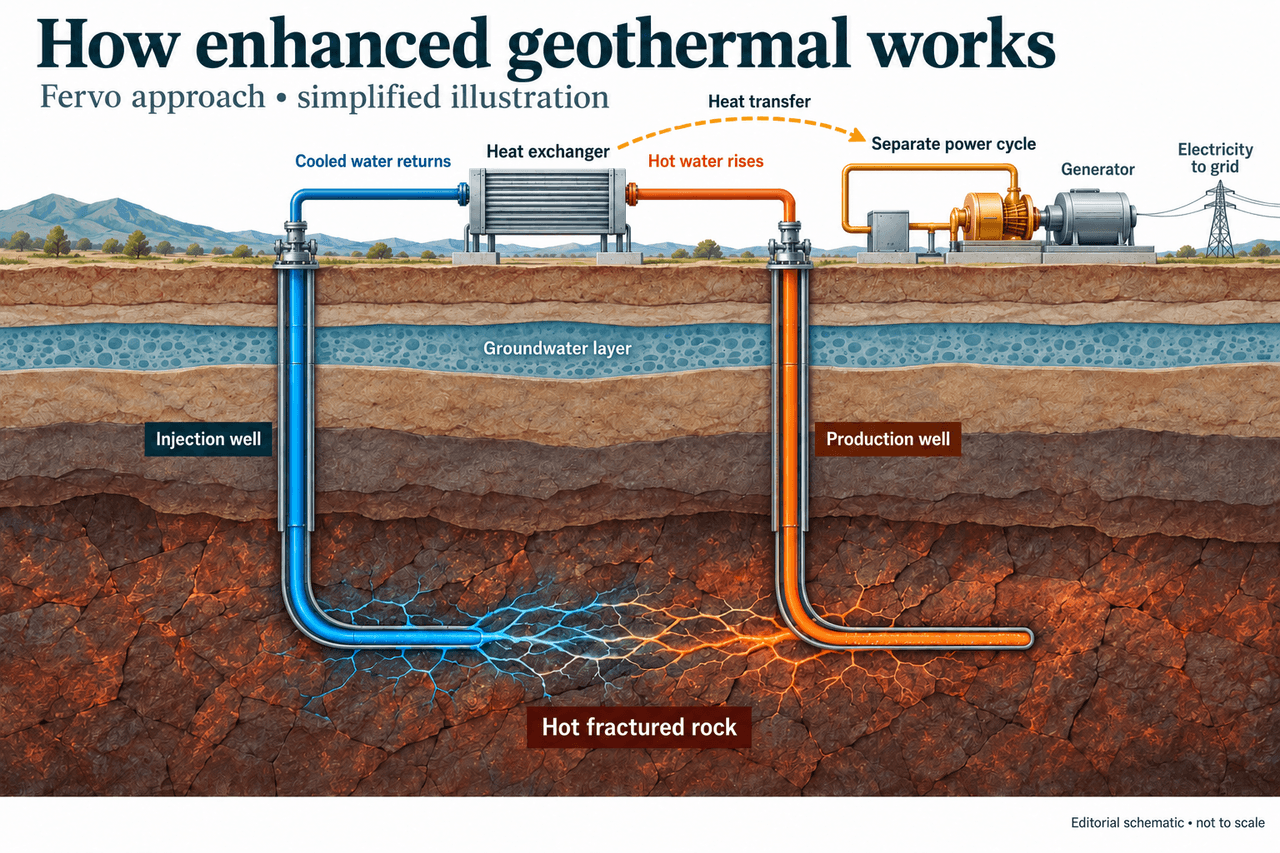
Conventional geothermal depends on a favorable combination of underground heat, fluid and rock through which that fluid can move. Enhanced geothermal systems, or EGS, attempt to widen the opportunity by creating or improving flow paths in hot rock. Water travels through the engineered reservoir, collects heat and returns to the surface to supply a power plant. The Department of Energy's explanation of EGS distinguishes this approach from closed-loop geothermal, which circulates fluid inside sealed underground pipes rather than through a fracture network.
That distinction matters. Different approaches face different drilling, heat-transfer and operating problems. Success at Cape Station should be assessed as evidence for Fervo's EGS approach, rather than proof that every technology described as advanced geothermal has reached the same stage.
EGS also changes the business proposition. Developers can try to reproduce a well design and construction process instead of relying entirely on finding another unusually accommodating natural reservoir. Geological differences remain, but more of the development challenge becomes something crews can measure, practice and improve.
A drilling learning curve with actual measurements
Fervo's July drilling update provides a concrete example. The company said Sawtooth 7, its ninth well using its third-generation design, reached 19,448 feet of measured depth in 21 days, including a 7,500-foot horizontal section. Its first commercial Project Red well in 2022 had taken 70 days to reach 11,220 feet of measured depth. Measured depth follows the well's path, so these figures do not mean the newer well extends nearly four miles straight down. The company's drilling comparison also describes larger casing and a hotter resource in the newer design.
The combination is encouraging: a longer, more demanding well completed in less time. But a record well is only one observation. To judge an industrial learning curve, buyers and lenders need the average performance across a drilling program, the spread between good and difficult wells, and the cost of finishing each well so it can operate.
There is wider evidence that drilling practices can improve. In a 2026 geothermal assessment, the International Energy Agency describes gains at the publicly supported Utah FORGE research site as well as commercial developers. This matters because shared tools, trained crews and field knowledge can help an industry improve beyond the achievements of a single company.
The power plant needs a learning curve too
Fervo says it built and commissioned the first GeoBlock's power facility in 23 months and aims to reduce that to 18 months for future blocks. The shorter period is a company ambition, not an achieved fleet-wide construction time. Its October announcement says an additional 400 MW phase is under construction for expected operation in 2028.
Repeatable surface construction could be as important as faster drilling. Standard designs can reduce the amount of engineering that must be done again, while repeated equipment orders and familiar installation sequences can make schedules easier to manage. Those benefits are hypotheses to test through subsequent projects. A standardized plant still needs equipment delivered, workers available and its underground heat supply ready when commissioning begins.
The industrial-production story therefore has two linked parts: build a productive reservoir, then connect it to a plant that turns its heat into saleable electricity without an expensive delay between them.
Measure the electricity that leaves the site
The word net in the 33 MW announcement deserves attention. A geothermal plant uses some of its own output to operate equipment, including pumps. The national-laboratory System Advisor Model documentation calculates net production by subtracting these internal, or parasitic, loads from gross generation. It also treats outages, maintenance and ambient-temperature effects as operating losses. Pumping harder to increase circulation can therefore involve a trade-off between extracting more heat and consuming more electricity.
Power measured in megawatts is also different from energy delivered over months, measured in megawatt-hours. Capacity factor compares actual generation over a period with what a plant would produce running continuously at its rated capacity. The Energy Information Administration explains why plants with the same capacity can deliver different amounts of electricity.
Commercial operation and an initial output threshold cannot establish an annual capacity factor. Cape Station now has the opportunity to build that record. Useful disclosures would include net generation, maintenance interruptions, pumping requirements and changes in production temperature. Dependable power becomes more valuable when customers can see how dependability holds up through actual operating seasons.
From cheaper wells to cheaper electricity
In its August results, Fervo projected an all-in cost of $5,500 per kilowatt for Cape Station's second phase and reiterated a longer-term $3,000-per-kilowatt target. These are company cost expectations, not final audited costs for completed plants.
Dollars per kilowatt describe the cost of building capacity. Dollars per megawatt-hour describe the cost of producing electricity. Moving between them requires assumptions about financing, plant life, operating expenses and output. A cheaper well helps, but it cannot by itself establish the price of dependable electricity over decades.
The IEA's 2024 geothermal report illustrates how much assumptions matter. Its low-cost case reaches roughly $50 per MWh for next-generation geothermal in 2035; its medium-cost case reaches roughly $120. Both use a 7% real, pre-tax financing rate. Those modeled futures are useful benchmarks, not measurements of Cape Station's current costs.
A reliable customer contract can help here. The IEA's 2026 financing analysis describes how long-term purchase agreements provide income visibility that supports debt financing. The implication is that early customers can help fund repetition and learning. Whether those gains eventually reach a much broader market will depend on delivered costs, rather than the size of the first customer commitments.
What faster drilling cannot solve by itself
The underground reservoir must remain productive. The IEA identifies persistent EGS challenges involving water losses, pumping demand, well integrity and maintaining useful flow and temperature. Water availability consequently belongs in a project's economics from the beginning. Communities need credible information about the source of that water and how much must be replaced during operation.
Induced seismicity needs equally serious attention. Creating and operating an EGS reservoir can change stresses underground. DOE's seismicity guidance emphasizes risk assessment and communication with regulators and the public. Monitoring and clear operating responses are part of earning permission to develop a resource, not optional additions after a plant succeeds.
Permitting and electricity delivery can also determine the schedule. DOE describes multiple permitting and environmental-review requirements affecting geothermal development. Its site-selection guidance includes proximity to transmission lines or electricity demand. Saving time on a well does little for the delivery date if another essential piece remains unavailable.
The next proof is repetition
Cape Station has supplied a substantial first operating milestone. The next questions are practical: Do later blocks reach service predictably? Do average drilling and construction costs fall? Does the reservoir sustain useful output without rising water or pumping requirements? Does net electricity arrive consistently enough to justify the economics?
If Fervo can answer those questions across successive projects, geothermal will have a stronger claim to becoming a repeatable source of new clean power. The most persuasive evidence will be a growing operating record, alongside falling costs per unit of electricity delivered. That is the industrial-production test now beginning in Utah.
Sources · 13
- https://fervoenergy.com/fervo-energy-declares-commercial-operation-at-cape-station-ahead-of-schedule-leading-the-race-for-next-generation-geothermal-energy/
- https://ir.fervoenergy.com/news-releases/news-release-details/fervo-energy-and-google-sign-396-mw-ppa
- https://www.energy.gov/hgeo/geothermal/enhanced-geothermal-systems
- https://ir.fervoenergy.com/news-releases/news-release-details/fervo-energy-learning-curve-continues-3rd-generation-well-design
- https://www.iea.org/commentaries/investment-in-next-generation-geothermal-is-surging-policies-are-key-to-further-growth
- https://samrepo.nlr.gov/help/geo_plant_equipment.html
- https://www.eia.gov/tools/faqs/faq.php?id=104&t=3
- https://ir.fervoenergy.com/news-releases/news-release-details/fervo-energy-reports-second-quarter-2026-results
- https://iea.blob.core.windows.net/assets/b46f9bee-0c32-4a59-ba95-546530004173/TheFutureofGeothermal.pdf#page=80
- https://iea.blob.core.windows.net/assets/b46f9bee-0c32-4a59-ba95-546530004173/TheFutureofGeothermal.pdf#page=39
- https://www.energy.gov/hgeo/geothermal/articles/doe-releases-updated-induced-seismicity-protocol
- https://www.energy.gov/hgeo/geothermal/permitting-geothermal-power-development-projects
- https://www.energy.gov/hgeo/geothermal/geothermal-faqs