An Airplane at a Manhattan Heliport: Electra's Bet on Urban Aviation
The EL2 flight tests a different bargain for city access: accept a short rolling takeoff to gain the possibilities of regional fixed-wing travel. The surrounding airspace will decide where that bargain works.
Published October 27, 2026Analysis / Transportation / Urban Air Mobility
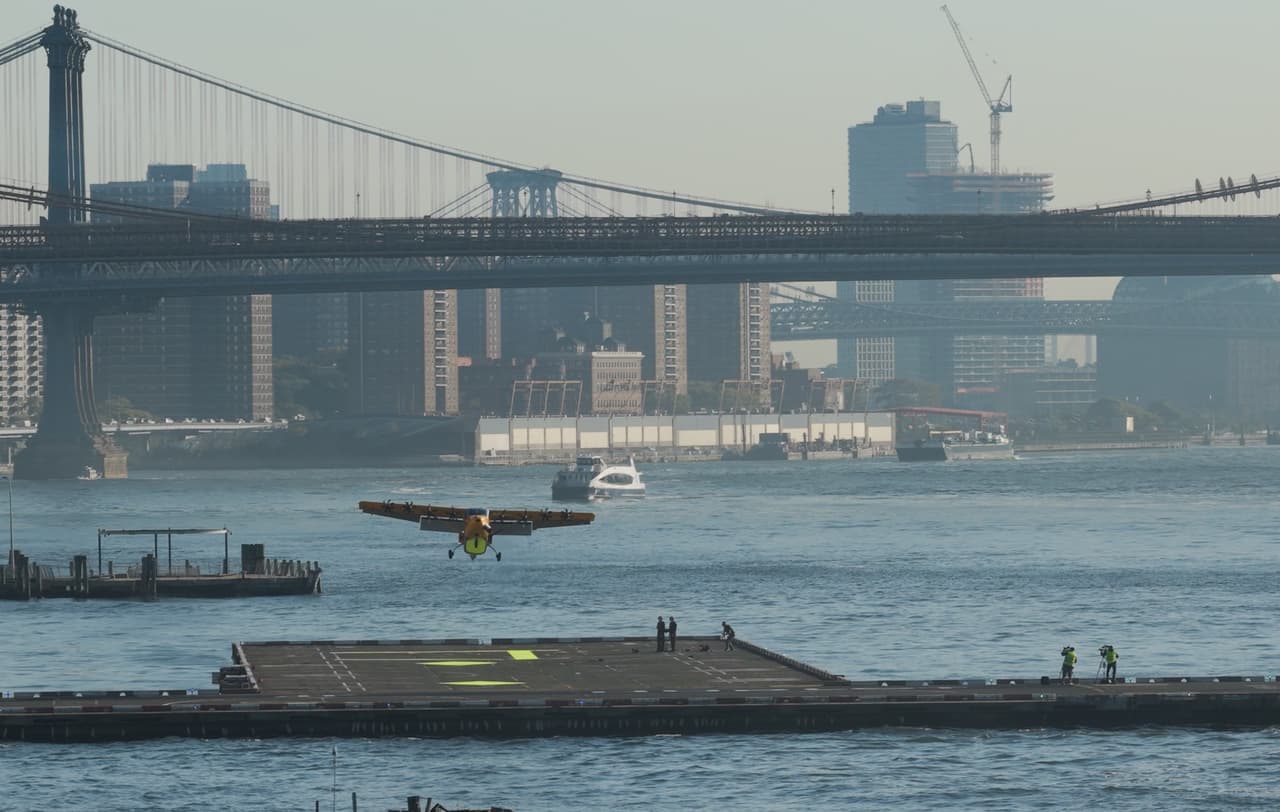
An airplane with wings and wheels took off and landed at a Lower Manhattan heliport on October 26. Electra's EL2 technology demonstrator used Downtown Skyport, placing a regional-aviation idea at the edge of a city where convenient access is valuable and open space is scarce. A short rolling takeoff had brought fixed-wing flight to ground normally reserved for helicopters. [1]
The flight exposes a different bargain in urban aviation. Helicopters and electric vertical takeoff and landing aircraft, or eVTOLs, use powered lift to leave a compact pad. Electra accepts a brief ground run to get airborne. That exchange could give suitable city sites a role in regional travel, provided the aircraft can use the space around them safely and repeatedly. The opportunity rests on the combination of airplane, flight path and location.
Electra's larger EL9 passenger aircraft remains in development. The company's current design figures include nine passengers and a cruise speed of 175 knots, about 200 mph. Those are the ambitions behind the Manhattan visit. The demonstrated event concerned the smaller EL2, with its own loading, flight-test procedures and development role. [1] [2]
The space beyond the wheels
Ordinary wings need air moving over them to generate lift. Electra accelerates that air with electric propellers positioned across the wing, directing the flow over large flaps. This blown-lift arrangement helps the airplane fly slowly enough to take off after a short acceleration. In a 2024 Virginia test campaign, Electra reported an EL2 takeoff ground roll below 170 feet, a landing roll below 114 feet and flight at speeds as low as 25 knots. Those results belong to that earlier campaign. [5]
The company's technology page lists a 150-foot ground roll for its Ultra Short design. Ground roll measures the distance traveled on the surface. A usable departure must also lift away from the site and clear whatever lies ahead; an arrival needs room to descend, touch down and stop. A compact number for the wheels describes one part of a much larger three-dimensional operation. [2]
Helicopter infrastructure already illustrates this distinction. The Federal Aviation Administration's active heliport guidance provides for safety areas, approach and departure surfaces, and clearance from surrounding obstacles. It recommends aligning preferred paths with prevailing winds and explains how a second path adds flexibility when winds change. An aircraft can fit on the pavement while the available airspace restricts the conditions in which it can use that pavement. [3]
An ultra-short airplane adds its own geometry. Its wings must clear people, structures and parked aircraft while it rolls and turns. The surface must support its loads and provide predictable braking. An approach that works with a helpful headwind may need different margins when the wind shifts. These are site-assessment questions, rather than reasons to assume that a helicopter facility transfers automatically to another kind of aircraft.
Waterfront locations could be promising because water may leave a clearer approach corridor than a street lined with buildings. The same logic favors some existing airfields and open industrial sites. A network would emerge from those compatible locations, each connected to useful destinations. A short strip squeezed between obstructions could offer less practical access than a more spacious site a little farther away.
Vertical aircraft retain an advantage where a rolling lane cannot fit. They also need protected space beyond their landing marks. FAA vertiport guidance addresses aircraft geometry, parking and the fast-moving air pushed down and outward by propellers. On October 22, the agency posted proposed broader vertical-flight infrastructure guidance, intended eventually to replace its existing heliport and vertiport documents. The proposal remains a draft. Electra will need an aircraft-specific case for its own use of compact facilities as those standards evolve. [6] [7]
What the comparison can support
The physical tradeoff extends into flight. A vertical aircraft's propulsion supports its weight during hover, demanding substantial power. NASA's engineering work identifies vertical takeoff and landing as demanding phases for battery-powered vehicles. Electra uses batteries for takeoff and landing and a fuel-burning turbogenerator for cruise, with charging possible in flight or on the ground. Its design trades some ground space for a different energy arrangement. [2] [8]
Many eVTOLs also transfer lift to wings in cruise, so the comparison requires more than dividing aircraft into airplanes and vertical machines. Route length, payload, reserves, charging time and the actual configuration determine the result. Electra's hybrid architecture could make service less dependent on a charger at every stop, while adding a turbine, fuel handling and their maintenance obligations. An all-electric competitor has a different balance of energy supply and turnaround requirements.
The blown-lift system brings a particular safety question: propulsion helps create the extra lift used at low speed, as well as providing forward thrust. A loss of power must therefore be assessed for its effects on both lift and control. General FAA airplane rules require controllability across the requested loading conditions and flight phases, including likely reversible control or propulsion failures. The detailed EL9 approval framework and evidence will determine how its architecture meets the applicable requirements. [10]
A city operator would also need repeatable margins for departures, rejected takeoffs and interrupted approaches across the approved weather and payload envelope. The Manhattan release supplies a successful event without publishing its weight, wind, exact ground roll or obstacle-clearance data. Those details would connect the demonstration to the operating conditions a future passenger schedule could reliably sustain. [1]
Electra says the FAA established the EL9's certification basis in July. That sets the framework for showing compliance. The September agreement with Atlas covers airframes for flight testing and certification, with first deliveries expected in 2027. Producing those aircraft, completing their tests and obtaining commercial approvals are successive parts of the program. The EL2's visit gives the company experience with an urban site while that larger development proceeds. [4]
A quiet aircraft needs a workable schedule
Noise will help determine whether access survives contact with the neighborhood. Electra lists 75 A-weighted decibels at 300 feet during takeoff on its technology page. The figure alone cannot establish how EL9 service would sound along this waterfront or how it would compare with a particular helicopter or eVTOL flying the same mission. [2]
NASA and Joby's acoustic flight test shows how much the details matter. Researchers used a 58-channel microphone array across 31 distinct conditions. Approach maneuvers produced larger areas above the study's 75-decibel contour than departures, and fully wing-supported flight was the quietest phase tested. The findings concern Joby's prototype; they demonstrate the need to compare aircraft at matched distances, flight phases and operating conditions. [9]
Residents experience a sequence of flights, including their timing, duration and paths. A quieter individual departure could make more frequent service acceptable, or the added frequency could become the central complaint. Aircraft noise measurements and a proposed timetable together would tell a city more than a single sound level. Ground handling, propeller airflow and shared use of the facility also affect who can safely occupy the surrounding space.
The economics run from door to door
Electra promotes large journey-time savings, including about three hours and 45 minutes between New York and Boston. That estimate depends on the journeys being compared. A convenient Manhattan departure has value only if the arrival site, ground connections, check-in and departure frequency suit the traveler. Waiting for a less frequent flight or traveling across the destination city can consume the time saved at the first end. [1]
The company also advertises operating costs 70 percent below helicopters and eVTOLs. Its Manhattan announcement provides no route-level cost model establishing that comparison. A NASA-commissioned 2026 study of advanced-air-mobility public-service missions offers a useful accounting lesson: acquisition costs, operating costs and utilization interact, while positioning flights and landing or handling charges can materially change the cost of a mission. Its medical-transport examples supply context for those cost categories, rather than fares for Electra routes. [1] [11]
Nine seats could spread a flight's cost across more paying passengers, if enough travelers want the same destination at roughly the same time. For an otherwise identical flight cost, selling four seats instead of eight doubles the cost allocated to each occupied seat. That arithmetic illustrates why a low aircraft operating cost needs a matching demand pattern. Empty repositioning legs, lightly used departures, weather cancellations and a reserve aircraft all enter the operator's calculation.
Electra's strongest urban case is therefore a selective one: connect sites that offer both an accessible location and enough usable airspace to support dependable regional trips. Manhattan has supplied a vivid example of physical access. The commercial test will be a pair of suitable endpoints, a certified passenger airplane and a schedule that carries enough people to pay for the whole operation. A 150-foot ground roll can widen the search for those places. The route succeeds when the rest of the journey fits.
Sources
Sources · 11
- https://electra.aero/news/no-runway-required-electra-takes-off-and-lands-ultra-short-airplane-at-manhattan-heliport
- https://electra.aero/technology
- https://www.faa.gov/airports/resources/advisory_circulars/index.cfm/go/document.current/documentnumber/150_5390-2
- https://electra.aero/news/electra-and-the-atlas-group-sign-airframe-agreement-for-el9-ultra-short
- https://www.prnewswire.com/news-releases/electras-hybrid-electric-test-aircraft-achieves-first-ultra-short-estol-takeoff-and-landing-in-piloted-test-flights-302157558.html
- https://www.faa.gov/airports/engineering/engineering_briefs/eb_105a_vertiports
- https://www.faa.gov/airports/resources/advisory_circulars/index.cfm/go/document.information/documentID/1045778
- https://ntrs.nasa.gov/api/citations/20220018582/downloads/20220018582_Sheth_SciTech2023_presentation.pdf
- https://ntrs.nasa.gov/citations/20220006729
- https://www.ecfr.gov/current/title-14/section-23.2135
- https://ntrs.nasa.gov/api/citations/20260002866/downloads/NASA_CR-20260002866.pdf